
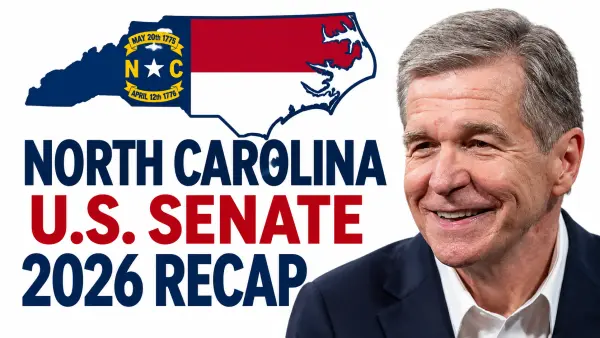
This recap reflects reporting available as of Nov. 21, 2026. Vote figures are the latest reported counts and may differ slightly from certified totals. For the race as it looked in September, see our North Carolina Senate election briefing.
The Result
Former Gov. Roy Cooper won North Carolina’s open Senate seat on Nov. 3, beating Republican Michael Whatley by about 20 points, 58.7 percent to 39.1 percent in preliminary AP figures. The AP called the race at 8:23 p.m., less than an hour after polls closed. Cooper becomes the first Democrat elected to the Senate from North Carolina since 2008, and it was his seventh statewide victory. He flips the seat held by retiring Republican Sen. Thom Tillis, in a state Trump carried in all three of his presidential runs.
How the Campaign Unfolded
Our briefing in early September described this as one of the two or three races most likely to decide Senate control. It never became that close. Cooper, running under the slogan “Make Stuff Cost Less,” led every poll, and Whatley, a former Republican National Committee chair in his first run for office, struggled to build name recognition beyond the Republican base.
Trump campaigned for Whatley several times, including a Charlotte-area rally days after mail ballots went out. At that rally he called the state’s cities “blood-soaked killing fields.” Fact-check: North Carolina’s violent crime rate ranks in the middle third of states, according to FBI data cited by the Associated Press. Trump also blamed Cooper for the slow recovery from Hurricane Helene, saying he did nothing to help storm victims, a claim Cooper rejected. At one North Carolina rally, Trump himself suggested Whatley might lose.
The advertising war drew repeated fact-checks on both sides. FactCheck.org found that a Republican super PAC ad falsely implied a prisoner release under Cooper led to a killing in South Carolina, and that a second pro-Whatley ad about untested rape kits was misleading. It also found that a Cooper ad used Whatley’s real remarks about falling prices but stripped them of context.
By October, national Republicans had concluded the race was lost. GOP organizations pulled television ads from North Carolina and moved the money to other battlegrounds, including Kansas. Cooper’s campaign raised $49.6 million to Whatley’s $13.7 million.
Why Voters Chose Cooper
Cooper’s record as governor held up better than either campaign’s attacks on it. In the ABC News Voter Poll, 60 percent of voters approved of his performance as governor, and only 37 percent said his views were too extreme. On the other side, 59 percent said Whatley was too supportive of Trump, and Cooper won 88 percent of those voters.
The coalition was broad. Independents, about a third of voters, backed Cooper 63 to 32. White voters split almost evenly, 50 to 48 for Cooper, and about 9 in 10 Black voters supported him. Voters were split between the economy and the state of democracy as their top issue, with about a third naming each; Cooper won the economy group 59 to 38 and the democracy group by a wider margin. The ground game also favored Cooper: in the separate AP Voter Poll, about 4 in 10 voters said his campaign had contacted them, compared with about a quarter for Whatley’s.
Expectations vs. Outcome
- Polling average: RealClearPolitics’ final average had Cooper ahead by about 11 points. He won by nearly 20, a miss of more than 8 points.
- Forecasters: The Cook Political Report and Sabato’s Crystal Ball rated the race Likely Democratic at the end; Inside Elections had it at Lean Democratic.
- Prediction markets: Kalshi priced Cooper’s chances at about 98 percent.
Republican coverage had focused on Cooper’s record on crime and disaster response, while Democratic coverage and several nonpartisan analysts emphasized his crossover appeal in a state Trump keeps winning. The voter data favors the second reading. Hurricane Helene recovery, which our briefing described as a proxy fight between the campaigns, stayed in the race through Trump’s attacks, but a 60 percent approval rating for Cooper’s time as governor suggests those attacks did not move many voters.
Our briefing’s central framing, that this would be a tipping-point race for Senate control, did not hold up. By the final weeks it was one of the least competitive marquee contests on the map, and the polls still understated Cooper’s margin.
Victory and Concession
Whatley conceded within minutes of the race being called, at his election-night event in Gastonia. Seconds into his remarks his microphone cut out. He said he had called Cooper to congratulate him and that North Carolina was “a state worth fighting for.”
In Raleigh, Cooper promised to focus on the cost of gas and groceries, ending the war with Iran, and taking on corruption and special interests as an independent voice for the state. The result, he said, showed “when everyday people come together, we can make change.”
- Whatley’s concession (WFAE, article)
- Cooper’s victory speech (AP via WECT, article)
What’s Next for Both Candidates
Current as of Nov. 21, 2026.
Cooper will be sworn in with the new Congress in January, succeeding Tillis and serving alongside Republican Sen. Ted Budd. He has said his priorities are living costs, ending the Iran war and an independent voting record.
Whatley told supporters his commitment to the state remained as strong as ever. This article could not find any public statement from Whatley about his next role.
Related Links
- WUNC/NPR: Democrat Roy Cooper wins a North Carolina Senate seat
- WBTV: Roy Cooper wins 2026 U.S. Senate race in North Carolina
- NC Newsline: Cooper becomes first Democrat to win a U.S. Senate race in North Carolina since 2008
- TheGrio: Nearly 90% of Black voters back Cooper
- WBTV: Election guide to Cooper vs. Whatley
