
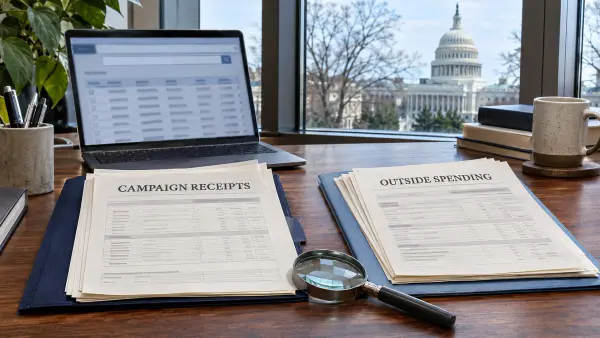
PoliTalking.US has published a searchable campaign finance directory covering the officials expected to take office in 2027: 100 Senate seats, 441 House seats including non-voting delegates, and 50 governors. Each entry shows what a campaign reported raising, and for most members of Congress what it spent and had left, with links to the underlying filings. The directory also shows selected outside spending for or against each official.
Background
Federal candidates report their finances to the Federal Election Commission (FEC). The directory draws congressional totals from those reports, most of which run through October 14, 2026, almost three weeks before the November 3 election. Governor figures come from state portals and secondary sources, so they use different labels and dates and are not ranked against each other. Twenty entries are marked provisional because their races had not been called or finalized when the roster was compiled.
Two kinds of money sit side by side in each entry. Receipts are what a candidate’s own campaign collected, under contribution limits. Outside spending is what super PACs and other groups spent independently to support or oppose a candidate, with no limit on size. Our explainer on how US campaigns are funded covers the rules behind both.
What Stands Out in the Numbers
The scale. Senate entries with FEC totals reported about $1.12 billion in receipts and House entries about $1.35 billion. The typical member raised far less than the headline names: the House median is about $2.2 million and the Senate median about $3.9 million. Reporting periods differ, so these sums are approximate.
Small donors. Texas Democrat James Talarico tops the list at $146.3 million. About $75.3 million of that, just over half, came in unitemized contributions, which are gifts from people who gave $200 or less in total. In the House, Alexandria Ocasio-Cortez leads with $38.0 million, ahead of Speaker Mike Johnson at $24.6 million.
Self-funding. Some winners largely paid their own way. New York Republican Anthony Constantino lent his campaign $17 million of the $17.1 million it reported, and Maryland Democrat April McClain Delaney lent hers $11 million.
Money in reserve. Arizona Senator Mark Kelly, who was not on the ballot, reported $26.5 million in cash on hand.
Outside groups. The largest single line in the directory is not a campaign’s own money. Texas PAC reported $112.2 million in spending against Talarico, in filings through November 9.
What the Directory Does Not Show
Losing candidates. The directory lists winners. Republican Ken Paxton, who lost the Texas Senate race, has no entry, so the money spent for him appears only as spending against Talarico. That race shows how much can sit outside a candidate’s own report. Elon Musk gave $158 million in September to the Senate Leadership Fund, which sent the same amounts to Texas PAC a day after each gift, according to FEC filings reported by CBS News. Paxton’s own campaign raised about $22 million, according to KSAT’s review of federal data.
Published totals for Musk’s spending in Texas conflict. The Texas Tribune put it at more than $200 million, counting gifts to other pro-Paxton groups and his own America PAC. The directory’s records show $168 million from Musk to the Senate Leadership Fund over the full cycle. The figures cover different groups and dates.
Donors who are not disclosed. Super PACs must name their donors, but nonprofits that give to them do not. The directory lists One Nation, a nonprofit tied to Senate Republican leadership, as the source of $132.9 million to the Senate Leadership Fund. Who gave that money to One Nation is not public. OpenSecrets identified at least $1.47 billion in such contributions this cycle and called the figure a lower bound, International Business Times reported.
Everything else. Party committees, leadership PACs, issue advertising that never names an election, and most late money are also outside the directory. OpenSecrets projects $11.9 billion in total federal spending for the 2026 midterms.
What Different Sides Are Saying
Disclosure advocates argue that voters cannot judge an ad without knowing who paid for it. Shanna Ports of the Campaign Legal Center told AFP that “voters should be able to know who is financing the ads that they see.” Fact-check: The gap is real but partial. Musk’s gifts became public because super PACs must report donors, although the filings arrived weeks after the ads began. Money routed through nonprofits stays hidden. The practice is also not limited to one party: Issue One found that the main super PACs of both parties took money from affiliated nonprofits, with Republican groups receiving more.
Donor privacy advocates reject the label itself. The Philanthropy Roundtable argues that the term is a myth and that such money is better described as “private giving” protected by the First Amendment. Fact-check: Whether donor anonymity is a right worth protecting is a matter of opinion and of ongoing litigation. The narrower claim that this money funds issue education rather than campaigns does not fit every case. The transfers recorded in the directory went to super PACs that ran advertising for and against named candidates.
On whether money decides elections, the Texas result cuts both ways. Republicans outspent Democrats on advertising by nearly two to one in the general election, by the Texas Tribune’s account, and Paxton still lost. Talarico was also the best-funded candidate in the country. One race does not settle the question.
Related Links
- Politaking.US Directory of Campaign Financing
- How U.S. Campaigns Are Funded: Donations, PACs, and Outside Spending (PoliTalking.US)
- Texas Senate 2026: Paxton vs. Talarico (PoliTalking.US)
- How to Research Candidate Records (Federal Election Commission)
- How US Midterms Have Cost a Record $12bn (Al Jazeera)
- New Data Illuminates How Secret Money Fuels 2026 Midterms (Issue One)
- Anonymous by Design: Why Donor Privacy Still Matters (Philanthropy Roundtable)
- James Talarico Defeats Ken Paxton in Texas’ U.S. Senate Race (Texas Tribune)
Discussion Questions
- Which number in this article surprised you most, and why?
- Have you ever looked up who funds a politician? What did you find?
- Should people who give to political nonprofits be allowed to stay anonymous?
- Is a campaign funded by many small donors different from one funded by a few large ones?
- Why might a donor give to a super PAC instead of directly to a candidate?
- According to the article, why does Ken Paxton have no entry in the directory?
- Should candidates be allowed to lend their own campaigns unlimited money?
- Does the Texas result show that money matters less than people think?
- Imagine you are a new member of Congress. Would you accept help from a group that hides its donors?
- How does campaign spending in the US compare with elections in another country you know?
