
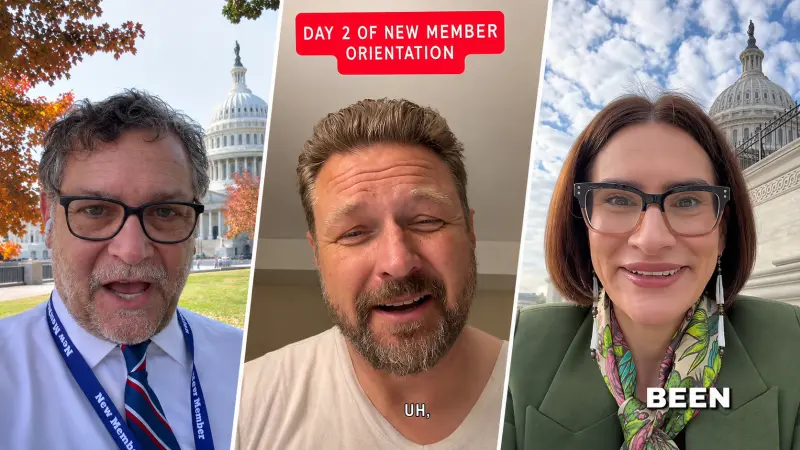
A week after the November 3 midterms, newly elected members of Congress are using short videos to introduce themselves, report back from orientation and, in one case, pick a public fight with their own party’s leadership. This series collects those videos, summarizes what each official says, and adds the context a viewer needs to judge it.
Part 1 covers three officials: two House members-elect and one senator-elect. Each video was posted on the official’s own account between November 10 and November 11, 2026.
Don Leonard (D), Ohio’s 15th District: The Speaker Vote
What he says: Recorded on the first evening of orientation, the video describes a meeting with unnamed senior members of the House Democratic caucus. Leonard says they warned him that withholding support for Hakeem Jeffries as speaker would make his next two years difficult and cost him reelection. He says his conditions for supporting Jeffries are a constitutional amendment to overturn Citizens United and an end to US support for the war with Iran. He closes by saying the “big D Democratic Party needs some little D democracy.”
Context: Leonard flipped a district that Donald Trump carried by about 10 points in 2024, defeating Republican Rep. Mike Carey. He did not name the members he met. House Democratic Caucus Chair Pete Aguilar told reporters he did not know which senior Democrats Leonard meant, and Leonard later described the conversation to Axios as friendly and well-intentioned. Fact-check: the account of the meeting is Leonard’s alone and could not be independently verified.
The follow-up: That evening, Leonard posted a shorter video saying his first video had caused a stir in Washington. He repeats that he owes nothing to anyone but the voters of his district and promises to keep pushing. The two videos together had over a million TikTok views by November 12.
Peggy Flanagan (D), Minnesota Senator-elect: The Wellstone Story
What she says: Wrapping up Senate orientation, Flanagan tells the story of a hotel worker who remembered the late Minnesota Senator Paul Wellstone pulling up in a big green bus 36 years earlier. She uses it to make a point about kindness and remembering who senators work for, calling it “the power of this place.”
Context: Flanagan defeated Republican Michele Tafoya and is the first Native American woman elected to the Senate. Wellstone, a progressive Democrat, won his Senate seat in 1990 with a campaign known for its green bus, which fits the timeline in the story. Fact-check: the hotel worker’s recollection is a personal anecdote and cannot be checked.
Fred Wellman (D), Missouri’s 2nd District: Weighing the Speaker Vote
View this post on Instagram
What he says: Filmed outside his new office on Veterans Day, the video opens with greetings to fellow veterans and an update on orientation. Wellman then turns to the speaker’s race, which he says has drawn more comments and emails from constituents than anything else. He repeats his campaign position that he would decide once in Washington, after hearing from caucus leadership. His conditions are that leaders commit to tackling the cost of living and corruption right away, adding, “We have to do multiple things at once.” He then praises Jeffries as the only candidate for speaker, says the caucus is united, and notes that Jeffries would be the first Black speaker in US history.
Context: Wellman, an Army veteran and former podcast host, beat seven-term Republican Rep. Ann Wagner 51% to 46%. His video stops short of a formal endorsement but reads very differently from Leonard’s: where Leonard describes pressure from leadership, Wellman stresses unity. Fact-check: Jeffries would indeed be the first Black speaker if elected. He has also promised a 100-day agenda on the cost of living, which matches one of Wellman’s two conditions. Democratic aides told Reuters that no one poses a serious threat to Jeffries, but this article could not confirm whether any other member has formally entered the caucus race.
Related Links
- Don Leonard isn’t a House member yet. He’s already rocking Capitol Hill (Axios)
- Don Leonard says top Dems threatened him over Jeffries holdout
- 10 things to know about Peggy Flanagan, Minnesota’s next US senator (MPR News)
- Democrat Fred Wellman ousts Republican Ann Wagner in Missouri congressional upset (Missouri Independent)
- The candidates who made history in the 2026 midterm elections (NBC)
- The 2026 Election by the Numbers (CFR)
Discussion Questions
- Do you follow any elected officials on TikTok or Instagram? Why or why not?
- Which of these videos did you find most effective, and why?
- Should newly elected officials describe private conversations with party leaders in public videos?
- Do you think Leonard’s video will help or hurt him with voters in his district?
- Is it reasonable for a new member to set conditions before supporting a party leader?
- Why might officials prefer posting short videos to giving traditional interviews?
- Leonard and Wellman set similar conditions for Jeffries but sound very different. Which approach do you find more convincing?
- Flanagan tells a story rather than listing policy goals. Is that an effective way to introduce yourself?
- Why might some officials use TikTok much more than others?
- Imagine you are a newly elected official. What would you say in your first video to voters?
