
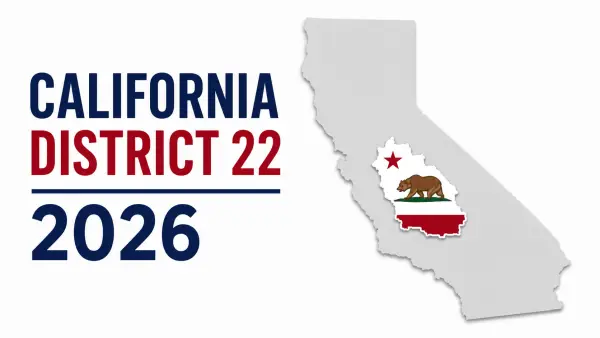
Race status as of July 26, 2026. Polling and campaign finance figures in this race change frequently.
Why this race is on our list
California voters approved a mid-decade redistricting measure in November 2025 partly to make this seat winnable for Democrats. Democrats then nominated a 31-year-old school board trustee running on Medicare for All, over the moderate assemblymember their national committee had recruited, after more than $2 million was spent against him. He faces a Republican who voted to impeach Donald Trump, has won this district six of the seven times he has run, and voted for a law that cut Medicaid in the district with the highest Medicaid enrollment of any Republican holds.
CA-22: the district behind the race
This is the Central Valley: Bakersfield and the farm country around it, spanning parts of Kern, Kings, Tulare, Fresno, and now Madera counties. It is agricultural, heavily Latino, and low income, and water policy is a permanent local issue in a way it is nowhere else on this list.
Health coverage is the dominant economic fact here. By an NBC News analysis, CA-22 has the highest share of Medicaid recipients and of households receiving food assistance of any district represented by a Republican. Estimates of local Medi-Cal enrollment range from about six in ten residents to roughly two-thirds depending on the source and the boundaries used, and enrollment figures matched to the new post-redistricting lines had not been published as of this writing. The range is wide; the direction is not in doubt.
The lines changed substantially. The new map added communities in Fresno and Madera counties including Caruthers, Kerman, San Joaquin, and Raisin City, while moving areas around Arvin, Shafter, and Wasco into the 20th District and Avenal into the 18th. Porterville is now split between two districts. The redrawn seat is still competitive rather than safe: Cook’s Partisan Voter Index rates it R+1, down from D+5 before this cycle, and analysts calculate the new lines would have gone for Biden by 17 points in 2020 and for Trump by about 2 in 2024. Both numbers are true, four years apart, which is the whole problem with characterizing this district.
A mechanical note that matters more here than anywhere else in this series. California uses a top-two primary: all candidates run together in June and the two highest finishers advance regardless of party. That means the November ballot in CA-22 contains exactly two names, no third party can appear on it, and our usual threshold for including additional candidates has nothing to apply to. It also means the June result is a partial preview of the general with the same candidates, which is unusual and useful.
The candidates
David Valadao (R), incumbent. A dairy farmer from Hanford, first elected in 2012, in office from 2013 to 2019, defeated by T.J. Cox in 2018, and back since winning a 2020 rematch. Six wins in seven attempts. He is one of the few House Republicans who voted to impeach Trump after January 6 and is still in Congress. He voted for the 2025 tax and spending law, providing a vote his party could not spare, and in January 2026 he voted with Democrats to extend Affordable Care Act subsidies. His campaign centers on water for Central Valley agriculture, inflation and gas prices, jobs and job training, and benefits for seniors and veterans. He publicly criticized Governor Gavin Newsom over the redistricting measure that reshaped his district. He had raised $4.23 million as of mid-May and holds a substantial cash advantage.
Randy Villegas (D), challenger. Age 31, from Visalia, the son of Mexican immigrants. A political science professor at College of the Sequoias and an auto shop owner, appointed to the Visalia Unified school board in 2021. He is affiliated with the Working Families Party and endorsed by Bernie Sanders and Alexandria Ocasio-Cortez, along with former Congressman Tony Cárdenas and a group of California elected officials. He supports Medicare for All and describes his campaign as economic populism. He had raised $1.75 million as of mid-May, well behind Valadao, but outraised him roughly two to one in the quarter ending June 30, finishing that period with about $571,000 on hand.
The primary itself is part of the story. Villegas took second with more than 32 percent against Assemblymember Jasmeet Bains, a Bakersfield physician who was the first South Asian woman elected to the California legislature and who represents much of the district in Sacramento. The Democratic Congressional Campaign Committee had added Bains to its priority-candidate program before the primary, which angered local Democrats who said national officials had promised neutrality. The California Democratic Party declined to endorse. More than $2.2 million in outside money was spent against Villegas in the final month, including by a group aligned with AIPAC and by super PACs tied to House Democrats. He won anyway.
What the campaigns are contesting
Valadao’s argument is the one he has made for a decade: that a Republican who occasionally breaks with his party delivers water, farm policy, and federal money that a Democrat in the minority could not. His campaign says the Central Valley needs a representative people can be proud of and trust.
Villegas is running on health care and cost of living, and specifically on Valadao’s vote for the 2025 law. He has held events outside Valadao’s district office with labor and health advocates and has run a town hall tour. He told Politico when he launched that he was running on an economic populist message, and his primary win is being read statewide as a test of whether that message travels in a district Democrats have twice tried to win with moderates.
Immigration enforcement cuts through both campaigns in a way it does not in the other races on this list, because a large share of the district’s agricultural workforce and its families are directly affected. Villegas has publicly criticized federal enforcement actions. Valadao has historically been more supportive of legal status for farmworkers than most of his conference, which is part of how he has held Latino support.
Evidence check
Not a full fact check. Six recurring claims, three per candidate, with context and sources.
“Valadao is an independent Republican who stands up to his party.” Supported in specific instances and contradicted in the biggest one. He voted to impeach Trump in 2021 and paid a real political price for it. He voted with Democrats in January 2026 to extend ACA subsidies. He also cast a vote his leadership needed for the 2025 tax and spending law, in the district most exposed to its Medicaid provisions. Independence on some votes is not the same as independence on the consequential one, and both facts belong in the same sentence.
“Valadao voted to cut Medicaid in the district that needs it most.” Accurate as far as the underlying facts go. He voted for the law; his district ranks first among Republican-held districts on Medicaid and food assistance enrollment. Two caveats. The commonly cited local Medi-Cal figures range from about six in ten to roughly two-thirds of residents and were calculated on the old district lines, so the precise number for the seat he is now defending is not established. And Valadao has said he worked within his conference to limit the reductions, a claim about private negotiations that we cannot verify either way.
“Valadao overperforms his district.” Historically true and getting smaller. When the seat was rated D+5 he was winning it repeatedly, which is a genuine outlier performance. In 2024 he won by about 7 points while Trump carried the old district by about 6, so roughly a point of overperformance that year. Under the new lines the district would have gone for Trump by about 2. He is no longer running far ahead of his party here, because his party caught up to him.
“A progressive cannot win CA-22.” Made by national Democrats and by his primary opponent rather than by anyone in his own campaign, and the evidence cuts against the premise without establishing the opposite. Democrats did run a moderate, former Assemblymember Rudy Salas, in both 2022 and 2024, and lost 51.5 to 48.5 and then 53.4 to 46.6. Villegas beat a better-known moderate with heavy outside spending against him. None of that shows he can win a general election, where the electorate is larger and less Democratic than a June primary electorate.
“Villegas is a socialist” and “radical Randy.” The first is a Republican label, the second was his primary opponent’s. Neither is a self-description. What is checkable: he supports Medicare for All, is affiliated with the Working Families Party, and is endorsed by Bernie Sanders and Alexandria Ocasio-Cortez. Those positions are genuinely to the left of anything this district has elected, which is a fair thing for voters to weigh. Whether they amount to socialism is a dispute about a word.
“Democrats took 59 percent of the primary vote, so Valadao is in trouble.” Sabato’s Crystal Ball applied that test and moved Valadao to underdog status, and the combined Democratic share against his 41 percent is real. Three cautions. Primary electorates are not general electorates. Midterm primary turnout is low. And the number itself moved substantially during the count: on election night the combined Democratic share was around 55 percent, and late-arriving mail ballots pushed it to 59, which is a useful reminder about California returns generally. The test has a decent track record. It is a signal, not a result, and forecasters still range from Toss-up to Tilt Republican.
What supporters are saying
Sourced voter comment is thin on both sides here, thinner than in the Texas race, and for a structural reason worth naming: Central Valley congressional races get less on-the-ground national coverage than statewide races do, and much of what exists comes from the campaigns themselves.
Villegas supporters. The clearest evidence is the primary itself. More than 4,000 individual donors had contributed before the race began in earnest, and voters chose him over a sitting assemblymember despite $2.2 million in advertising against him, which is an unusually direct measurement of what a Democratic electorate here wanted. Organized support includes the Working Families Party, labor groups that joined him outside Valadao’s office, and out-of-area volunteer networks now doing voter contact for the general. Bains herself said she was shocked by Valadao’s vote for the 2025 law, which is notable given that she spent the primary attacking Villegas.
Valadao supporters. His strongest evidence is also electoral rather than anecdotal: six wins in seven tries, including two against well-funded moderate Democrats in a district that leaned Democratic on paper. Republican operatives in the district have long argued that national Democrats misread Central Valley Latino voters, who they say prioritize costs, fuel, schools, and safety over national party framing. The 2024 results are consistent with that argument. His institutional support is the national Republican campaign apparatus and a cash advantage that has not yet been spent.
How this race is being framed
Three different frames are competing here, and they are not just spin.
The national Democratic frame is arithmetic plus vindication: this is one of the five California seats the new map was drawn to deliver, and failing to win it would make the whole redistricting exercise look like a miscalculation. The national Republican frame is that Valadao has beaten better-funded, better-known Democrats before on worse-looking maps.
The third frame is the one CalMatters and others have emphasized, and it is the most interesting: this race is a controlled test of an argument inside the Democratic Party. Democrats ran moderates here twice and lost twice. They have now nominated an economic populist against the wishes of their national committee. If Villegas wins, one theory of how Democrats recover working-class and Latino voters gets strong evidence. If he loses in a district drawn to be winnable, the other theory does.
Worth noting what all three frames treat as background rather than subject. The district’s defining fact is that a majority of its residents rely on public health coverage, and its congressman cast a decisive vote to reduce it and then voted to extend a different set of subsidies. That is a specific record on a specific local condition, and it will probably matter more to voters here than any of the three narratives built around them.
Discussion Questions
- California voters approved redrawing this district partly to make it easier for one party to win it. Is that legitimate politics, illegitimate, or legitimate only as a response to the same thing elsewhere?
- Valadao voted to impeach a president of his own party and later cast a decisive vote for that party’s signature law. Which of those tells you more about him?
- Democrats ran moderates here in 2022 and 2024 and lost both times. Does that mean the moderate strategy was wrong, or that the district was simply hard?
- National Democrats spent heavily against their own eventual nominee. What should a party committee’s role in a primary be?
- Roughly six in ten people here rely on Medi-Cal. What obligation does that place on a representative whose party wants to reduce the program?
- Valadao has held Latino support in a heavily Latino district that has trended toward his party. What do you think explains that, and what would change it?
- California’s top-two system means no third-party candidate can appear on the November ballot here. Is that a feature or a flaw?
- Water policy dominates local politics here and appears in almost no national coverage of the race. What else gets lost when national outlets cover a district as a seat count?
- Villegas is 31 and has held one appointed local office. How much governing experience should a voter require?
- If your preferred candidate loses, what would you want the winner to do first?
Related Links
- Ballotpedia: California’s 22nd Congressional District election, 2026
- Randy Villegas for Congress campaign site
- KQED on how Proposition 50 redrew California’s map
- CalMatters on fundraising in California’s swing districts
- NBC News on the Sanders endorsement and the Democratic split
- GV Wire on Villegas advancing to the general election
- NBC News 2024 general election results for CA-22
- NBC News 2026 top-two primary results for CA-22
