
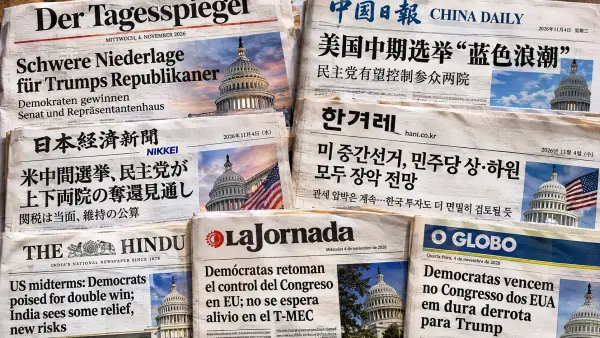
Democrats are projected to win control of both the House and the Senate after the Nov. 3 midterms, and coverage outside the US quickly settled on one shared reading: a heavy defeat for President Trump driven by prices and the Iran war. Where the coverage split was on what comes next. Countries with the most exposure to US tariffs mostly told their readers not to expect much relief, while some leaders read the result as a turning point. This post compares how outlets and officials in nine countries framed the results in the first 24 hours.
This post reflects coverage published by Nov. 4, 2026. Several races are still being counted, and no seat totals here are final.
Europe and Africa
Germany: a check that Congress had stopped providing
The Berlin daily Der Tagesspiegel led with voters punishing Trump’s Republicans and called it a “schwere Niederlage” (heavy defeat). Its main report argued that Congress had largely failed as a check on Trump’s second term and that Democrats now gain leverage over budgets, confirmations and investigations. It also warned that impeachment could backfire by rallying Trump’s base. The business paper Handelsblatt took a lighter tone, calling it a night Democrats had dreamed of.
South Africa: “a new era”
The most expansive official reading came from President Cyril Ramaphosa, speaking after voting in South Africa’s own municipal elections. The result, he told reporters, is “going to introduce a new era in world relations,” according to Reuters. The context matters: the same week, the Trump administration moved to end South Africa’s duty-free access under AGOA, a US trade program, starting in January. Ramaphosa paired his optimism with a push for new export markets, saying diversification had become the order of the day.
East Asia
China: a rebuke, with China left out
Chinese state media reported the results as a sweeping rebuke and did not connect them to US-China relations. China Daily’s report, headlined “Blue wave sweeps US midterms,” tied the outcome to fuel, grocery and healthcare costs and to public opposition to the Iran war, and quoted no Chinese experts. The state news agency Xinhua chose an outside voice to close the loop: its election report quoted Iran’s parliament speaker reading the vote as a rejection of war (see Iran below). Chinese-language commentary on the portal Phoenix used the phrase “中期选举魔咒,” the midterm curse, for the pattern of presidents losing seats.
Japan: plan for tariffs to stay
For Japanese companies, the message was continuity. The Japan External Trade Organization (JETRO), the government’s trade promotion agency, told businesses that tariffs on Japanese autos, steel and other goods were imposed by the executive branch without Congress, so a new Congress is unlikely to remove them. Its post-election analysis advised firms to assume current tariff levels will hold for now. It also noted that Trump posted an image labeled “VETO” on social media after the results.
South Korea: more scrutiny of Korean investment
Korean coverage used vivid language for the result (“blue tsunami” in Financial News) but was cautious about consequences. A Financial News analysis argued that tariff pressure will continue and that a Democratic Congress could scrutinize how Korea’s pledged $200 billion in US investment is selected and spent. A Korea International Trade Association researcher said the executive-order-driven America First trade approach would likely persist. A Soongsil University trade professor went further, arguing that Democrats have traditionally been tougher on trade specifics.
South Asia and the Middle East
India: some relief, new risks
Indian outlets carried a Bloomberg report, also run by Business Standard, framing the result as mixed for New Delhi. Unnamed Indian officials welcomed stronger congressional oversight of Trump’s tariff powers, and analysts suggested a weakened president might have less leverage in trade talks. The risks listed were specific: a September Russia oil sanctions law that allows tariffs of up to 100% on top buyers of Russian energy, and pressure on H-1B work visas used heavily by Indian IT firms. Nitin Pai of the Takshashila Institution told Business Standard that India “should prepare for the rough ride” of the past two years.
Iran: “NO TO WAR”
Iran’s parliament speaker, Mohammad Bagher Ghalibaf, posted on X that Americans had “said NO TO WAR, and we endorse this message.” He paired that with a warning that Iran would respond harshly if Washington ignored the public’s will, as reported by The Tribune (India). Fact-check: Most coverage, including China Daily and Xinhua, cited both prices and the war as factors, and Trump acknowledged the war was “a piece of it,” according to Xinhua. Reading the result as a single verdict on the war is an interpretation, not a finding.
The Americas
Mexico: a Democratic Congress will not settle USMCA
Mexican analysis focused on the US-Mexico-Canada trade agreement (T-MEC in Spanish), which the US declined to extend for 16 years in July, triggering annual reviews. A Proceso report citing analysts at UNAM and the consultancy Integralia argued that Democratic control would not ease trade pressure. It also suggested Trump may deepen his economic nationalism in 2027. Security demands on organized crime and drug trafficking, it noted, have support in both US parties.
Brazil: “historic defeat,” through wire copy
Brazilian papers ran the story largely as written by the French wire service AFP, with headlines like O Tempo’s “derrota histórica” (historic defeat) for Trump. Coverage highlighted Sen. Jon Ossoff calling Trump a “pato manco” (lame duck) and did not draw a Brazil-specific angle. The same AFP framing appeared in Senegal’s Le Soleil, whose headline said Trump “concedes defeat”; the article body reported only that Trump said he would accept the voters’ verdict while also vowing to veto Democratic bills.
What the Coverage Shared
Three patterns ran across nearly every country. First, the cause: outlets from Berlin to Beijing named the cost of living and the Iran war, usually together. Second, the limits: the most trade-exposed countries (Japan, South Korea, Mexico, India) stressed that tariffs mostly rest on executive authority, so a new Congress changes oversight more than policy. Third, a tendency for headlines to run ahead of the text, as with the “concedes” headline in Senegal, which matters for readers who see only the headline.
Related Links
- US Midterm Elections: Democrats Take Control of House and Senate, The Irish Times
- Blue Wave Sweeps US Midterms as Democrats Seize Congress, China Daily
- Democrats Control Congress. What Now?, ABC News (Australia)
- Midterms: Deutliche Niederlage für die Republikaner, Handelsblatt (German)
- Midterms nos EUA: Em derrota histórica de Trump, O Tempo (Portuguese)
- The US-Iran War: Ceasefire Breakdown and Renewed Strikes
Discussion Questions
- How did news media in your country cover the US midterms?
- Why do you think so many countries focused on trade rather than on the candidates?
- Do you think Ramaphosa’s “new era” reading or Japan’s “expect continuity” reading is more realistic?
- Should foreign officials comment publicly on another country’s election results?
- Why might Chinese state media leave US-China relations out of its election coverage?
- How much should a headline be allowed to simplify what an article says?
- Is it fair to read an election result as a verdict on a single issue, such as a war?
- What are the risks of relying on wire services for foreign news?
- Does the result of a US election affect daily life where you live? How?
- Imagine you are a trade minister in a country hit by US tariffs. What would you do after these results?
