
Reading
On election night, television maps fill with color within hours, so it can look as if the vote has been counted. It has not. What viewers see is mostly a series of race calls: a news organization’s projection that one candidate cannot be caught. No state finishes its official count on election night, and in close races the gap between the night’s headlines and the final result can last weeks. The reasons are mostly written into state law.
Mail Ballots Take Extra Steps
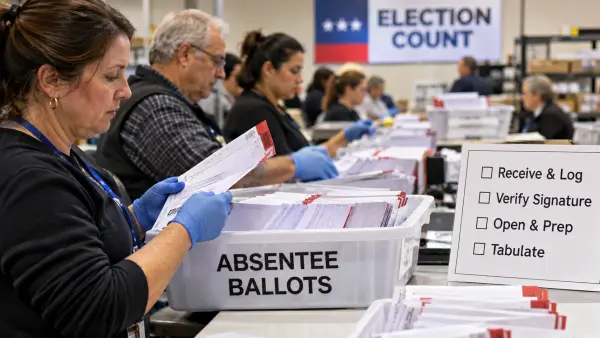
An in-person vote is usually scanned the moment the voter feeds it into a machine. An absentee ballot sent by mail needs processing first: logging its arrival, checking the envelope, comparing the voter’s signature with the one on file (signature verification), opening the envelope and flattening the ballot. Only then comes tabulation, when scanners count the votes. Forty-four states let officials begin processing before Election Day, but six, including Pennsylvania and Wisconsin, do not allow it until Election Day itself, according to the National Conference of State Legislatures (NCSL). In those states, large piles of mail ballots are still being opened while polls close.
Timing also depends on when ballots may arrive. Some states count only ballots received by Election Day. Others have a grace period for ballots with a postmark on or before Election Day. In June 2026 the Supreme Court ruled that federal law allows such grace periods (see our coverage of the ruling). Ballots from overseas and military voters often have separate, later deadlines too. In Alaska, qualifying absentee ballots can arrive up to 15 days after the election, PBS NewsHour reported.
Fixing Problems Before Ballots Count
Some ballots arrive with a missing signature or one that does not match. In 33 states, voters are told about the problem and given a chance to cure it, NCSL reports. Deadlines vary: Nevada allows six days after the election, and Arizona allows five business days. Voters whose eligibility is uncertain on Election Day may cast a provisional ballot, which counts only after officials confirm the voter was entitled to vote. Until those deadlines pass, a few thousand ballots in a close race remain undecided.
Counting in Batches, Then Making It Official
Counties report results in batches as they finish them, which is why leads can shift overnight when a large county reports its mail ballots late. After counting comes the canvass, when local boards check totals against records, and then certification, when officials formally approve the results. Certification deadlines range widely: some local results are certified within days, while Ohio’s canvass is not final until 81 days after the election and California certifies statewide results on day 38.
Recounts, Ranked Choice and Runoffs
A very close result can trigger a recount. Twenty-eight states have automatic recounts when the margin falls below a legal threshold, often half a percentage point, and 43 allow candidates or voters to request one, according to Ballotpedia. Recounts add weeks but rarely change the winner: of 36 statewide recounts from 2000 to 2023, three reversed the result, and the average shift was about 551 votes, a FairVote analysis found.
Two states add a further step. Maine and Alaska use ranked choice voting, so if no candidate wins a majority of first choices, ballots are counted again in rounds (see our ranked choice explainer). Maine must bring ballots and memory devices to the capital, Augusta, for that count. Georgia goes further still: a candidate who fails to win more than 50% faces a runoff election about four weeks later, on Dec. 1 this year.
Who Calls a Race, and Why It Matters
Race calls come from news organizations such as The Associated Press and Decision Desk HQ, not from governments. A call is a statistical judgment that the trailing candidate cannot catch up based on the votes still outstanding. Calls are usually right, but they are not official, and a concession speech has no legal force either.
The length of the count has become politically contested. President Trump and the Republican National Committee argue that results should be known on election night and that ballots arriving after Election Day should not count. Election administrators answer that counting speed reflects state law and that accuracy matters more than speed. Data from the 2024 election suggests the stakes of the late-ballot fight are modest: late-arriving ballots made up no more than about 3% of the vote in any state, Votebeat found. Whether a faster count would build trust or simply exclude some legitimate voters is the core disagreement.
Glossary
race call (noun): a news organization’s announcement that a candidate has won, based on its analysis of the votes counted and still outstanding.
Translations: 宣布胜选 | 当確判定 | 당선 확정 발표 | चुनाव परिणाम की घोषणा | إعلان الفائز | объявление победителя | proyección del ganador | annonce du vainqueur
- The race call came shortly after midnight, once rural counties reported.
- Viewers often mistake a race call for an official result.
projection (noun): an estimate of a final result made before all votes are counted.
Translations: 预测 | 予測 | 예측 | अनुमान | توقع | прогноз | proyección | projection
- The network’s projection showed the senator winning by about four points.
- Analysts updated their projection as more mail ballots arrived.
absentee ballot (noun): a ballot filled out away from the polling place, usually returned by mail or drop box.
Translations: 缺席选票 | 不在者投票用紙 | 부재자 투표용지 | अनुपस्थित मतपत्र | بطاقة اقتراع غيابي | открепительный бюллетень | boleta de voto en ausencia | bulletin de vote par correspondance
- She mailed her absentee ballot a week before the election.
- Each absentee ballot envelope must be signed by the voter.
processing (noun): the steps taken to check and prepare mail ballots before they can be counted.
Translations: 预处理 | 事前処理 | 사전 처리 | प्रसंस्करण | معالجة | обработка | procesamiento | traitement
- Processing includes opening envelopes and flattening ballots.
- Pennsylvania does not allow processing to begin before Election Day.
tabulation (noun): the counting of votes, usually by scanning ballots through a machine.
Translations: 计票 | 集計 | 개표 집계 | मतगणना | فرز الأصوات | подсчёт голосов | escrutinio | dépouillement
- Tabulation of in-person votes finished within hours.
- Observers from both parties watched the tabulation.
signature verification (noun): comparing the signature on a ballot envelope with the voter’s signature on file.
Translations: 签名核验 | 署名照合 | 서명 대조 | हस्ताक्षर सत्यापन | التحقق من التوقيع | проверка подписи | verificación de firma | vérification de signature
- Signature verification is done by trained staff in most counties.
- Her ballot was set aside after failing signature verification.
cure (verb): to fix a problem with a submitted ballot so that it can be counted.
Translations: 补正 | 不備を補正する | 보완하다 | त्रुटि सुधारना | تصحيح الخلل | исправить недочёт | subsanar | régulariser
- Voters have six days to cure a missing signature in Nevada.
- Campaign volunteers called voters to help them cure their ballots.
provisional ballot (noun): a ballot cast when a voter’s eligibility is uncertain, counted only after it is confirmed.
Translations: 临时选票 | 暫定投票 | 잠정 투표 | अनंतिम मतपत्र | بطاقة اقتراع مؤقتة | условный бюллетень | boleta provisional | bulletin provisoire
- His name was missing from the list, so he cast a provisional ballot.
- Each provisional ballot is reviewed before it is added to the count.
grace period (noun): extra time allowed after a deadline, such as days after Election Day for mail ballots to arrive.
Translations: 宽限期 | 猶予期間 | 유예 기간 | छूट अवधि | فترة سماح | льготный период | período de gracia | délai de grâce
- The state’s grace period lets ballots arrive up to a week late.
- Critics want to end the grace period for mail ballots.
postmark (noun): a mark printed by the postal service showing the date a letter was mailed.
Translations: 邮戳 | 消印 | 소인 | डाक मुहर | ختم البريد | почтовый штемпель | matasellos | cachet de la poste
- A ballot needs a postmark dated on or before Election Day.
- Some envelopes arrived with no readable postmark.
batch (noun): a group of ballots or results counted and reported together.
Translations: 批次 | 一括分 | 묶음 | बैच | دفعة | партия | lote | lot
- The lead changed when the county released a large batch of mail votes.
- Officials reported results in batches throughout the night.
canvass (noun): the official review of vote totals after an election, before results are certified.
Translations: 正式核票 | 開票結果の審査 | 개표 검수 | मतों की आधिकारिक जांच | المراجعة الرسمية للأصوات | официальная проверка итогов | escrutinio oficial | recensement officiel des votes
- The county canvass found a small error in one precinct.
- During the canvass, officials match ballot counts to voter records.
certification (noun): the formal approval of final election results by officials.
Translations: 认证 | 認定 | 인증 | प्रमाणन | المصادقة | утверждение итогов | certificación | certification
- Certification makes the result legally official.
- The state’s certification deadline is in early December.
recount (noun): a second count of the votes in an election, usually because the result is very close.
Translations: 重新计票 | 再集計 | 재검표 | पुनर्गणना | إعادة فرز الأصوات | пересчёт голосов | recuento | recomptage
- The recount changed the final total by only twelve votes.
- The losing candidate asked for a recount.
margin (noun): the difference in votes between the winner and the runner-up.
Translations: 票差 | 票差 | 표 차이 | अंतर | الفارق | разрыв | margen | écart
- The margin was less than one percentage point.
- As more ballots were counted, the margin grew.
threshold (noun): a level that must be reached before a rule applies.
Translations: 门槛 | 基準値 | 기준치 | सीमा | الحد الأدنى | порог | umbral | seuil
- The race fell below the threshold for an automatic recount.
- Each state sets its own threshold for recounts.
runoff (noun): a second election between the top candidates when no one wins enough votes the first time.
Translations: 决选 | 決選投票 | 결선 투표 | अपवाह चुनाव | جولة إعادة | второй тур | segunda vuelta | second tour
- Georgia holds a runoff if no candidate wins more than half the vote.
- Turnout usually drops in a runoff.
majority (noun): more than half of all the votes counted.
Translations: 过半数 | 過半数 | 과반수 | पूर्ण बहुमत | الأغلبية المطلقة | абсолютное большинство | mayoría absoluta | majorité absolue
- No candidate won a majority in the first round.
- A majority of the remaining ballots decides the winner.
Discussion Questions
- Have you ever voted by mail or absentee? How was that experience?
- How long does it usually take to know election results in your country?
- Did anything in the reading surprise you about how votes are counted?
- Should mail ballots that arrive after Election Day be counted if they were mailed on time?
- Is it fair to give voters several days to cure a ballot after the election?
- Should news organizations wait longer before calling close races?
- Why do you think the speed of vote counting has become a partisan issue?
- Would one national counting rule be better than 50 different state rules?
- Do runoffs give voters a better choice, or do they mostly lower turnout?
- Do you trust the results more when counting is fast or when it is slow and careful?
- What could election officials do to make long counts less confusing to the public?
- Imagine you are a state election director. What deadline would you set for mail ballots, and why?
Related Links
- Timelines for Absentee and Mail Ballot Processing and Counting, Ballotpedia
- Elections Defined: Ballot Curing Provides Safeguard, NCSL
- Recount Laws in Pennsylvania, Ballotpedia
- Brazil’s Fast Vote Counting Is Not Proof of US Election Cheating, PolitiFact via WLRN
- Election Night Guide, Part 3: After 10 p.m. and Beyond
