
What Happened
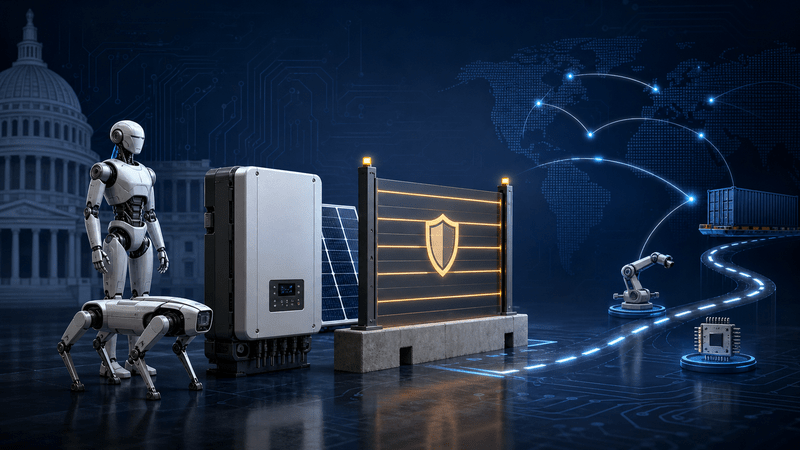
The Federal Communications Commission added two equipment categories to its Covered List on July 28: certain advanced mobile robots and connected power inverters. The list identifies communications equipment or services that the federal government has determined pose an unacceptable risk to U.S. national security or the safety of people in the United States.
The robot category includes qualifying mobile ground robots such as humanoid and quadruped robots. The inverter category covers connected devices that convert electricity and are widely used in solar systems, batteries, data centers and other infrastructure.
The action blocks new FCC authorizations for covered models. It does not automatically remove equipment that consumers and businesses already own, and it does not stop sales of models that previously received authorization. Producers may also seek conditional approval from the Department of War or the Department of Homeland Security.
Background: What Is the FCC Covered List?
The FCC maintains the Covered List under the Secure and Trusted Communications Networks Act. Equipment on the list generally cannot receive a new FCC authorization, which is normally required before radio-frequency devices can be imported or marketed in the United States.
The government has previously used this system for equipment linked to specific companies and for categories such as foreign-produced drones and consumer routers. The new action continues a broader country-of-production approach, rather than naming only individual manufacturers.
The robot definition is narrower than the phrase “all foreign robots.” It focuses on mobile ground systems that meet technical requirements involving size, sensors, connectivity and control software. Stationary industrial robot arms, connected vehicles, drones, rail vehicles and certain medical systems are excluded.
Why Robots and Inverters?
Federal officials argue that connected robots could collect images, map facilities, transmit sensitive data or receive malicious remote commands. They say dependence on overseas production also creates a supply-chain risk if a foreign government or manufacturer can interrupt access to equipment or software.
The government raised similar concerns about power inverters. Because many inverters connect remotely for monitoring and maintenance, a compromised system could expose data or allow an attacker to disrupt parts of the electric grid. A federal security determination describes these risks as solar panels, batteries and data centers rely on more connected power equipment.
The public evidence supports treating connected devices as possible cyber targets. It does not establish that every foreign-made robot or inverter contains a hidden access mechanism or has been used in an attack.
What Different Sides Are Saying
Supporters of the Restrictions
FCC Chair Brendan Carr says the action protects critical supply chains and aligns communications policy with national-security assessments. Supporters point to China’s large share of global robot and inverter production, previous cyber incidents involving connected equipment, and the possibility that low-cost imports could make the United States dependent on a strategic competitor.
Bipartisan lawmakers have also proposed robotics legislation directing the FCC to restrict certain humanoid and quadruped robots associated with foreign adversaries. They argue that mobile robots combine cameras, microphones, software and physical movement in ways that deserve special safeguards.
Fact-check: China is a leading producer of humanoid robots and power inverters, and connected devices can create genuine cybersecurity risks. However, the FCC action covers foreign production, not only products made in China.
Critics of the Restrictions
China’s government calls the policy protectionist and says the United States is stretching the definition of national security to suppress Chinese companies. Industry critics warn that a broad country-of-production rule may raise costs, reduce access to affordable research platforms and disrupt solar or battery projects that rely on overseas suppliers.
Other critics question whether the FCC provided enough public evidence, economic analysis or transition time before restricting entire product categories. They argue that security standards, inspections and targeted restrictions could address risk with less disruption.
Fact-check: The restrictions could reduce competition for future models, but their eventual price and supply effects are not yet known. Previously authorized products remain available, and a conditional-approval process exists for new models.
Fact Check
Claim: The United States banned every foreign robot
Verdict: False. The action covers defined mobile ground robots that meet several technical criteria. It excludes multiple categories, including stationary industrial arms and regulated medical devices.
Claim: Existing robots and inverters must be removed
Verdict: False. The immediate restrictions apply to new equipment authorizations. Equipment already authorized or purchased is not automatically removed by this action.
Claim: This is only a tariff on Chinese imports
Verdict: False. A tariff adds a tax to imports. The FCC action limits authorization of covered new models and is written as a national-security restriction on foreign-produced equipment.
Claim: Every covered device has been proven dangerous
Verdict: Unsupported. The policy is based on category-wide cybersecurity and supply-chain risks. The government has not publicly shown that every individual model has been compromised.
What Comes Next
Manufacturers can seek conditional approval, change production arrangements or challenge the policy. Researchers, energy developers and importers will have to determine whether planned models already hold FCC authorization or fall within an exemption.
The action may also intensify debate in Congress over whether national-security restrictions should target particular countries and companies or apply to broad categories of foreign-made technology.
Related Links
- FCC action on robots and inverters
- FCC Covered List
- Power-inverter security determination
- AP report on FCC restrictions
- Congressional robotics bill
- IEEE robot supply-chain analysis
Discussion Questions
- Which security risk in the article seems most serious?
- Should rules focus on product origin or proven vulnerabilities?
- How might these restrictions affect technology prices?
- Why are power inverters part of this policy?
- Is conditional approval a fair compromise?
- What evidence should the government publish before restricting equipment?
- How should security and competition be balanced?
- Which claim in the debate needs more evidence?
- Have connected devices changed how you think about privacy?
- Imagine you manage a robotics lab. How would you respond to this rule?
