
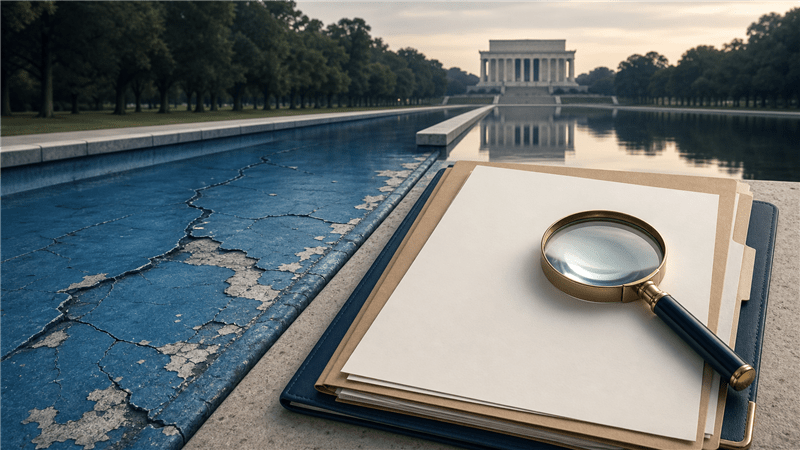
The Justice Department moved on July 31 to dismiss its felony property-destruction case against former Olympic canoeist David Hearn, saying newly obtained records undermined the claim that he vandalized the Lincoln Memorial Reflecting Pool.
In a 20-page filing described by the Associated Press, prosecutors said the widespread damage instead resulted from faulty contractor installation and pressure to complete the renovation before the United States’ 250th-anniversary events. A judge must still formally grant the government’s request.
The filing reverses the factual position the U.S. Attorney’s Office took when it announced Hearn’s indictment four weeks earlier. It also creates a public dispute between President Donald Trump, who continues to blame vandals, and U.S. Attorney Jeanine Pirro, whose office now says the available evidence cannot prove vandalism beyond a reasonable doubt.
Background
The National Park Service closed the Reflecting Pool during the spring to clean it, repair joints and install a new lining. Its official renovation notice said the work was intended to reduce future repairs.
Hearn stopped at the pool during a bicycle ride on June 19. He has said that he briefly touched a loose piece of coating and stopped when a park employee told him to let go. The government initially accused him of forcefully pulling up the liner and causing at least $1,000 in damage.
A grand jury indicted Hearn on July 2. The Justice Department announcement called the incident a deliberate act of destruction. Pirro said the government would protect national monuments and hold vandals accountable. The same announcement also correctly stated that an indictment is only an allegation and that defendants are presumed innocent.
Why the Case Changed
Hearn pleaded not guilty and challenged the government’s evidence. His lawyers said a National Park Service witness had acknowledged that the pool was already damaged, could not calculate damage caused by Hearn and believed the same repairs would have been necessary anyway. The Associated Press reported that the defense sought complete grand-jury transcripts because of what it called irregularities.
Prosecutors later received additional Interior Department documents and inspected the pool again. According to the dismissal filing, damage appeared throughout the pool, including areas that a person standing at the edge could not easily reach. Prosecutors said the new information made it difficult to attribute the damage to vandalism, much less prove that accusation beyond a reasonable doubt.
The filing also said Interior should have provided the information sooner and that prosecutors would not have sought an indictment if they had known it. That statement matters because it identifies an interagency information failure, not simply a changed legal strategy.
What Different Sides Are Saying
The Justice Department
Pirro’s office says dismissal is required by the newly discovered evidence. Prosecutors are not merely saying the case would be hard to win. They now say the original vandalism theory was contradicted by project records and the physical condition of the pool.
Fact check: The Associated Press’s review of the filing supports that description. The AP reports that prosecutors attributed the damage to faulty installation and a rushed schedule. The court has not yet made its own final finding about the contractor’s responsibility.
Hearn and his lawyers
Hearn’s attorneys say the case should never have been brought and describe his arrest and prosecution as an abuse of government power. They have asked for an apology and argue that dismissal cannot erase the consequences for their client.
Fact check: The Associated Press confirms that Hearn disputed the accusation from the beginning and that a government witness reportedly could not identify damage attributable to him. Whether the initial charging decision was abusive is a judgment about prosecutorial conduct, not a fact established by the dismissal request alone.
President Trump
Trump criticized Pirro after the filing and continued to say most of the damage came from vandals. The Associated Press reported that he offered no clear new evidence for that claim.
Fact check: The latest documented evidence does not support Trump’s broad claim. Pirro’s own prosecutors say the information now available makes vandalism difficult to establish. It remains possible that separate acts caused limited damage, but that would not prove Hearn caused the charged damage.
Interior officials and the contractor
Interior Secretary Doug Burgum previously defended the work and said the administration would keep the same contractor. In early July, the Associated Press quoted Burgum saying he was certain vandals caused the damage.
Fact check: Burgum’s earlier certainty conflicts with the later prosecutorial filing. The filing cites Interior records as evidence of flawed installation, but neither a final court judgment nor a completed public contracting review has assigned civil liability.
Fact Check
Claim: Hearn has already been acquitted
Verdict: False. The Justice Department has requested dismissal. An acquittal follows a not-guilty verdict, while dismissal ends a charge without such a verdict. The judge still must act on the motion.
Claim: Prosecutors still believe Hearn caused the liner damage
Verdict: False. The Associated Press says the government filing concludes that newly received evidence refuted the original vandalism theory and made proof beyond a reasonable doubt unavailable.
Claim: The new filing proves nobody vandalized any part of the pool
Verdict: Unsupported. The filing addresses the evidence supporting Hearn’s charge and the widespread liner damage. It does not establish that no separate vandalism occurred anywhere during the renovation.
What Comes Next
The court is expected to decide whether to grant the government’s motion. Attention may then shift to why prosecutors did not receive key Interior records before seeking an indictment, whether the renovation contract will be reviewed and whether Hearn pursues any civil claim.
The episode also illustrates why indictments should be described carefully. A grand jury decides whether probable cause exists to bring a charge. It does not decide guilt, and it generally hears only the prosecution’s presentation. Here, later disclosure changed the prosecution’s own assessment of the case.
Related Links
- AP report on the dismissal request
- AP report on Trump’s response
- Justice Department indictment announcement
- National Park Service renovation notice
- AP report on grand-jury questions
- AP report on the renovation dispute
Discussion Questions
- Why did prosecutors change their position?
- What evidence mattered most?
- How should agencies share evidence?
- When should prosecutors dismiss a case?
- What does an indictment establish?
- Which claim needs more investigation?
- How can public statements affect fairness?
- Have you ever revised a conclusion?
- Should officials apologize after mistaken charges?
- Imagine you are the judge. What would you examine?
