
Why This Race Matters
This overview reflects information available as of September 4, 2026. Candidates, polling, and endorsements may change before Election Day on November 3.
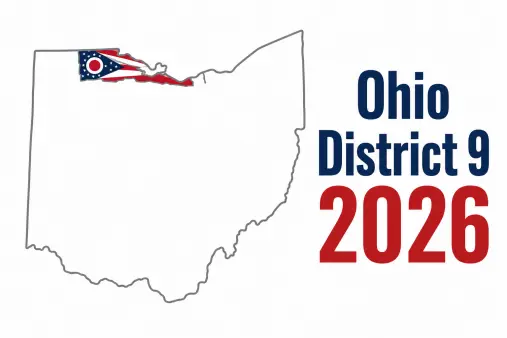
Ohio’s 9th District, the “snake by the lake” seat that runs from Toledo to Sandusky, is held by Rep. Marcy Kaptur, the longest-serving woman in congressional history, but a court-ordered mid-decade redistricting has made it one of the most Republican-leaning districts anywhere still held by a Democrat. Ohio’s constitution required new maps this cycle because an earlier map passed without bipartisan support, and the Ohio Redistricting Commission’s new lines pushed the district’s presidential lean from Trump+7 to roughly Trump+10 or more. Kaptur has overperformed her district’s partisan lean in nearly every election since 1982, so this race is as much a test of personal-vote strength against redistricting as it is a normal partisan contest.
The Race
This is a rematch of 2024, when Kaptur narrowly defeated Republican Derek Merrin, 48.3% to 47.6%, under the old lines. Merrin, a former state representative and real estate investor, won a five-way Republican primary in May with 43% of the vote, beating state Rep. Josh Williams and former ICE deputy director Madison Sheahan. Libertarian Matthew Althaus is also on the November ballot.
Ratings on the race have varied by tracker and by month. Ohio Capital Journal reported Cook Political Report rating it a toss-up in March; by May, Inside Elections had shifted to Tilt Republican, reflecting the new map’s more conservative lean and Merrin’s history of outperforming other Republican challengers against Kaptur.
The Candidates
Marcy Kaptur (Democrat, incumbent) was first elected in 1982 and previously worked as an urban planner, including in the Carter administration. She has built her career around Great Lakes environmental protection and manufacturing jobs, and her campaign emphasizes a long record of securing federal investment for northwest Ohio regardless of which party controls Washington.
Derek Merrin (Republican) served in the Ohio House from 2016 to 2024 and works as a real estate investor. He argues that decades in Congress have left Kaptur out of touch with the district, and his campaign has focused on introducing himself to the new, more inland and conservative counties added to the district by redistricting.
Top Issues
Manufacturing and trade policy are central given the district’s industrial base along the Lake Erie shoreline, an area Kaptur has represented through decades of shifts in steel and auto manufacturing employment. Merrin has framed the race as a referendum on twenty-two terms of one-party representation, arguing new leadership would better align with the Trump administration’s economic agenda.
Great Lakes environmental funding, a signature Kaptur priority for decades, remains a live issue given federal funding fights over water infrastructure. Merrin has focused more on general affordability and has echoed national Republican messaging on border security, despite the district’s distance from the southern border.
Evidence Check
Estimates of the new district’s presidential lean vary by source: Inside Elections calculated Trump would have carried the 2026 lines by 11 points, while an analysis by The Downballot put Trump’s 2024 vote share in the new district at 54.8%, roughly consistent with an 8 to 10 point margin depending on turnout assumptions. Both estimates agree the district became more Republican, even if the exact margin differs by source and methodology.
Merrin’s public comments have called Kaptur “part of the problem, not the solution” after decades in Washington. That is a subjective characterization rather than a checkable fact; Kaptur’s committee record and the federal projects she has secured for the district are matters of public record that voters can weigh against that framing themselves.
Supporter Voices
Merrin, after winning his primary, told supporters that “Northwest Ohio is ready for fresh new leadership,” a message aimed at the district’s newer, more conservative territory. House Democratic Congressional Campaign Committee chair Suzan DelBene said in a statement that Kaptur remains uniquely dedicated to the region, adding that voters “rejected Merrin in 2024” and predicting they would do so again.
Most available quotes so far come from national party committees and the candidates themselves rather than a broad sample of district voters, typical for a race still in its early general-election phase.
How This Race Is Being Framed
National Republican coverage frames this as one of the party’s best pickup opportunities nationally, pointing to Merrin’s repeat candidacy and the new map’s more favorable lines as reasons this may finally be the cycle Kaptur loses. National Democratic-aligned coverage instead emphasizes Kaptur’s decades-long pattern of outrunning her district’s partisan lean, treating her personal brand as a factor that redistricting alone may not overcome, while acknowledging this is her most difficult map yet.
