
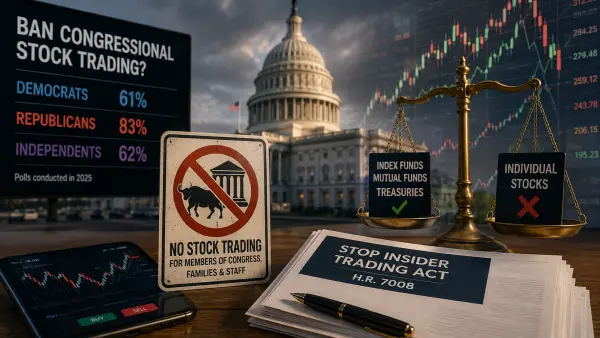
In brief: Two independent national polls fielded since April 2025 both find majority support in both parties for banning members of Congress from trading individual stocks, with Republican support ranging from 58 to 83 percent and Democratic support from 61 to 70 percent depending on question wording. No ban is law as of this writing. The one bill that reached a House floor vote in July 2026 passed on a near party-line count because it was paired with an unrelated voter-ID measure, and because Democrats who otherwise back a ban objected that it only restricts future stock purchases, not existing holdings.
The Question
The polling in this piece tests a specific policy, not a general sentiment. As written in the surveys below, the question is whether members of Congress, and in most bill versions their spouses and dependent children, should be barred from buying individual company stock while in office. Members would still be able to hold index funds, mutual funds, and Treasury securities.
That single sentence covers several bills currently pending in Congress that differ from one another in ways this piece flags below: whether the restriction covers only future purchases or requires selling existing holdings, whether it extends to senior staff or to the president, vice president, and Supreme Court, and how violations are enforced. The polls cited here generally test the concept, not any one bill’s exact text.
Where Majorities Agree
Data for Progress, a polling firm that describes itself as progressive, surveyed 1,171 likely voters nationally from April 18 to 21, 2025, with a margin of error of plus or minus 3 points. Respondents were asked whether they would support or oppose banning members of Congress from trading individual stocks, with mutual and index funds carved out. Support came to 61 percent among Democrats, 58 percent among Republicans, and 62 percent among independents.
A Fox News poll conducted January 23 to 26, 2026, jointly by Beacon Research, a Democratic firm, and Shaw & Company Research, a Republican one, surveyed 1,005 registered voters with a margin of error of plus or minus 3 points. It found 75 percent overall favored a ban on stock trading by members of Congress, their immediate family, and staff, including 70 percent of Democrats and 83 percent of Republicans. Fox reported the figure as unchanged from a September 2025 wave of the same tracking poll.
These two surveys agree on direction but not magnitude, a gap of 12 to 25 points across parties. Some of that likely reflects wording: the Data for Progress question named a specific carve-out for funds, while the Fox question folded in staff. Neither survey’s crosstabs explain the full gap, so this piece is reporting it rather than resolving it.
A third figure circulates constantly in press releases and floor speeches: 86 percent overall, 87 percent of Republicans, 88 percent of Democrats. That number comes from a University of Maryland Program for Public Consultation survey fielded in May 2023, over three years before this piece was written, using a “policymaking simulation” format that walks respondents through arguments on both sides before asking for a verdict. Congressional offices were still citing it as current in press materials as recently as this year. This piece treats it as historical context rather than one of the two qualifying recent surveys, given its age and its different methodology.
Figures current as of September 4, 2026.
Where Agreement Breaks Down
The polled concept and the bill that actually passed the House are not the same thing. H.R. 7008, the Stop Insider Trading Act, bars members, spouses, and dependent children only from future purchases of individual stock. It does not require selling what they already own, and it lets a member sell existing holdings after giving seven days’ public notice. No poll cited above specifically tested that narrower version.
The Project On Government Oversight, a watchdog group that supports a ban in principle, has said it will oppose any version that exempts spouses or minor children, and has raised concerns that a qualified blind trust, one of the mechanisms competing bills allow as an alternative to divestment, does not give the public any real visibility into what a member still holds. That same argument, that a blind trust is not real divestment, is a live dispute in Canada’s comparable law, discussed below.
Other splits: whether the ban should extend to the president, vice president, and Supreme Court, which several Democratic-sponsored bills include and the House GOP bill does not; whether senior congressional staff who see the same nonpublic information as members should be covered; and how steep penalties should be. PoliTalking could not locate a poll that named a specific tradeoff, such as capital-gains tax exposure on a forced sale, before asking whether people still support a ban; the figures above measure support for the concept in the abstract. Rep. Seth Magaziner, a Democratic co-sponsor of a broader competing bill, told reporters the version that passed was “a stock trading ban that still allows stock trading.” His attempt to substitute the broader bill in the House Rules Committee failed 4 to 8, on a party-line vote.
Who Opposes It and Why
The clearest opposition on the record came from the Senate Homeland Security and Governmental Affairs Committee, which advanced a competing Senate bill 8 to 7 in July 2025. Republican Sen. Ron Johnson of Wisconsin cast the lone Republican vote against his own party’s majority, joining every Democrat on the panel, while every other Republican present voted no. Johnson has argued existing disclosure and insider-trading law already cover the problem and that a trading ban would make it harder to recruit candidates who are not already wealthy, since a member’s roughly $174,000 salary is not enough to build savings without some investment income. He has called the proposal the “career politician protection act.”
A related, less partisan argument holds that requiring a member to liquidate an existing portfolio on taking office, often at a specific tax and timing disadvantage, filters out people whose wealth is tied up in a family business or a concentrated stock position, favoring candidates who are independently liquid or who have no substantial assets at all.
A narrower empirical question sits underneath the political one. Economists analyzing congressional trading data from 1995 to 2021 found that rank-and-file members do not systematically beat the market, while members who reach committee or party leadership positions do. That distinction, between ordinary members and those with real gatekeeping power, does not map onto any bill currently pending, all of which apply the same rule to every member regardless of seniority. This is a contested finding, and this piece is not adjudicating it.
Why It Hasn’t Happened
Congress addressed this only partially in 2012, when the STOCK Act passed 96 to 3 in the Senate and 417 to 2 in the House, and required disclosure of trades over $1,000 within 45 days, but did not restrict trading itself. Renewed bills have failed to reach a vote in every Congress since 2021.
The current push produced more visible motion than prior years. The House Administration Committee held a hearing in November 2025, its first on the topic since a lapse in government funding earlier that year. Rep. Anna Paulina Luna filed a discharge petition in December 2025 to force a floor vote over leadership’s objection. The committee reported H.R. 7008 by a 7-to-4 vote in January 2026, and the full House passed it 232 to 198 in July, with all Republicans present and 13 Democrats in favor.
Most Democrats opposed the final package for two compounding reasons: its narrower future-purchases-only scope, and the fact that House leadership combined the vote with a separate photo-ID requirement for voting, a measure with no direct relationship to stock trading that most Democrats oppose on its own terms. That pairing is why multiple news outlets reported the bill’s path through the Senate as uncertain even before the House vote was final. As of this writing, the Senate has not scheduled a floor vote on any version.
Comparative Reference
Canada’s Conflict of Interest Act requires cabinet ministers, not all members of Parliament, to either sell individual holdings or place them in a blind trust within 120 days of taking office. Prime Minister Mark Carney moved his assets into a blind trust ahead of that deadline in 2025. A House of Commons ethics committee report this year recommended dropping the blind trust option entirely and requiring outright sale, after the government-accountability group Democracy Watch argued a trust that still reports a member’s net worth without itemizing holdings is not genuine divestment, an argument close to POGO’s above.
What does not transfer directly to Washington is scale and structure. Canada’s rule reaches a few dozen cabinet ministers whose conflicts arise from their specific portfolio, energy, finance, or health, for example. Every version of the American proposal reaches all 535 members of Congress, whose potential conflicts arise from committee assignment rather than cabinet rank, a much larger population with a much more diffuse set of individual conflicts to screen for.
Related Links
- Data for Progress toplines and crosstabs, April 2025
- Fox News poll crosstabs, January 2026
- H.R. 7008 full legislative history and roll calls
- Senate committee 8-7 vote coverage
- POGO testimony on bill design flaws
- Canada’s Conflict of Interest Act, Section 27
- University of Maryland 2023 survey (historical context)
Discussion Questions
- Before reading this, did you know Congress hadn’t already banned this?
- Does it change your view that the two most recent polls disagree by 12 to 25 points?
- Should a ban cover only future purchases, or force members to sell what they already hold?
- Is Ron Johnson’s recruitment argument, that a ban would deter non-wealthy candidates, a serious concern or an excuse?
- Should the ban extend to the president, vice president, and Supreme Court, as some bills propose?
- Does pairing the stock trading vote with an unrelated voter-ID measure strike you as normal legislative practice or as bad faith?
- Is a blind trust a real solution, or does POGO’s objection to it hold up?
- Why do you think this issue polls above 55 percent in both parties but still hasn’t passed?
- Does Canada’s narrower rule, covering only cabinet ministers, suggest the U.S. proposals are reaching too far or not far enough?
- Imagine you are a newly elected member of Congress with an existing stock portfolio. What would you do with it, and why?
