
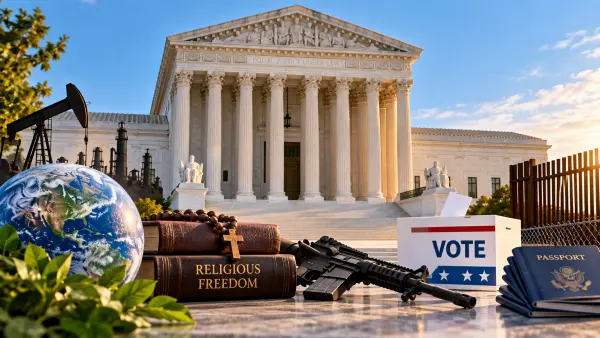
The Supreme Court opens its 2026-27 term today with arguments in a climate-liability case, with major disputes over religion, AR-15 bans, Arizona’s voting rules and the Trump administration’s immigration policies set for later this fall. The Court now issues about twice as many full-court rulings on emergency applications as on argued cases, according to Georgetown law professor Stephen Vladeck, NPR reported.
Background
The Court has six conservative justices. Three were appointed by President Donald Trump, who told Time last week that they “voted against me too often,” The Hill reported. New cases are added to the docket through the year.
October 5, climate. The Court will decide whether federal law bars Boulder, Colorado, from suing Exxon Mobil and Suncor Energy in state court over the alleged deceptive marketing of fossil fuels, CBS News reported. The Colorado Supreme Court let the suit proceed, and Justice Samuel Alito is not taking part. The Trump administration backs the companies, and a decision is expected by the end of June, Reuters reported.
November 3, religion. In St. Mary Catholic Parish v. Roy, a Catholic parish asks for an exemption from the nondiscrimination rule in Colorado’s universal preschool program, which pays for families to send four-year-olds to the preschool of their choice. The argument falls on Election Day.
December, guns, voting and immigration. On December 2, the Court hears challenges to AR-15 bans in Cook County, Illinois, and Connecticut, the first time it will address a ban on a particular kind of firearm, Roll Call reported. On December 8 it takes up whether Arizona can require proof of citizenship to register to vote with its state form. On December 9 it hears the legality of third-country deportations, after allowing them to resume while it decides. A separate case on detaining immigrants without bond hearings is likely to be argued early next year.
Waiting in the wings. Cases that may reach the Court include Ten Commandments displays in classrooms, the transgender military ban, Trump’s acting U.S. attorney appointments and his effort to cancel spending approved by Congress. Our report on the path to an emergency order explains how such disputes reach the justices.
What Different Sides Are Saying
Oil companies say emissions cannot be traced, and Boulder says its claim is local. Exxon and Suncor say emissions “cannot be unmixed and traced to their individual sources,” and warn that allowing such suits would effectively impose a carbon tax that could bankrupt the industry, according to CBS. Boulder says it is suing over deceptive marketing, not emissions, and seeks only its share of local costs, according to a Congressional Research Service primer.
Gun-rights lawyers say the government cannot pick which arms people may own. Erin Murphy, who litigates for gun owners, told NPR the key question is who decides what guns people can have. Former Solicitor General Don Verrilli Jr. said an AR-15 can fire up to 100 rounds a minute unmodified, but that millions of Americans own one and disarming them would be disruptive. Many experts expect the bans to face skepticism from the Court, Roll Call reported.
The parish says it is being excluded for its religion, and Colorado says its rule is neutral. The petitioners argue the Court’s 2022 decision in Carson v. Makin sets “a clear rule” against excluding religious groups from a funding program. The U.S. Court of Appeals for the 10th Circuit sided with the state.
Critics say the emergency docket gives too little guidance. Lower-court judges, liberal and conservative, complain that the Court’s brief explanations are inadequate, NPR reported. Stanford law professor Pam Karlan said the Justice Department has “a boss who wants everything taken up” at the Court.
Fact-check, the religion case: NPR said the Court may be on the verge of requiring taxpayers to fund religious schools that refuse to admit LGBTQ students, and that it has never held religious schools entitled to full funding. The case is narrower in form: Colorado’s program pays families, and the question is whether the Free Exercise Clause requires an exemption from the nondiscrimination rule, according to CBS. The petitioners say earlier decisions already bar excluding religious schools from funding programs, which is the core disagreement.
Fact-check, Alito’s recusal: CBS reported that the letter announcing Alito’s recusal gave no reason. Reuters reported that he owns stock in several oil and gas companies but not Exxon or Suncor, according to his disclosure forms. Linking the recusal to those holdings is an inference, and this article could not confirm his reason.
Fact-check, the docket’s size: The Court has agreed to hear 30 cases so far, PBS reported. That is below the 45 to 80 it has typically heard in a term, according to Roll Call. Experts quoted by Roll Call said the apparent lull will not last, and Vladeck said the term’s biggest cases may not be on the docket yet.
Fact-check, the climate stakes: The Court is not deciding whether Exxon or Suncor misled the public, which the companies deny, only whether federal law bars the suit, according to CBS. The warnings about carbon taxes and bankruptcy are predictions from the companies’ filings, and this article did not verify them.
View from Outside the US
Suncor is based in Canada, but this article found no analysis from non-US outlets beyond syndicated Reuters reports.
Note on Scope
This article previews the argument calendar as reported through October 4 and does not predict outcomes. Argument dates can change, and the Court may add cases. Sources give different captions for the detention case and list one or two gun cases, so this article describes them without relying on captions. Election-law disputes that may arrive on the emergency docket are not yet before the Court.
Related Links
- The Supreme Court faces another term jam-packed with controversy (NPR)
- Guns, voting and immigration on deck for Supreme Court (Roll Call)
- Supreme Court gears up for new term with major cases on climate change, immigration and guns (CBS News)
- US Supreme Court to kick off term with bid by Big Oil to toss climate suits (Reuters)
- Supreme Court ready to tackle climate, immigration and gun rights. Here are 5 cases to watch (PBS News)
- State-law climate tort suits and Suncor v. Boulder County: a primer for Congress (Congressional Research Service)
- Public funding for religious preschools to face First Amendment test (National Constitution Center)
Discussion Questions
- Do you follow Supreme Court cases, or mostly hear about them after a ruling?
- Should cities and states be able to sue energy companies under state law for climate harms?
- Should a state that funds preschool for every family have to include religious preschools that set their own admissions rules?
- Who should decide which firearms people may own: Congress, states, or courts?
- Should states be able to require more proof of citizenship for voter registration than federal law does?
- Is it fair to deport someone to a country they have no ties to if that country promises not to harm them?
- What are the benefits and risks of the Court deciding major disputes through quick emergency orders?
- Does a president criticizing the justices he appointed affect how you view the Court?
- Should justices explain why they step aside from a case?
- Imagine you are a justice. Which pending case would you most want to hear, and why?
