
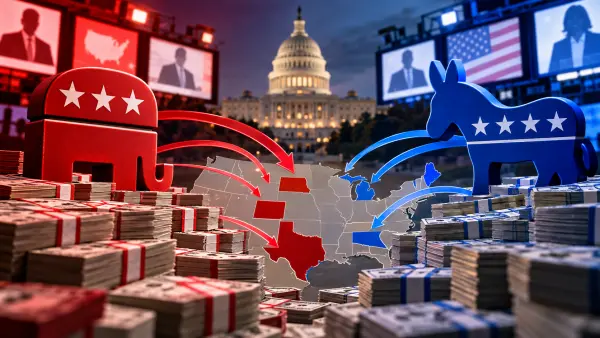
Campaign money in the final weeks is moving toward Republican-held seats once treated as safe, and away from races where a side thinks the outcome is settled. Through October 12, Republican-aligned groups led total congressional ad spending, $1.98 billion to $1.75 billion, while Democrats led in House races, AdImpact reported. Republican groups are adding money in Kansas, Nebraska and Texas and have cut North Carolina. Democratic groups are adding money in Michigan and Maine and pausing Georgia and North Carolina. These moves show where each side sees risk, not who will win.
Background
Candidates, party committees and outside groups play different roles. Super PACs can take unlimited contributions but must spend independently of campaigns. On June 30, the Supreme Court ruled 6-3 in NRSC v. FEC that limits on party spending coordinated with candidates violate the First Amendment, which gives party committees more freedom to work with campaigns.
The figures below mostly cover television advertising, which is only one part of campaign spending. They leave out donations that have not yet been spent, mail, canvassing and most digital work.
Senate: Republicans lead on ads, Democrats on candidate fundraising
In Senate races, pro-Republican ad spending reached $1.3 billion against $964.0 million for Democrats. In House races, Democrats led $787.3 million to $678.9 million. The costliest Senate races on air are Texas ($490.4 million), Ohio ($431.7 million) and Michigan ($295.3 million).
Candidate fundraising runs the other way. CNBC’s review of third-quarter reports found Democratic Senate candidates outraising Republicans in Texas (James Talarico $60.2 million, Ken Paxton about $10.2 million), Michigan (Abdul El-Sayed $30.7 million, Mike Rogers $9.7 million), Ohio (Sherrod Brown $23.1 million, Jon Husted $4.8 million) and Maine (Troy Jackson $20.4 million, Susan Collins $5.2 million). Republican super PACs made up much of the difference. The Senate Leadership Fund (SLF) raised a record $272.9 million in the quarter, about $122 million more than Democrats’ Senate Majority PAC (SMP).
Texas: one donor reshapes the Republican budget
Elon Musk gave SLF $158 million in September, $75 million on September 9 and $83 million on September 23, Axios reported. SLF passed the same amounts to Texas PAC, which backs Paxton against Talarico, the next day. Those transfers are one pool of money, so the $158 million donation and the $158 million transfer should not be added together. Musk’s gift was nearly 58% of SLF’s third-quarter haul.
Axios reported that the infusion let Republicans flood Texas while freeing cash for Kansas and South Carolina. Republicans have also been outspending Democrats in Texas by a wide margin, though not by as much as the dollar figures suggest (see below).
Republicans add in Kansas, Nebraska and Alaska, and cut North Carolina
On October 2, the Associated Press reported, citing four people with knowledge of the decision, that SLF would cut North Carolina ads and reserve nearly $8.2 million to support Sen. Roger Marshall in Kansas. SLF had planned about $18 million more in North Carolina over the next month and had already spent roughly $32 million there. AP linked the shift to doubts that Republican Michael Whatley can beat Democrat Roy Cooper and to a tightening Kansas race.
SLF has also put $15 million toward defending Sen. Pete Ricketts in Nebraska against independent Dan Osborn and $14 million toward Sen. Dan Sullivan in Alaska, according to the CNBC review. The Congressional Leadership Fund, the House counterpart, raised a record $94.4 million in the quarter and entered October with $156 million in cash.
Democrats add in Michigan and Maine, pause Georgia and North Carolina
Semafor reported on October 14 that SMP is adding $3.7 million in Michigan, bringing its total there to nearly $35 million, and $3 million in Maine against Collins. SMP is pausing ads in Georgia and North Carolina, where Sen. Jon Ossoff and Cooper are favored. Its ads this week point to New Hampshire, Michigan, Maine, Kansas, Ohio, Iowa, Alaska and Texas. Semafor gave no reason for the pause beyond the candidates’ favored status.
Both parties have therefore reduced North Carolina spending, for opposite reasons: Republican groups because of doubts about their nominee, Democratic groups because their nominee is ahead.
What an ad dollar buys
Dollars do not buy equal exposure. In September, across the nine most competitive Senate races, Republican-side broadcast TV spending was $233 million against $121 million for Democrats, but Republicans got only about 40% more gross rating points, a measure of audience reach. Democrats paid about $201 per point and Republicans about $274, AdImpact data reported by Scripps shows. Outside groups supplied about nine in ten Republican ad dollars, compared with about half for Democrats. In Texas, Republicans outspent Democrats more than 4 to 1 but received about 2.6 times the points. The report did not explain the cause of the price gap.
House: Republicans triage, Democrats seek $17 million
The Congressional Leadership Fund canceled planned ads in four districts and increased spending in 16 others, from Texas to Pennsylvania, AP reported this week, citing three Republican campaign officials. The four are Iowa’s 1st District (held by Republican Mariannette Miller-Meeks), New Jersey’s 7th (Tom Kean), and districts near Cincinnati and in east-central Michigan. The group had already spent $13.3 million in those races, more than 12% of its total through October 13. That is money spent, not the amount of canceled advertising.
The Democratic Congressional Campaign Committee launched a $17 million fundraising drive with an October 22 deadline. The money would fund ads in districts once seen as out of reach, including Ohio’s 10th, the Miami area, suburban St. Louis and Little Rock. The $17 million is a goal, not money raised or spent.
What Different Sides Are Saying
Republicans say the shifts are triage and Texas money does not cost other states. A Republican strategist, Stu Sandler, told AP that spending shows where parties believe they are competing. Axios reported that Musk’s money let SLF fund Texas without draining other battlegrounds. Fact-check: AP separately reported that SLF cut North Carolina, with sources pointing to Whatley’s prospects. This article could not establish whether Texas spending influenced that decision or others.
Democrats say Republicans are on defense. SMP spokesperson Lauren French said Republicans are “scrambling” in Kansas, per AP. The DCCC’s Courtney Rice said the extra money would go to seats beyond those the committee needs to reach 218. Fact-check: SLF’s added money in Kansas, Nebraska and Alaska is documented, but whether that is a scramble or planned reserve spending is a characterization. The DCCC’s $17 million has not been shown to be raised.
View from Outside the US
Kenya’s Citizen Digital, carrying a Reuters report from October 14, said Musk has spent roughly $366 million this cycle, counted from January 1, 2025, including at least $276 million to Republican groups since July. An America PAC spokesman told Reuters that about $90 million of the cycle total went toward a prior election or other issues. Reuters said he is likely the largest single political donor in this year’s races.
Note on Scope
This article covers AdImpact television data through October 12 and reports through October 17, 2026. It does not cover digital, mail, field programs, or state and local races. Several details rest on anonymous sources in AP reporting. This article could not verify an SLF cut in Georgia, a Nevada House ad withdrawal tied to MAGA Inc., or crypto-industry spending totals in Ohio and Nebraska, where sources differed. It could not locate a public SLF statement on how Texas spending affected other states, or a Republican National Committee or Democratic National Committee spending breakdown. Reservations and plans can change before Election Day on November 3.
Related Links
- MediaPost: Political TV Ad Spend Up 30% Through Mid-October
- Axios: Inside Elon Musk’s Texas Rescue Mission
- AP via Spectrum News: Senate Republicans Move Cash From North Carolina to Kansas
- Semafor: Top Democratic Super PAC Spends More in Michigan, Maine
- PBS NewsHour: Republicans Retreat From Battleground Districts
- CNBC: Five Midterm Money Takeaways
- Scripps: Republicans Flood Senate Races With Ad Money but Pay a Premium
Discussion Questions
- How much do campaign ads influence your voting decisions, if at all?
- Why might a party cut ad spending in a race it expects to win and in one it expects to lose?
- Should one donor be able to give $158 million to a single political committee?
- What is the difference between money given to a candidate and money spent independently on a candidate’s behalf?
- Does it matter that Republicans pay more per ad point than Democrats if they still spend more overall?
- Should parties be able to coordinate more closely with their candidates, as the Supreme Court’s June ruling now allows?
- Do changes in ad spending tell us more about the race, or about the groups doing the spending?
- How should journalists report an unconfirmed spending plan, such as a fundraising goal or a reservation?
- How do campaign finance rules in other democracies compare with those in the United States?
- Imagine you are an election reformer. What one change to campaign spending rules would you propose, and why?
