
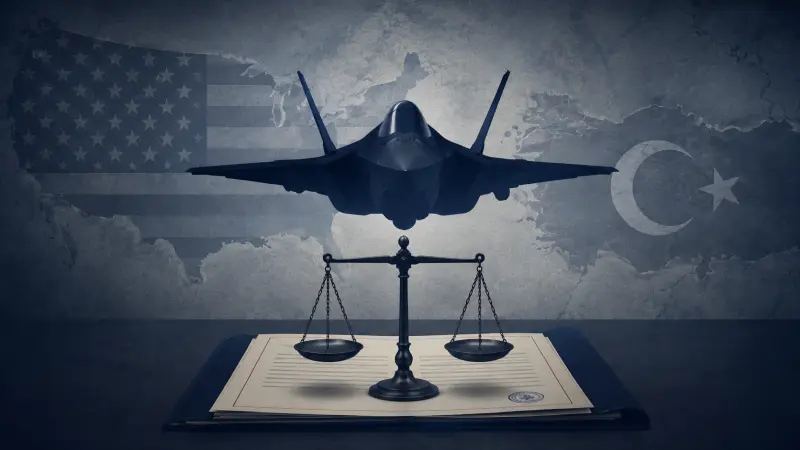
At the NATO summit in Ankara on July 7 to 8, 2026, President Trump said he would “certainly consider” selling F-35 fighter jets to Turkey, a NATO member that has been barred from the program since 2019. Speaking alongside Turkish President Recep Tayyip Erdogan, Trump also announced that the United States would lift sanctions imposed on Turkey under the Countering America’s Adversaries Through Sanctions Act (CAATSA). He stopped short of announcing a final decision on the jets themselves.
The statements came after weeks of anticipation. Reuters and the New York Times had reported, citing unnamed sources, that Trump was expected to back Turkey’s return to the F-35 program during the trip. His own remarks in Ankara were less definitive: he called the plane “the best” available and cited Turkey’s “loyalty,” but described a sale as “a decision we’re going to make” rather than one already made.
Background
Turkey ordered the Russian-made S-400 air defense system in 2017 and took delivery in 2019, despite repeated US warnings that operating it alongside the F-35 could let Russia gather intelligence on the stealth jet’s radar signature. In response, the first Trump administration removed Turkey from the multinational F-35 program and sanctioned Turkey’s defense procurement agency under CAATSA.
Congress separately wrote the restriction into statute. Section 1245 of the Fiscal Year 2020 National Defense Authorization Act (NDAA) bars the transfer of F-35 aircraft, parts, or technical data to Turkey unless the Secretaries of Defense and State certify, 90 days in advance, that Turkey no longer possesses the S-400, has pledged not to reacquire it, and has not taken on other Russian systems that could compromise the jet. That certification has not been made, and Turkey has not removed the S-400.
Lifting CAATSA sanctions and clearing the legal path for an F-35 sale are two distinct actions. Sanctions relief addresses the 2020 penalties on Turkey’s procurement agency; the F-35 transfer is governed separately by the NDAA certification requirement. Trump’s Ankara announcement addressed the sanctions directly but left the certification question, and therefore the F-35 sale itself, unresolved.
Vice President JD Vance said last month that Defense Secretary Pete Hegseth’s department was reviewing whether Turkey had met the conditions required under US law. The administration has already cleared a separate sale of F110 jet engines for Turkey’s domestically built KAAN fighter program.
What Different Sides Are Saying
Trump and Turkey argue the relationship has changed enough to justify the sale. Trump told reporters that Turkey has been “much more loyal than other countries,” citing Turkish cooperation on Iran-related issues. This is a characterization of the bilateral relationship, not a checkable fact, and should be read as Trump’s own framing rather than an independently verifiable claim.
Fact-check: Trump’s remarks are accurately reported across multiple outlets covering the July 7 press appearance. Whether Turkey has in fact been more “loyal” than other NATO allies is a matter of judgment, not something that can be fact-checked.
Erdogan said Turkey had already been promised a batch of jets. At the joint appearance, Erdogan stated that Turkey had received a prior commitment for five F-35 aircraft.
Fact-check: This claim comes from Erdogan directly and has not been independently confirmed by US officials in available reporting. I could not verify the existence or terms of any such prior commitment.
Turkish Foreign Minister Hakan Fidan framed the obstacle as procedural rather than a matter of political will. He said both governments have a “strong will” to lift sanctions, and that the outcome now depends on how the process unfolds in the US Congress.
Fact-check: This statement is verifiable as Fidan’s public position, reported by CNN Turk. It does not resolve whether Congress or existing law would actually permit the sale; that remains contested, as the sections below describe.
A bipartisan group of House members says any sale would violate current law. Reps. Mike Lawler (R-NY) and Brad Sherman (D-CA) led a letter, co-signed by four other Republicans and three other Democrats, warning Trump against reversing the F-35 ban. Separately, a Hellenic Caucus-led letter and a resolution from Rep. Dina Titus targeting a related engine sale reflect the same underlying objection.
Fact-check: The letters and the Titus resolution are verifiable through the sponsoring members’ official statements. The legal argument itself, that Section 1245 of the FY2020 NDAA bars transfer absent certification, is accurate as a description of current statute. Whether the administration could still find a legal path around it (for example, by certifying compliance on disputed grounds) is an open legal question that has not been tested in court.
Rep. Brad Sherman argues the sale would be flatly illegal under current conditions. He told The Hill that “it is illegal to sell” the jets as long as Turkey retains the S-400 and declares it will keep the system.
Fact-check: This is Sherman’s legal interpretation of the statute, and it aligns with the plain text of Section 1245 given that no certification has been issued. It is worth noting the law is conditional, not an absolute permanent ban. It allows a legal path if the required certification is made, so “illegal” applies to the sale proceeding under present, uncertified conditions rather than to any conceivable future sale.
Defense analysts say the security concern is that S-400 radar could help Russia study the F-35’s stealth characteristics. A former national security adviser to Sen. Thom Tillis said proposals to simply warehouse the S-400 would not resolve the underlying risk, pointing to what the system could learn about “tracking” and “telemetry” from nearby NATO aircraft.
Fact-check: This is the widely cited rationale behind the original 2019 expulsion and the statutory restriction, and it is consistent with public statements from defense officials over several years. The specific technical extent of any intelligence risk is based on classified assessments that cannot be independently verified here.
The Wall Street Journal’s editorial board opposes the sale on strategic grounds. The board wrote that permitting the S-400 and F-35 to operate in proximity would give Russia a “window” into the jet’s capabilities, and separately argued Trump has “better uses for his political capital” than pursuing this fight with Congress.
Fact-check: This is the editorial board’s opinion and strategic judgment, not a factual claim requiring verification. It should be read as opinion, not as an independent assessment of the underlying security risk.
Israeli Prime Minister Benjamin Netanyahu publicly urged Trump not to proceed. In a Fox News interview, he said Turkey is “governed by a man who calls openly for the annihilation of Israel” and that selling F-35s would upset the regional balance of air power.
Fact-check: Netanyahu’s remarks are accurately reported and attributed to a July 6 Fox News interview. His characterization of Erdogan’s rhetoric and his assessment of the regional “power balance” are his own characterizations and strategic judgments, not independently checkable facts, though Erdogan has made public statements critical of Israel’s conduct in Gaza that are separately documented.
Related Links
- Washington Post: Trump says “we will consider” fighter-jet sale to Turkey despite opposition in Congress
- PBS NewsHour: Trump says U.S. will lift Turkey sanctions, consider selling F-35s
- The Hill: Trump, eyeing F-35 reversal for Turkey, faces growing pressure ahead of NATO summit
- Defense News: US will lift sanctions on Turkey, possibly sell F-35 fighter jets, Trump says
- Office of Rep. Chris Pappas: Bipartisan group opposes unlawful sale of fighter jets to Turkey
- CSIS: The Great Unwinding: The U.S.-Turkey Arms Sales Dispute
- Times of Israel: NATO summit and Trump’s support for F-35 sale boost Turkey’s standing as Israel’s clout erodes
Discussion Questions
- Have you followed news coverage of NATO summits before? What stood out to you about this one, if anything?
- Do you think Turkey should be readmitted to the F-35 program while it still has the S-400 system?
- Do you find Trump’s loyalty argument or Congress’s legal argument more persuasive?
- Why might a president want to move forward on something Congress has already restricted by law?
- How might this decision affect trust between Israel and the United States?
- What role should personal relationships between leaders play in decisions like this one?
- Should Congress have more control over foreign arms sales, or should the president have more flexibility?
- Why do defense officials consider the S-400 and F-35 incompatible?
- What are the risks and benefits of rewarding a country with advanced weapons despite past violations of US conditions?
- Imagine you are a member of Congress with no direct stake in this issue. How would you decide whether to support the sale?
