
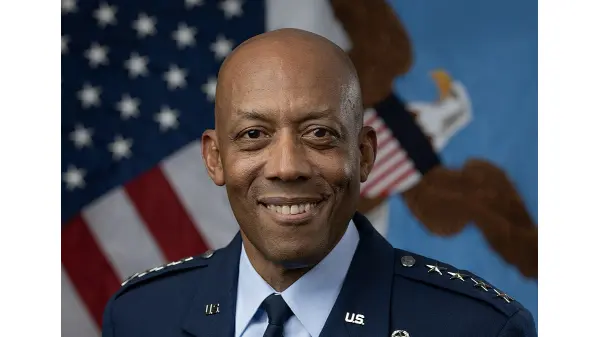
On July 3, 2026, retired Gen. Charles Q. Brown Jr., who served as Chairman of the Joint Chiefs of Staff until he was dismissed by the Trump administration in February 2025, published an essay in Foreign Affairs warning against using the US military for domestic political missions. The piece, co-authored with Duke University political scientist Peter Feaver and North Carolina attorney Andrew Kragie, argues that “when presidents use the armed forces for more politically contentious missions, such as addressing domestic crime in cities, the work of the military becomes more fraught.” The authors write that turning to a military solution instead of fixing “the underlying incapacity or dysfunction in civilian institutions” diverts the armed forces from their primary combat mission.
The essay does not name President Trump or Defense Secretary Pete Hegseth directly. Its publication, timed near the country’s 250th anniversary, was widely reported as a response to the administration’s continued use of National Guard troops and Marines in American cities.
Background
Brown was dismissed as Chairman of the Joint Chiefs on February 21, 2025, alongside Chief of Naval Operations Adm. Lisa Franchetti, in what reporting at the time described as the first removal of multiple sitting Joint Chiefs members in US history. Before his confirmation as defense secretary, Hegseth had publicly called for Brown’s removal, questioning Brown’s diversity and inclusion initiatives and suggesting he had been promoted because of his race rather than merit. This essay is Brown’s most extensive public comment since his firing, though it is framed as a general argument about civil-military relations rather than a personal account of his dismissal.
Since 2025, the Trump administration has deployed, or attempted to deploy, National Guard troops and Marines to several Democratic-led cities, including Los Angeles, Portland, Chicago, and Washington, DC, citing rising crime and the need to protect federal immigration enforcement operations. Federal district courts in California, Oregon, and Illinois each ruled against these deployments, and the US Court of Appeals for the Seventh Circuit upheld the block in the Illinois case. A California court found that troops had been used to carry out law enforcement functions in violation of the Posse Comitatus Act, a law generally barring the military from domestic policing. In December 2025, the Supreme Court, in what was reported as an apparent 6 to 3 vote, left in place a lower court’s block on deploying the National Guard to the Chicago area, finding the administration had not identified a legal basis for the deployment. The administration withdrew troops from Chicago, Portland, and Los Angeles at the end of December 2025, though federal deployments continued in Washington, DC, and, as of earlier this year, in New Orleans.
What Different Sides Are Saying
Brown, Feaver, and Kragie argue that repeatedly assigning the military politically charged domestic missions damages public trust in the armed forces as a neutral institution and pulls it away from combat readiness. This is a normative, opinion-based argument about institutional risk, not a specific checkable factual claim, so it is not something that can be fact-checked. It reflects the authors’ professional judgment, informed by Brown’s own military leadership background and Feaver’s academic work on civil-military relations.
Defense Secretary Pete Hegseth has defended the deployments as apolitical law enforcement support. Responding to protests against the National Guard’s presence in Washington, DC, Hegseth said protesters “can’t see law and order and common sense in front of them, that there’s nothing ideological about this group, there’s nothing political about this exercise,” adding that “law and order is something all Americans deserve.” This is a claim about the deployments’ intent and character that is genuinely contested and cannot be independently verified as a factual matter, since intent is not directly observable. It is worth noting, however, that this is a distinct question from whether the deployments had adequate legal authority. Multiple federal courts, applying statutory standards rather than assessing political intent, found the administration lacked authority for at least some deployments under the specific laws it invoked.
Officials in Illinois and California, who sued over the deployments, argued that the effort had a partisan motive, specifically to pressure Democratic-led cities. This is also a claim about intent. It reflects the position those states took in litigation, but it was not the basis on which courts ultimately ruled. The rulings turned on statutory authority under Title 10 and the Posse Comitatus Act, not on a judicial finding of partisan motive, so it would be inaccurate to describe partisan intent as something the courts confirmed, even though the underlying legal rulings did go against the administration.
Note on Scope
Brown’s essay is framed as a general argument about the history of civil-military relations dating back to George Washington, not a detailed critique of any single deployment. Litigation over several of the underlying deployments remains active or was resolved only on a preliminary basis. The Supreme Court’s December 2025 ruling on Chicago was itself preliminary, addressing whether to leave a lower court’s block in place while the underlying case continues, rather than a final ruling on the merits.
Related Links
- Top general fired by Trump administration criticizes use of military for political missions – CNN
- Trump fires chairman of the Joint Chiefs of Staff Gen. Charles Q. Brown Jr. – NPR
- Supreme Court rejects Trump’s bid to deploy National Guard in Illinois – NBC News
- Supreme Court rejects Trump’s effort to deploy National Guard in Illinois – SCOTUSblog
- Fired ex-Joint Chiefs chairman warns against politicizing the military in new essay – Washington Times
- Trump’s threat to invoke the Insurrection Act, explained – ACLU
Discussion Questions
- Do you think a retired general should speak publicly about how the military is being used?
- Is it possible to use troops for a domestic mission without it becoming politically charged?
- Do you find Hegseth’s defense or Brown’s warning more persuasive?
- Why might a court decide a case based on legal authority rather than on whether an action was “political”?
- How should the public weigh a claim about someone’s intent when it cannot be directly proven?
- What responsibilities do civilian leaders have toward institutions, like the military, that serve them?
- Should an official publicly respond to a fired general’s criticism, or let the argument stand on its own?
- How might repeated domestic deployments change how people view the military over time?
- What is the difference between using troops for disaster relief and using them for crime enforcement?
- Imagine you are advising a new president. What guidelines would you set for when the military can be used inside US cities?
