
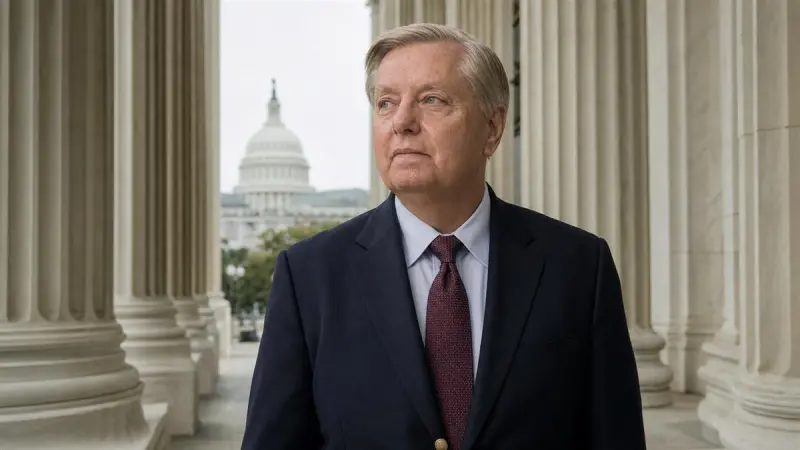
What Happened
Senator Lindsey Graham, the South Carolina Republican, died on the night of Saturday, July 11, 2026, at his home in Washington, DC. He was 71. His office announced that he died following a “brief and sudden illness.” The Washington, DC, medical examiner’s preliminary finding pointed to an aortic dissection, a rupture in the body’s main artery. A statement from his communications director referred to complications from cardiovascular disease. Both descriptions were preliminary at the time of reporting.
Graham had returned only days earlier from Kyiv, one of many trips he made to Ukraine after Russia’s 2022 invasion. President Donald Trump said he had spoken with Graham by phone on Saturday, hours before his death, about pending legislation. Tributes came quickly from Trump, South Carolina Governor Henry McMaster, NATO Secretary-General Mark Rutte, and Israeli Prime Minister Benjamin Netanyahu.
Background
Graham served in the US House from 1995 to 2003 and in the Senate from 2003 until his death, chairing the Senate Judiciary Committee from 2019 to 2021 and later playing a central role in Republican budget work. He first drew national attention as one of the House managers who prosecuted President Bill Clinton in his 1999 Senate impeachment trial.
For much of his career he was known as a foreign policy hawk and a protege of the late Senator John McCain. The two, along with former Senator Joe Lieberman, were nicknamed the “Three Amigos” for their frequent overseas travel and shared belief in an assertive US role abroad. Graham was among the Senate’s most consistent supporters of Israel and Ukraine and its sharpest critic of Iran’s government.
His relationship with Trump defined the later phase of his career. During the 2016 Republican primary, in which Graham briefly ran for president, he was one of Trump’s harshest Republican critics, at one point calling him a “race-baiting, xenophobic, religious bigot” and refusing to vote for him. After Trump took office, Graham became one of his closest allies in the Senate. That reversal is central to how supporters and critics alike describe his legacy.
What Different Sides Are Saying
Supporters and allies describe Graham as an effective legislator and a steady voice for American leadership abroad. Trump told reporters there was “no better advocate” in the Senate. Governor McMaster called him the “fiercest of fighters for South Carolina and America.” Netanyahu said Israel had lost “one of its greatest friends.” Backers point to his work confirming Supreme Court justices and federal judges, his role in crafting the 2025 tax-and-spending package that Republicans passed, and his sustained push for military aid to Ukraine.
Critics focus on the same career and reach the opposite conclusion. Some describe his shift from Trump critic to loyalist as opportunism rather than conviction. Progressive commentators criticized his hawkish record, with at least one outlet cataloguing what it called a “bloodthirsty” foreign policy legacy and objecting to warm tributes from Democratic senators. Critics also point to his conduct after the 2020 election. Georgia Secretary of State Brad Raffensperger, a Republican, said Graham called him and asked whether he could disqualify mail-in ballots in counties with higher rates of signature mismatches. Raffensperger interpreted this as a suggestion to discard legally cast ballots. Graham denied that interpretation, saying he was only asking how signature verification worked. This is a genuine dispute of interpretation between two people about the same call; the underlying fact that the call took place is not in question, but what Graham intended by it remains contested.
Fact-check note: The “critic to ally” arc is well documented and not disputed by either side. The characterizations of that arc, whether framed as growth, pragmatism, or a surrender of principle, are opinion and framing, not factual claims that can be checked. We label them as such rather than adjudicating them.
The Election and Senate Fallout
Graham’s death carries immediate practical consequences because he was in the middle of a reelection campaign. He had won South Carolina’s Republican Senate primary in June and was widely expected to secure a fifth term in November.
Under South Carolina law, Governor McMaster, a Republican, may appoint someone to serve out the remainder of Graham’s term, which runs through early January. Because the seat was already on the November ballot, the vacancy also triggers a special primary to choose a new Republican nominee. State law points to a special primary around August 11, with a possible runoff on August 25 and a candidate filing period running roughly July 21 to July 28. As of this writing, South Carolina officials had not formally confirmed the exact schedule, and at least one report noted a potential conflict with federal rules that generally require 45 days of absentee voting for military and overseas voters. The eventual Republican nominee would face the Democratic nominee, pediatrician Annie Andrews, in November.
On the balance of power, the short-term effect is limited but real. Republicans held a 53 to 47 Senate majority, and the seat sits in a deep-red state, so McMaster’s appointment is expected to restore that margin quickly. The caucus had already been operating one member short in recent weeks, which adds pressure to fill the seat without delay. For the longer term, Graham’s death removes one of the Senate’s most forceful advocates for continued US support of Ukraine, which is why several accounts noted that his absence raises questions about the direction of Republican policy on Russia.
Several South Carolina Republicans are weighing a run, including Representatives Nancy Mace, Ralph Norman, and William Timmons, Lieutenant Governor Pamela Evette, and Treasury Secretary Scott Bessent, a South Carolina native. Representative Joe Wilson publicly ruled himself out, saying he wanted to protect the party’s narrow House majority. Trump, who remains the dominant force in Republican primaries, said he had someone in mind but declined to name a preference out of what he called respect for Graham. Whether he backs a placeholder appointee or a candidate who will also run in November is one of the open questions shaping the race.
Related Links
- Lindsey Graham dead at 71, leaving a legacy as a Trump booster and foreign policy hawk (NBC News)
- Lindsey Graham, longtime GOP senator and Trump ally, dies at 71 (CNN)
- What’s next for Lindsey Graham’s Senate seat (The Washington Post)
- Who will replace Lindsey Graham? What happens next in the Senate (CNN)
- Republicans scramble to find a replacement ahead of the midterms (NBC News)
- What made US Senator Lindsey Graham a controversial figure (Al Jazeera)
- Georgia officials spar with Graham over alleged ballot comments, 2020 (NBC News)
Discussion Questions
- Have you ever changed your opinion about a public figure over time? What caused the change?
- Do you think a politician’s foreign policy record should weigh as heavily as their domestic one when judging them?
- Graham went from calling Trump a “jackass” to being a close ally. How do you read that shift?
- Why do political figures sometimes reverse strong public positions they once held?
- Should governors be able to appoint temporary senators, or should every vacancy go straight to a special election?
- Supporters called Graham a “fierce fighter” and critics called him “bloodthirsty.” What do those labels tell you about how a legacy gets written?
- How do you personally decide whether a public figure’s legacy is mostly positive or mostly negative?
- Why does the death of a single senator affect a national agenda as much as it does?
- Is it appropriate for politicians to publicly praise an opponent they strongly disagreed with after that person dies?
- Imagine you are the governor of South Carolina. Who would you appoint to the seat, and what would you weigh most in that choice?
