
This post reflects events as of July 11, 2026. The situation is changing rapidly, and some details below may be overtaken by events. Talks between US and Iranian officials are scheduled in Oman today.
What Happened
The ceasefire between the United States and Iran broke down this week after the most intense exchange of fire since the agreement was reached. Early in the week, Iran struck three commercial vessels in the Strait of Hormuz, including a Saudi ship and a Qatari liquefied natural gas carrier. The United States responded with two nights of airstrikes, hitting what US Central Command described as roughly 90 targets inside Iran in the second round, including missile and drone storage sites and air defense systems. Iran then launched missiles and drones at US bases and allied territory in Bahrain, Kuwait, Qatar, and Jordan, which said it shot down eight Iranian missiles.
Speaking at the NATO summit in Ankara on Wednesday, President Trump declared the ceasefire “over,” though he said negotiations could continue. Iran’s Health Ministry said at least 14 people were killed and 78 wounded in the two days of US strikes, in its first overall count; that figure comes from the Iranian government and has not been independently verified. By Thursday evening the exchange appeared to ease, with no new US strikes ordered, and Iranian Foreign Minister Abbas Araghchi is expected in Oman on Saturday for talks. The Trump administration’s negotiating team is led by Vice President JD Vance, Jared Kushner, special envoy Steve Witkoff, and Secretary of State Marco Rubio.
Separately, unexplained blasts were reported in southern Iran overnight Thursday into Friday, including near the Bushehr nuclear power plant. The United States denied responsibility, and a US official specifically denied targeting Bushehr. Who caused those explosions has not been established in available reporting.
Background
The war began in late February and early March 2026 with US and Israeli strikes on Iran, including strikes on Tehran. Iran’s Supreme Leader Ayatollah Ali Khamenei was killed during the war and was buried Thursday in Mashhad after multi-day funeral ceremonies. His son and successor, Mojtaba Khamenei, has not appeared publicly since assuming the role, which has fueled speculation about his condition that cannot be verified from available reporting.
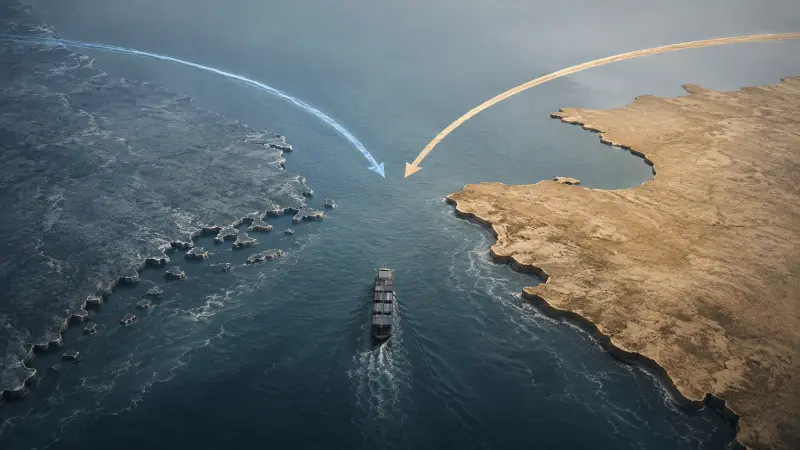
A Pakistan-mediated ceasefire took hold in April after both sides rejected earlier proposals, and in mid-June the two countries signed a memorandum of understanding, negotiated through Islamabad, that opened a 60-day window to reach a final agreement. The central sticking point has been the Strait of Hormuz, the waterway carrying roughly a fifth of the world’s oil before the war. Iran maintains that under the memorandum it reopens the strait according to its own arrangements; the United States and Gulf states treat Iranian attacks on shipping there as a violation of the agreement and of international law. Both sides have accused each other of violating the ceasefire repeatedly since April.
The economic effects are measurable. Before the war, about 110 ships transited the strait daily; this week traffic fell to a few dozen at most, with one tracking service counting 34 transits on Thursday and another count showing as few as 13 in a 24-hour window. US gasoline prices, which averaged $2.98 per gallon before the war and peaked above $4.50 in May, fell to $3.80 during the ceasefire and have begun rising again, reaching $3.88 on Friday according to AAA.
What Different Sides Are Saying
President Trump says Iran broke the ceasefire and is desperate to negotiate anyway. He described the US strikes as retribution for Iran’s attacks on ships, warned that further Iranian attacks would bring a stronger response, and said Iranian leaders “wanna make a deal” while questioning whether they would honor one. At the summit’s closing press conference he went further, calling negotiations potentially a waste of time and saying “let’s just finish the job.”
Fact-check: Trump’s statements are accurately reported across multiple outlets. His claims about Iran’s motives and desperation are his own characterizations and cannot be verified. Note that his public statements this week pointed in two directions at once, toward both continued talks and expanded military action, and reporting does not resolve which reflects administration policy.
The administration says the strikes were about protecting shipping, not restarting the war. US Central Command said its strikes were aimed at degrading Iran’s ability to threaten freedom of navigation in the Strait of Hormuz, and a US official described a deliberate strike-then-pause strategy meant to leave room for diplomacy.
Fact-check: The stated targeting rationale is verifiable as CENTCOM’s official position. Whether the strikes were proportionate or escalatory is a matter of judgment on which the two governments and outside analysts disagree.
Iran says the United States is the violator and warns it will not surrender. Iran’s Foreign Ministry called the US strikes a “grave war crime,” saying they hit civilian infrastructure including two railway bridges on the route to Mashhad ahead of Khamenei’s burial. Chief negotiator Mohammad Bagher Ghalibaf said Iran is prepared for all-out defense and that the conflict will never end with Iran’s surrender.
Fact-check: The statements are accurately attributed to Iranian officials and state media. NBC News geolocated video showing a damaged railway bridge in Golestan province, which supports the claim that a bridge was hit; the war-crime characterization is a legal claim that no court has adjudicated. Iranian casualty figures come from Iran’s government and have not been independently confirmed.
Gulf states condemned Iran’s attacks on shipping as a threat to all of them. The Gulf Cooperation Council denounced the strikes on the Saudi and Qatari vessels as an assault on maritime safety, said attacks in Bahraini and Kuwaiti waters violated international law and the US-Iran memorandum, and invoked the right of self-defense under the UN Charter.
Fact-check: The GCC statement is public and verifiable. Notably, several of the same Gulf and regional governments condemning Iran, particularly Qatar, are simultaneously mediating between Washington and Tehran, alongside Pakistan and Oman.
Israel says it is ready to resume the war alone if necessary. Israel’s defense minister said the IDF is prepared to regain air superiority and strike Iran independently. Separately, Israeli sources told CNN the US is keeping Israel out of the current fighting to avoid losing control of the conflict, a claim a US official dismissed as fake news while affirming close coordination. Israel also shared intelligence with the US alleging a new Iranian plan to assassinate President Trump, according to sources cited by CNN.
Fact-check: The defense minister’s statement is public. The claims about US-Israel friction rest on anonymous sources and are directly disputed by a US official, so they should be treated as contested. The assassination-plot claim is attributed to shared intelligence that has not been made public and cannot be verified from available reporting.
Inside Iran, the ceasefire itself is contested. During the funeral ceremonies, Foreign Minister Araghchi was reportedly attacked by regime supporters who oppose the agreement with Washington, and President Masoud Pezeshkian was also confronted, according to reporting from CNN.
Fact-check: These accounts come from reporting on a country with heavy press restrictions and could not be independently confirmed. They are consistent with broader reporting of conservative opposition to the negotiations, but the details should be treated with caution.
What to Watch
Three open questions will shape the coming days. First, whether Saturday’s talks in Oman produce a public Iranian commitment on the Strait of Hormuz, which reporting indicates is Washington’s core demand. Second, whether the memorandum of understanding survives in any form, given that Trump has declared it over while his administration continues negotiating under its framework. Third, whether the fighting stays contained to the US and Iran, or widens to include Israel or draws in the Gulf states whose territory has already been struck.
Related Links
- CBS News: US-Iran latest, Trump reiterates ceasefire is over but says US will continue negotiating
- NBC News: US and Iran exchange intense new attacks after Trump says ceasefire is over
- CNN: Live updates on the US-Iran war and Strait of Hormuz diplomacy
- Al Jazeera: Iran war live, Trump says talks agreed but ceasefire over
- Fox News: US renews strikes on IRGC as peace and ceasefire stall
- Wikipedia: 2026 Iran war ceasefire (background and timeline)
Discussion Questions
- Have you been following this war closely, occasionally, or not much? What has shaped that?
- Trump declared the ceasefire over while his team keeps negotiating. How do you interpret that combination?
- Why is the Strait of Hormuz so central to this conflict?
- Both sides accuse the other of violating the agreement. How can outside observers judge claims like that?
- Casualty figures in this story come only from the Iranian government. How should news readers handle numbers that cannot be independently checked?
- Qatar is both condemning Iran and mediating between Iran and the US. Can a country do both credibly?
- How much should rising gas prices influence public opinion about a war?
- What are the risks of a strike-and-pause strategy compared to sustained military action or none at all?
- Iran has a new supreme leader who has not appeared in public. How might leadership uncertainty affect negotiations?
- Imagine you are a mediator from a neutral country meeting both delegations in Oman. What would you propose first?
