
Watch the Discussion
Watch the video and read the transcript on PBS. The program runs 55 minutes and 34 seconds.
About the Program
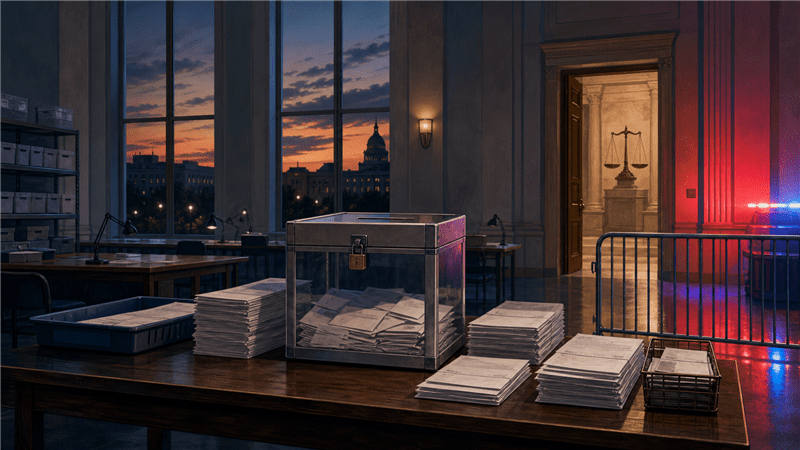
Breaking the Deadlock: How to Fix an Election, released by PBS on July 7, 2026, is a guided thought experiment. It is not a report about a real election emergency. Moderator Aaron Tang asks nine public figures to respond as a fictional crisis unfolds in the state of Middlevania and the city of Bigton.
The panel includes former New Jersey governor Chris Christie, Representative Dan Crenshaw, entrepreneur Mark Cuban, former defense secretary Mark Esper, Utah lieutenant governor Deidre Henderson, former senator Claire McCaskill, constitutional law professor Melissa Murray, activist Brittany Packnett Cunningham and attorney and media commentator Aaron Parnas. They take on temporary roles such as governor, mayor, secretary of state, military commander, journalist and citizen.
The scenario combines several pressures. A foreign cartel is accused of planning violence. A dam is in danger. A president links federal help to political cooperation. Federal troops are sent to the area as voting begins. Protesters gather, some violence occurs, and officials argue about voter records, ballot security and whether the election can continue.
Because the facts are fictional and are revealed in stages, many panelists change or qualify their answers. That is part of the exercise. The central question is not simply who is right. It is how citizens and officials should make decisions when security, voting rights, public trust and limited information collide.
How We Grouped the Arguments
The panel does not split into two fixed teams. The same speaker may emphasize caution in one scene and resistance in another. For discussion, we grouped the recurring arguments into two broad perspectives: protecting institutional safeguards and dissent, and prioritizing security, continuity and public order. Each claim below is attributed to the speaker who made or developed it.
Perspective One: Protect Safeguards and Dissent
1. States have the leading role in running elections
Claim: Deidre Henderson argues that the fictional state should control its voter files and election procedures rather than automatically turn them over to the federal government.
Fact-check: This is broadly correct but incomplete. State and local officials administer most U.S. elections. However, the Elections Clause also gives Congress power to alter rules for congressional elections, and federal voting laws apply nationwide. The Constitution does not give states exclusive authority over every part of an election.
Counterargument: Federal agencies can have a legitimate role when enforcing voting rights or investigating election crimes. The key questions are whether a request has lawful authority, a clear purpose and safeguards against misuse.
2. Widespread ineligible voting has not been demonstrated
Claim: Henderson says there is no evidence of widespread voting by ineligible people. Claire McCaskill goes further and calls the problem politically manufactured.
Fact-check: The first statement is supported by available evidence. Individual illegal votes and registration errors occur, but reviews have generally found small numbers. For example, a Georgia audit reported by the Associated Press identified 20 noncitizens among about 8.2 million registered voters, none of whom voted in the 2024 general election. Calling the entire problem made up is too absolute because documented cases do exist.
Counterargument: Even rare violations can matter to public confidence and should be investigated. Strong enforcement can be paired with protections against wrongly removing eligible voters.
3. Detailed voter records could be misused
Claim: Melissa Murray warns that granular voter information could be used to identify or harass individual voters.
Fact-check: The risk is plausible, but it depends on which fields are shared, who receives them and what legal and technical protections apply. Voter files commonly include personal details, although public access and privacy rules vary by state. Sharing data is not automatically unlawful or abusive.
Counterargument: Carefully limited data sharing can help states and federal agencies identify duplicate records, deaths or possible ineligibility. A narrowly written request with auditing and privacy controls is different from an unrestricted transfer.
4. Troops near voting sites can intimidate voters
Claim: Brittany Packnett Cunningham argues that a large military presence around polling places could suppress participation even without an explicit order to stop anyone from voting.
Fact-check: The concern has a legal and historical basis. 18 U.S.C. Section 592 generally prohibits federal troops or armed personnel at places where an election is held, with an exception for repelling armed enemies. The fictional facts are deliberately difficult because officials claim a foreign security threat. The legal result would depend on the mission, location, authority and evidence.
Counterargument: If a threat is credible, security personnel positioned away from voting activity could protect voters and election workers. Visibility, distance, rules of engagement and coordination with election officials would matter.
5. A president cannot cancel a federal election alone
Claim: Henderson rejects the fictional president’s threat to cancel the election and insists that voting continue.
Fact-check: For federal elections, this is correct. A Congressional Research Service legal analysis found no presidential emergency power to postpone or cancel a federal election. Congress sets the date by law. Rules for state and local contests differ, but governors and election officials still must follow applicable state law.
Counterargument: Severe emergencies can force changes to individual voting locations or procedures. Those adjustments should come through existing law and courts, not a unilateral presidential announcement.
6. Peaceful protest is a democratic safeguard
Claim: Cunningham and Murray argue that public protest can expose possible abuse and show officials that citizens are watching.
Fact-check: The First Amendment protects peaceful assembly. That protection is not unlimited. Governments may apply content-neutral time, place and manner rules, and violence, threats or physical obstruction are not protected merely because they occur during a protest.
Counterargument: A protest near a tense security operation can increase confusion or danger. Organizers can preserve their message by keeping distance from voting lines, rejecting violence and coordinating safe routes.
7. Election procedures should not be disrupted in the middle of counting
Claim: Henderson says that chain of custody, bipartisan observation and planned audits are safer than abruptly seizing ballots while counting is underway.
Fact-check: This matches standard election safeguards described by the U.S. Election Assistance Commission. Documented custody, access controls, observers, testing and post-election audits help officials detect mistakes and preserve evidence.
Counterargument: Ordinary procedures may not be enough if investigators have specific evidence that ballots are being altered or destroyed. A properly authorized and carefully documented intervention could be necessary in an urgent case.
8. Courts are the proper place to challenge a ballot seizure
Claim: Henderson favors an emergency court order over physical resistance when federal agents seek the ballots.
Fact-check: Judicial review is the normal legal route for contesting a search or protecting election materials. Search warrants generally require probable cause and approval by a neutral judge. The fictional program ultimately has a judge pause the seizure, illustrating how courts can check executive action.
Counterargument: Courts may not always act before evidence is lost. Law enforcement officials also have a duty to preserve evidence when they possess a valid warrant, although they remain accountable for how it is executed.
Perspective Two: Prioritize Security, Continuity and Public Order
1. Election crimes are real even when they are uncommon
Claim: Dan Crenshaw says voter fraud should not be dismissed because actual cases exist.
Fact-check: Correct. The Justice Department’s Election Crimes Branch investigates and prosecutes offenses involving ballots, registration and campaign financing. The existence of cases does not establish that fraud is widespread or that it changed a particular result.
Counterargument: Policy should be proportionate to the evidence. Broad restrictions can burden many lawful voters while addressing a small number of violations.
2. Photo voter ID has broad public support
Claim: Crenshaw says about 80 percent of Americans support voter identification requirements.
Fact-check: Broadly correct. An August 2025 Pew Research Center survey found 83 percent favored requiring a government-issued photo ID to vote. Results can vary with question wording and with whether a proposal includes free IDs, exceptions or alternative verification.
Counterargument: Popularity does not settle questions about access or constitutionality. Supporters and critics may find common ground in free identification, broad availability and backup options for eligible voters.
3. Public confidence is itself an election concern
Claim: Crenshaw argues that officials must address voters who lack confidence in election systems, even when confirmed fraud is rare.
Fact-check: This is primarily a judgment about governance, not a testable claim that fraud occurred. Transparent procedures, observation and audits can improve confidence. Public suspicion alone is not proof that an election was compromised.
Counterargument: Officials can unintentionally deepen distrust by treating unsupported allegations as established facts. Confidence is best built with verifiable records and consistent explanations.
4. Service members must follow lawful civilian orders
Claim: Mark Esper emphasizes civilian control of the military and says service members must carry out lawful orders even when they disagree with the policy.
Fact-check: That is a core principle of the U.S. system. The important limit is the word lawful. Service members are not required to obey unlawful orders. The Posse Comitatus Act also restricts use of the armed forces to execute domestic law unless the Constitution or Congress authorizes it.
Counterargument: Formal legality may be uncertain during a fast crisis. Senior civilian and military lawyers should review the mission, and officials should state the mission and limits publicly when security permits.
5. A credible foreign threat can justify federal security support
Claim: Esper and Crenshaw give more weight to the reported cartel threat and argue that officials should not assume a troop deployment is only political.
Fact-check: Federal forces can support domestic authorities under specific statutes and constitutional powers. Yet the Congressional Research Service notes that military support to civilian law enforcement carries legal and practical limits. In the program, the evidence shifts, so neither the security claim nor the accusation of pretext is fully established at first.
Counterargument: Officials should seek corroborated intelligence and use the least intrusive capable force. Local law enforcement or the National Guard under state control may sometimes reduce legal and civic risks.
6. Protesters should not interfere with lawful operations
Claim: Esper says peaceful protest is protected but should not block a credible law enforcement or security operation. Crenshaw warns against confronting officers physically.
Fact-check: Broadly correct. Speech and peaceful assembly receive strong protection, but assault, threats and physical obstruction can be prosecuted. Whether a specific order to disperse is lawful depends on the facts and the rules applied.
Counterargument: Officials sometimes label disruptive but nonviolent dissent as a security problem. Clear boundaries, visible identification and space for lawful observation can reduce both interference and abuse.
7. One anonymous source is not enough to disprove a threat
Claim: When Aaron Parnas considers reporting that the claimed attack was false based on one source, Crenshaw, Esper and Cuban urge him to investigate further.
Fact-check: Their caution is justified. A source who did not personally see evidence of a plot cannot prove that no plot exists. A journalist might publish a carefully limited report based on one highly credible source, but should describe what is known, what is not known and what efforts were made to corroborate it.
Counterargument: Waiting for perfect certainty can allow officials to hide misconduct. The public-interest question is whether the verified information is important enough to report with precise limits and context.
8. Physically blocking a valid warrant can make the crisis worse
Claim: Crenshaw argues that citizens surrounding ballots to stop federal agents would risk arrests and escalation rather than protect the count.
Fact-check: Even a nonviolent blockade can be unlawful if it obstructs officers executing a valid warrant. People may choose civil disobedience for moral reasons, but peaceful intent does not guarantee immunity from arrest. In the scenario, the successful restraint comes from a court order, not force.
Counterargument: Visible, peaceful witnesses can deter misconduct and preserve public attention. Observation, documentation and rapid legal action offer lower-risk alternatives to physically blocking officers.
What the Panel Found in Common
Despite sharp disagreements, several shared principles emerge. Panelists across the political spectrum resist the idea that disaster relief should depend on political favors. They recognize that an election needs both security and public legitimacy. They also move toward verification before acting on uncertain claims.
The harder disagreement is about who deserves the benefit of the doubt during an emergency. Some panelists begin with concern about misuse of official power. Others begin with concern about the danger officials say they are trying to stop. The program shows why transparent evidence, clear legal authority and independent courts matter. Those tools allow people to test claims without relying only on trust in a leader, an agency or a crowd.
The scenario also makes room for a practical middle ground. Election officials can maintain documented custody and audits. Security officials can use distance, limited missions and civilian coordination. Journalists can report verified facts while being candid about uncertainty. Protesters can remain visible without blocking voters or lawful court processes. None of those steps ends the political argument, but each can lower the chance that fear becomes violence.
Related Links
- PBS: Breaking the Deadlock: How to Fix an Election
- Constitution Annotated: Article I, Section 4
- Congressional Research Service: Postponing Federal Elections and the COVID-19 Pandemic
- U.S. House Office of the Law Revision Counsel: 18 U.S.C. Section 592
- U.S. Department of Justice: Election Crimes Branch
- Pew Research Center: Views of Voter ID and Voting Access
- U.S. Election Assistance Commission: Can I Trust the Outcome of the Election?
Discussion Questions
- Which moment in the video was hardest for you to judge?
- When should state officials share voter data with the federal government?
- Did any panelist change your view? What did that person say?
- How close should security forces be allowed to get to a polling place?
- Why can public trust fall even when confirmed fraud is rare?
- What is the strongest argument for voter ID? What is the strongest concern?
- How should journalists report an urgent claim that has only one source?
- When does peaceful protest become improper interference?
- Which safeguard mattered most in the final ballot dispute?
- Imagine a real threat appears on Election Day. Who should decide whether a polling place moves or closes?
