
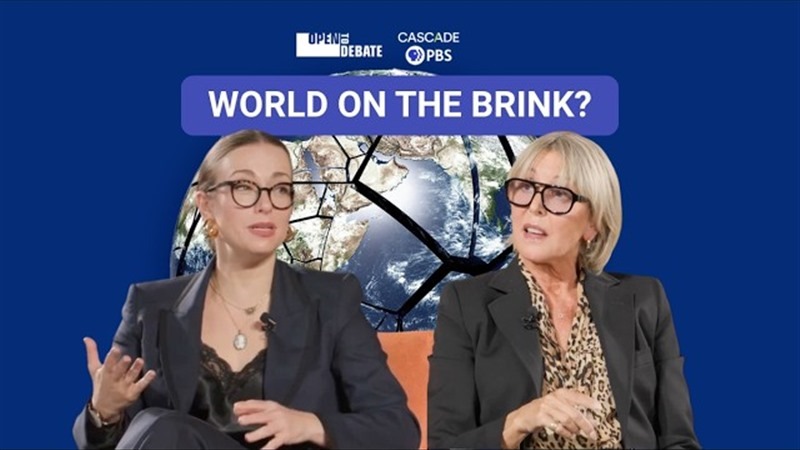
Watch the Discussion
Watch World on the Brink? on YouTube. The video runs 61 minutes and 34 seconds.
About the Discussion
World on the Brink? brings together journalist Julia Ioffe and American Enterprise Institute scholar Danielle Pletka for a wide-ranging discussion of the Iran war, Russia, NATO, China and the future of U.S. leadership. Open to Debate moderator John Donvan leads the conversation.
The event was recorded June 6, 2026, at the Cascade PBS Ideas Festival in Seattle and released on YouTube June 19. It is looser than a formal Oxford-style debate. Ioffe generally emphasizes clear political objectives, the limits of military power and the risks of intervention. Pletka generally emphasizes deterrence, sustained American engagement and the value of supporting democratic movements abroad. They also agree on several points, including that the Trump administration had not clearly defined victory in Iran.
Important update: The recording is not a current snapshot of the war. After it was recorded, a U.S.-Iran agreement produced a temporary ceasefire, but major hostilities resumed. On July 13, the Associated Press reported new attacks and competing U.S. and Iranian claims of control over the Strait of Hormuz. Claims in the video about whether the war had ended or who had won must therefore be read as arguments made on June 6.
How We Grouped the Arguments
The speakers are not fixed representatives of political parties, and neither position is internally uniform. For discussion, we organized their arguments around two recurring perspectives: restraint through clear goals and alliance consent, and active leadership through deterrence and sustained engagement. Each claim is followed by a fact-check and a relevant counterargument.
Perspective One: Clear Goals, Restraint and Alliance Consent
1. The United States entered the Iran war without a stable public definition of victory
Claim: Ioffe says the administration’s stated reasons appeared to move among regime change, ending Iran’s nuclear program and degrading its military capabilities.
Fact-check: The criticism is substantially supported, although different goals can exist at the same time. An April U.S. Central Command fact sheet described the mission as dismantling the regime’s security apparatus and prioritizing imminent threats. Public statements also emphasized missiles, nuclear facilities and political change. The administration presented several objectives, but that does not prove its internal military plan changed each time its public emphasis changed.
Counterargument: A campaign can have several connected aims. Military commanders may measure success through destroyed capabilities even when political leaders describe the larger purpose inconsistently.
2. The United States had not won the war by the time of the recording
Claim: Ioffe argues that Iran’s government survived, retained weapons and continued resisting U.S. demands, so Washington could not reasonably claim victory.
Fact-check: Whether a war has been won depends on the objective being measured. By June 6, Iran’s government still functioned and the Strait remained a major point of leverage. U.S. strikes had also caused extensive military damage. Events after the recording support Pletka’s warning that the outcome was not final: the ceasefire later broke down and major attacks resumed.
Counterargument: A state can achieve important military objectives without replacing an enemy government. Reduced missile, drone or nuclear capacity could count as partial success even if the conflict remains unresolved.
3. Iran gained powerful leverage through the Strait of Hormuz
Claim: Ioffe says control of the Strait allows Iran to threaten roughly a quarter of the world’s oil and gas supply.
Fact-check: The basic point is correct, but the wording needs precision. The U.S. Energy Information Administration estimates that Hormuz carried about 20 percent of global petroleum-liquids consumption, one-quarter of maritime-traded oil and more than 20 percent of global liquefied natural gas trade in the first half of 2025. It did not carry one-quarter of all global oil and gas production combined.
Counterargument: Iran’s leverage is costly to use. Closing or attacking traffic also harms Iran’s own exports, partners and regional economy, and invites military action to reopen the route.
4. Removing a supreme leader does not necessarily weaken the political system
Claim: Ioffe argues that killing Ayatollah Ali Khamenei did not remove the Islamic Republic and may have strengthened harder-line security figures.
Fact-check: The regime survived and Mojtaba Khamenei became the new supreme leader. That supports the narrower point that removing one leader did not collapse the system. Whether the government became more durable or more hard-line is harder to measure, especially during war and information restrictions. Its long-term stability cannot yet be verified.
Counterargument: Leadership losses, damaged command networks and economic pressure can weaken a government gradually. Survival in the first months does not prove long-term strength.
5. Regime-change plans often produce results Washington did not expect
Claim: Ioffe points to Iraq as a warning that removing a brutal ruler does not guarantee a stable liberal democracy.
Fact-check: Correct as a caution, but her suggestion that Iraq simply became worse is too broad. Iraq now holds competitive elections and has more political pluralism than under Saddam Hussein. However, Freedom House still rated Iraq Not Free, citing corruption, unlawful militias, weak institutions and Iranian influence. The intervention produced both freedoms and severe costs.
Counterargument: Comparing postwar instability only with an ideal democracy can hide the repression that existed before. Pletka argues that millions of Iraqis gained choices they did not have under Saddam.
6. Allies are less likely to help when they are insulted or excluded
Claim: Ioffe says an alliance is reciprocal and that European leaders faced political barriers to helping after being criticized and insufficiently consulted.
Fact-check: This is mostly an argument about effective diplomacy. The full record of private consultation is not public, so the extent of exclusion cannot be independently verified. European allies did later assist in regional security and have sharply increased defense spending. Pletka is also correct that Europe faces direct Iranian threats: the United Kingdom says it responded to more than 20 Iran-backed plots from 2022 through April 2025.
Counterargument: Allies have obligations based on shared interests, not only on whether a U.S. president treats them respectfully. European governments can oppose Washington’s tone while still helping address a common threat.
7. The Iran war gives Russia economic and strategic advantages
Claim: Ioffe says higher oil prices support Russia’s budget while U.S. attention and resources shift away from Ukraine.
Fact-check: The economic mechanism is sound. Russia is a major oil exporter, and the Stockholm International Peace Research Institute said Russian oil-sale revenues were expected to rise in 2026. The size of the benefit changes with prices, discounts, sanctions and Ukrainian attacks on Russian energy infrastructure. The claim that U.S. distraction directly changes the battlefield is plausible but harder to isolate.
Counterargument: Russia also loses when Iran and other partners are weakened. Its limited military help to Iran can damage Moscow’s reputation as a dependable ally.
8. U.S. efforts to choose another country’s leaders carry serious risks
Claim: Ioffe invokes the 1953 overthrow of Iranian Prime Minister Mohammad Mossadegh to challenge Pletka’s call for more active U.S. support in selecting acceptable leaders.
Fact-check: U.S. involvement is documented. A declassified CIA memorandum published by the State Department historian describes a campaign to remove Mossadegh and replace his government with one led by the shah and Fazlollah Zahedi. Historians still debate the relative importance of CIA action, British involvement and Iranian political forces.
Counterargument: Supporting independent media, civil society or democratic opposition is not the same as secretly installing a ruler. Pletka’s broader argument is that refusing all support can leave authoritarian forces unchallenged.
Perspective Two: Deterrence, Engagement and Democratic Leadership
1. It was too early to declare the Iran war lost
Claim: Pletka says the war could not be called because it had not ended and the president might resume a larger military campaign.
Fact-check: Later events support this limited prediction. A temporary agreement and ceasefire did not hold, and fighting resumed. This does not prove that the United States is winning. It proves that the outcome Pletka was discussing remained unsettled.
Counterargument: Governments can still assess whether early objectives failed. Saying a conflict is unfinished should not prevent scrutiny of costs, shifting goals or missed opportunities.
2. A country hit by more than 13,000 strikes is not better off militarily
Claim: Pletka cites more than 13,000 strikes as evidence that Iran suffered major damage.
Fact-check: The number matches CENTCOM’s April fact sheet, which reported more than 13,000 targets struck. It is an official U.S. military count, not an independently audited total. A high number of strikes demonstrates the scale of the campaign but does not by itself measure destroyed capability, civilian harm or political success.
Counterargument: Military punishment can coexist with strategic gain. Iran may be physically weaker while gaining bargaining leverage through Hormuz or stronger domestic control.
3. Iran’s missile, drone and nuclear capabilities were heavily degraded
Claim: Pletka argues that strikes sharply reduced Iran’s missile force and access to its nuclear program.
Fact-check: U.S. military reporting supports substantial damage to missile, drone, air-defense and command facilities. The complete level of damage cannot be verified publicly. Iran continued to launch attacks, and U.S. officials continued to demand nuclear restrictions, showing that significant capability and uncertainty remained.
Counterargument: Degradation can be temporary if technical knowledge, hidden material and manufacturing networks survive. Lasting success requires monitoring, diplomacy or repeated force.
4. A weaker Iranian regime could reduce support for armed groups across the region
Claim: Pletka says political change in Iran could weaken Hezbollah, the Houthis, Hamas and Iran-aligned militias in Iraq.
Fact-check: The connection is real. A Congressional Research Service overview documents Iranian funding, weapons, training and other support for these groups. It also stresses that their relationships with Tehran differ and that they sometimes act independently. Removing Iranian support would not automatically dissolve them.
Counterargument: Sudden state collapse could spread weapons, intensify competition and create new armed factions. The direction of change would depend on what replaced the regime.
5. Trump’s first-term Abraham Accords changed regional diplomacy
Claim: Pletka calls the accords transformational and says they produced genuine peace between Israel and several Arab states.
Fact-check: The accords were a major diplomatic achievement. They enabled official ties, trade and security cooperation involving Israel, the United Arab Emirates, Bahrain, Morocco and Sudan. Their reach should not be overstated. Implementation has varied, public opposition remains strong in some countries and the agreements did not resolve the Israeli-Palestinian conflict.
Counterargument: Durable state-to-state cooperation can still reduce conflict even when public opinion is divided and other disputes remain unresolved.
6. Iraqis have more freedom than they had under Saddam Hussein
Claim: Pletka says Iraq is not an ideal democracy but that many citizens now live with freedoms impossible under Saddam.
Fact-check: Broadly correct in relative terms. Iraq has competitive elections, multiple parties and greater space for religious and political representation. It also has major failures of rule of law, corruption, militia power and civil liberties. Both Pletka’s comparison and Ioffe’s warning about the intervention’s consequences can be true.
Counterargument: Greater formal choice does not erase the war’s deaths, displacement, sectarian violence or the continuing weakness of Iraqi institutions.
7. Pressure helped move NATO allies toward higher defense spending
Claim: Pletka argues that U.S. criticism, including Trump’s confrontational approach, pushed European allies to carry more of the defense burden.
Fact-check: Spending did rise sharply. NATO reported that European allies and Canada increased core defense spending by nearly 20 percent in 2025 and were advancing toward the newer 2035 targets. Trump applied pressure, but Russia’s invasion of Ukraine, national elections and European security concerns also drove the increase. No single cause can be isolated.
Counterargument: Pressure may produce more spending while also weakening trust. The useful question is whether higher budgets create deployable capabilities and stronger cooperation.
8. The United States remains the strongest power, but China competes through institutions
Claim: Pletka says the United States remains unmatched militarily and economically while China builds influence inside technical bodies such as the International Telecommunication Union.
Fact-check: The United States remains the largest military spender. SIPRI estimated $954 billion in U.S. military spending in 2025, about 2.8 times China’s total. The word unmatched is still a judgment because China competes in trade, technology, manufacturing and regional military power. Pletka’s suggestion that China currently runs the ITU is outdated: Chinese official Houlin Zhao led it from 2015 through 2022, but American Doreen Bogdan-Martin has served as secretary-general since 2023.
Counterargument: Formal leadership does not capture every kind of influence. China can shape standards through experts, voting coalitions, funding and market power even when a Chinese national does not lead the agency.
Where the Speakers Find Common Ground
Ioffe and Pletka disagree about the risks of American action, but they share important concerns. Both criticize the absence of a clear public definition of victory. Both recognize that Iran’s use of Hormuz cannot be ignored. Both describe Russia and China as self-interested powers rather than dependable protectors of smaller partners. Both also accept that military strength is only one part of leadership.
The deepest disagreement concerns what follows from uncertainty. Ioffe sees uncertainty as a reason to narrow objectives, consult allies and avoid trying to design another country’s politics. Pletka sees uncertainty as a reason to remain engaged, deter adversaries and build alternatives to authoritarian rule before a crisis reaches its final stage.
A possible middle ground is not simply doing more or doing less. It is defining measurable goals, identifying legal authority, consulting partners, preparing for unintended outcomes and saying what evidence would cause a policy to change. Those standards can be applied to military action, diplomacy and support for democratic movements alike.
Related Links
- Open to Debate: World on the Brink?
- Cascade PBS Ideas Festival: Open to Debate Session
- Associated Press: U.S. and Iran Vie for Control of the Strait of Hormuz
- U.S. Central Command: Operation Epic Fury Fact Sheet
- U.S. Energy Information Administration: World Oil Transit Chokepoints
- NATO: 2026 Defense Investment Update
- SIPRI: Global Military Spending in 2025
Discussion Questions
- What does each speaker mean by winning a war?
- Which speaker gives the clearer standard for success?
- Has a leader’s changing explanation ever affected your trust?
- How much consultation do allies owe one another?
- Why do foreign interventions produce unexpected results?
- What is Ioffe’s strongest argument?
- What is Pletka’s strongest argument?
- When does supporting democracy become improper interference?
- Is military strength enough to create global leadership?
- If you advised the president, which single goal would you set for Iran?
