
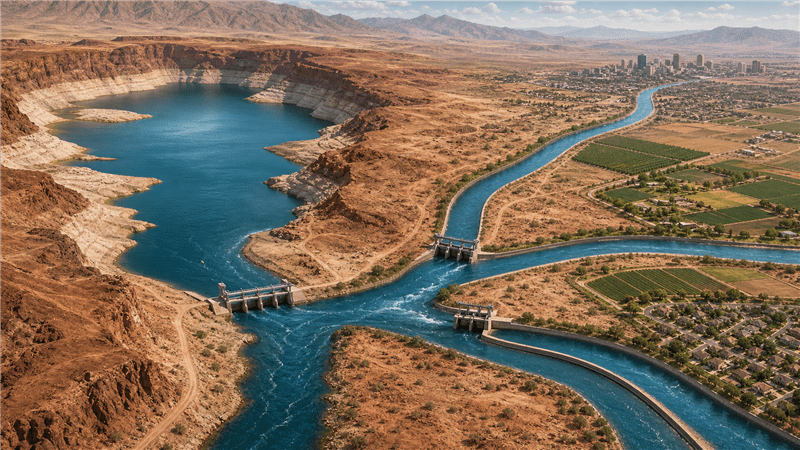
The federal government released a proposal on July 31 that could require Arizona, California and Nevada to reduce their combined use of Colorado River water by as much as 3 million acre-feet per year through 2036.
The plan would replace reservoir operating rules that expire at the end of 2026. Actual reductions would be recalculated every two years according to water conditions. The four Upper Basin states could rely mainly on voluntary conservation for now, a difference that has renewed a long-running argument about how responsibility should be divided.
Federal officials say action is necessary because Lake Mead and Lake Powell are near record lows after prolonged drought, heavy use, low snowpack and rising temperatures. State officials agree that the river faces a crisis but disagree sharply about whether the proposal distributes cuts fairly.
Background
The Colorado River supplies water to about 40 million people, supports 5.5 million acres of farmland, generates hydroelectric power and serves 30 Tribal Nations and two Mexican states. The Bureau of Reclamation describes the network of compacts, statutes, court rulings, treaties and operating rules as the Law of the River.
The current 2007 operating guidelines and 2019 drought plans expire in 2026. The Bureau of Reclamation said in February that it would proceed without full agreement among the seven basin states because new rules must be ready for the 2027 water year.
Negotiations have repeatedly stalled over a basic question. Lower Basin states say every state should accept measurable reductions because the river carries less water than past agreements assumed. Upper Basin states say they already use less than their legal allocations and should not face mandatory cuts that conflict with the 1922 compact.
What the Federal Proposal Would Do
According to the Associated Press, Arizona, California and Nevada could together lose access to as much as 3 million acre-feet annually. That volume is roughly equal to the combined annual allocations of Arizona and Nevada and enough to serve more than 25 million people for a year.
The maximum would not apply automatically every year. Reductions would deepen in drier conditions and be determined on a two-year cycle. The Lower Basin states would divide part of the burden under a framework they previously developed, while legal priority rights would affect the remainder.
California holds older priority rights than many Arizona users. That system can protect some California deliveries while placing greater pressure on central Arizona. Within each state, decisions also affect cities, farms, tribes, industries and environmental uses differently.
The proposal would allow Colorado, New Mexico, Utah and Wyoming to pursue voluntary agricultural conservation rather than imposing the same mandatory formula. Federal officials are expected to provide further implementation details and then finalize the rules.
Why the Proposal Is Coming Now
Reservoir conditions have deteriorated rapidly. A June federal announcement said system storage was about 36% of capacity and described record-low snowpack and extreme spring temperatures.
The Bureau is also releasing extra water from Flaming Gorge Reservoir to support Lake Powell. Its 2026 drought-response plan says the goal is to protect critical reservoir elevations needed for water delivery and hydropower.
Climate change is not the only cause. The basin has long promised and consumed more water than the river reliably produces. Agriculture uses most diverted water, while population growth, tribal water rights, environmental needs and delivery obligations to Mexico add competing demands.
What Different Sides Are Saying
The federal government
Interior officials say a flexible plan is needed to keep the system reliable while conditions change. They emphasize that the states failed to reach one agreement and that federal law requires new operating rules.
Fact check: The Bureau of Reclamation’s post-2026 project page confirms that several governing agreements expire in 2026 and that the federal process will determine operations for Lake Mead and Lake Powell. The government still must follow environmental review and other legal requirements.
Arizona
Arizona officials call the proposal flawed and warn that deep reductions could damage farms, cities and the state economy. Arizona has junior priority in important parts of the Lower Basin system, leaving it especially exposed.
Fact check: The Associated Press confirms Arizona’s objection and its lower-priority position. The maximum reduction is not a guaranteed annual cut, so descriptions should distinguish a possible ceiling from the amount that will actually apply.
California
California officials describe the proposal as an important milestone but not a finished solution. The state benefits from senior legal rights but also contains large agricultural districts that depend heavily on the river.
Fact check: The AP confirms California’s more measured initial response. Senior priority can affect distribution, but it does not mean every California user is protected from conservation or higher costs.
Nevada
Nevada officials call the proposed reductions unrealistic and potentially devastating. The state has the smallest Lower Basin allocation and has invested heavily in reuse and conservation.
Fact check: The AP confirms Nevada’s objection. Nevada’s efficiency record is relevant, but past conservation does not remove the physical need to balance total river use with supply.
The Upper Basin states
The governors of Colorado, New Mexico, Utah and Wyoming gave the proposal a cautiously favorable initial response. They have argued that mandatory cuts to their use would violate existing compact protections.
Fact check: The AP reports that the four governors welcomed guidelines tied more closely to available supply while continuing their legal review. Whether the compact forbids a particular mandatory reduction would depend on the final rule and possible litigation.
Tribal Nations
Tribes hold significant rights and depend on the river, but many communities still lack infrastructure to use water legally reserved for them. The Bureau’s public-comment record includes submissions from numerous Tribal Nations.
Fact check: The federal record verifies tribal participation, but the AP report does not establish that tribes collectively support or oppose the July 31 proposal. Tribal governments have distinct rights and positions and should not be treated as one side.
Fact Check
Claim: All three states will immediately lose 3 million acre-feet
Verdict: False. The Associated Press says 3 million acre-feet is the potential combined maximum. Actual reductions would depend on conditions and later allocation decisions.
Claim: The Upper Basin receives no responsibility
Verdict: Misleading. The proposal relies mainly on voluntary Upper Basin conservation rather than the mandatory Lower Basin formula. Upper Basin states also participate in drought-response releases, but critics argue the responsibilities are not equivalent.
Claim: The proposal is already final
Verdict: False. The AP says federal officials expect to finalize the plan after additional details. State review, environmental procedures and possible litigation remain.
What Comes Next
Federal officials must issue final operating rules before the 2027 water year. The states will negotiate how to divide reductions, and water agencies will consider conservation payments, fallowing, reuse, groundwater, desalination and rate increases.
A June memorandum among federal and Lower Basin agencies is exploring desalination and water recycling, but those projects cannot immediately replace millions of acre-feet. If the final rule is seen as violating water rights or federal procedure, one or more states or water users may sue.
Related Links
- AP report on the proposal
- Federal post-2026 process announcement
- Colorado River post-2026 project
- Draft environmental review comments
- 2026 drought-response operations
- Water reuse and desalination agreement
Discussion Questions
- Why are new rules necessary?
- What makes a water cut fair?
- Should priority rights control reductions?
- Which users face the greatest risk?
- How should tribes participate?
- What does flexibility add?
- Which claim needs more evidence?
- Have water costs affected you?
- Why did negotiations fail?
- Imagine you represent a basin state. What compromise would you offer?
