
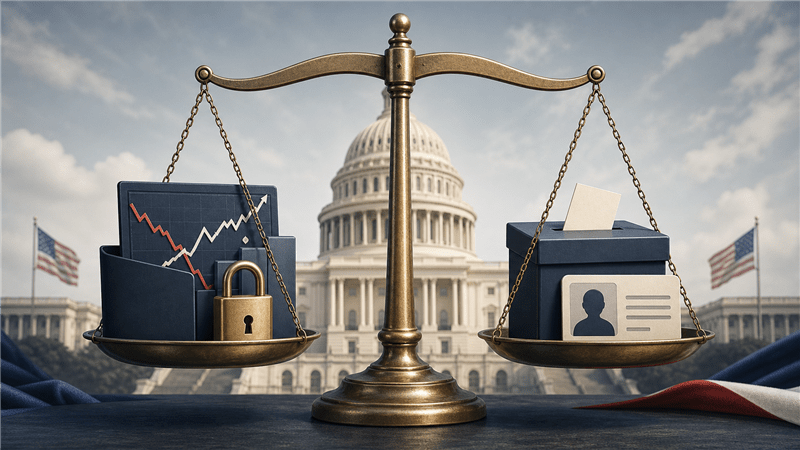
The House of Representatives passed H.R. 7008, the Stop Insider Trading Act, on July 22 by a vote of 232 to 198. The bill would restrict stock transactions by members of Congress and their families. It would also create nationwide photo-identification rules for voting in federal elections.
Supporters call the legislation a major ethics reform that would reduce opportunities for lawmakers to profit from information unavailable to the public. Critics say it is not a true stock-trading ban because lawmakers could keep and sell stocks they already own. They also object to combining congressional ethics with a contested election-law proposal.
The bill has passed only the House. It has not become law, and its prospects in the Senate remain uncertain. This discussion separates what the final House text would actually do from the political claims surrounding it.
Overview
The final House text contains two major policy changes. Section 2 governs investments held by members of Congress, their spouses and dependent children. Section 3 creates photo-ID requirements for people voting in federal elections.
On investments, covered people could no longer buy individual securities issued by publicly traded companies, including comparable interests obtained through derivatives. They could retain investments they already own and sell them after filing public notice at least seven and no more than 14 days before the sale. Diversified funds, certain trusts and small-business interests are excluded. Some transactions connected to a spouse’s or child’s occupation are also excepted.
A violation would trigger a fee of at least $2,000 or 10 percent of the transaction’s value, whichever is greater. The person would also forfeit net gains associated with the covered investment. The investment rules would take effect 180 days after enactment.
On voting, the House text would generally require an approved photo ID for in-person federal voting. A person without it could cast a provisional ballot and present identification, or a religious-objection affidavit, within three days. A mail voter could submit a copy of an approved ID, provide the last four digits of a Social Security number with an affidavit explaining unsuccessful efforts to obtain a copy, or use notarization. Certain military, overseas, elderly and disabled voters would be excepted. These rules would take effect 90 days after enactment.
The House Clerk records the measure as passed. The Associated Press reported that some Democrats joined the Republican majority, but that opposition grew after the voter-ID provision was attached.
The Case for the House Bill
Claim 1: The bill would stop lawmakers from buying individual stocks
Supporters argue that preventing new purchases attacks the most obvious route for using confidential government information for personal gain.
Fact check: Accurate, with limits. The Government Publishing Office’s final text prohibits members, spouses and dependent children from purchasing securities issued by publicly traded companies, including options and similar derivatives. It does not prohibit continued ownership or properly noticed sales of investments already held.
Claim 2: Covering spouses and children closes a major loophole
Supporters say a rule covering only lawmakers would be easy to avoid by moving transactions into a spouse’s or dependent child’s account.
Fact check: Mostly accurate. The Government Publishing Office’s final House text applies the purchase restriction and sale-notice requirement to spouses and dependent children. However, it includes exceptions for some transactions performed as part of a spouse’s or child’s primary occupation, compensation or fiduciary duties. Those exceptions may be reasonable for employment, but they mean family coverage is not absolute.
Claim 3: Advance notice would make suspicious sales visible
Supporters argue that announcing a sale before it occurs is more useful than learning about a transaction weeks later.
Fact check: Supported. The final text requires public notice seven to 14 days before a sale, including the projected date, description and number of shares. The House committee report contrasts that approach with the STOCK Act’s post-transaction disclosure system. Advance notice improves transparency, but it does not itself prove or prevent improper use of information.
Claim 4: The penalties are strong enough to matter
Supporters point to a fee based on transaction value and the surrender of gains as a meaningful deterrent.
Fact check: The penalties are substantial on paper. The Government Publishing Office text sets the fee at $2,000 or 10 percent of the transaction value, whichever is greater, plus net gain from the investment during the covered period. A prohibited purchase must also be sold. Enforcement would depend on the House or Senate ethics office identifying violations and applying those provisions consistently.
Claim 5: A purchase ban avoids forcing qualified people to sell businesses or investments
Supporters describe the bill as a compromise that reduces trading conflicts without requiring every new lawmaker and family member to restructure all their assets.
Fact check: This is a policy judgment. The bill does avoid mandatory divestment and excludes diversified funds, certain trusts and small-business interests. The Senate sponsors argue that this balance would not discourage successful private-sector professionals from serving. Critics counter that public office can reasonably require stronger conflict-of-interest rules.
Claim 6: The voter-ID section would increase confidence in elections
Supporters say nationally consistent identification rules would confirm voters are who they claim to be and could strengthen public trust.
Fact check: The bill would create national rules, but the effect on confidence is uncertain. The Government Publishing Office text requires specified photo identification and provides alternative procedures for some voters. It does not establish that impersonation fraud is common or show how much the new system would change public confidence. That claimed benefit is a prediction, not a verified result.
Claim 7: The House vote shows bipartisan demand for reform
Supporters note that the bill received votes from both parties and say Congress finally acted on a concern shared by voters across the political spectrum.
Fact check: Technically accurate but incomplete. The House Clerk confirms a 232 to 198 vote, and the Associated Press reports that some Democrats voted yes. Most Democratic opposition focused on the voter-ID section and the bill’s investment loopholes. Calling the result bipartisan is accurate, but it does not mean there was broad agreement on the final package.
Claim 8: An imperfect bill is a practical first step
Supporters argue that Congress should enact achievable restrictions now and strengthen them later rather than wait for a perfect divestment bill.
Fact check: This is a legislative strategy, not a factual conclusion. The House has advanced restrictions further than previous Congresses, and the measure would change current law. The Associated Press reports that Senate passage remains uncertain, so it is not yet clear whether this compromise is more achievable than competing proposals.
The Case Against the House Bill
Claim 1: It is not a genuine stock-trading ban
Critics say the title creates a stronger impression than the operative language because lawmakers could retain stocks and make future sales.
Fact check: Substantially accurate. The Government Publishing Office text bans new purchases but does not require divestment of existing holdings. Sales remain legal after advance notice. It is therefore more precise to call the bill a purchase restriction with sale disclosure than a complete ban on congressional stock ownership or trading.
Claim 2: Lawmakers could still profit from decisions affecting stocks they own
Critics argue that retaining an investment leaves a conflict whenever a member votes, investigates or receives information affecting that company.
Fact check: Accurate. Nothing in the House text prevents a lawmaker from voting on legislation that may affect an existing holding. A coalition of ethics organizations noted in its opposition letter that ownership alone can create a real or apparent conflict. Supporters respond that banning new purchases and disclosing sales would still reduce opportunities for abuse.
Claim 3: Advance notice does not eliminate profitable sales
Critics say a member with valuable nonpublic information could announce and complete a sale while following the disclosure rule.
Fact check: Correct about the bill’s mechanics. The Government Publishing Office text allows a compliant sale and does not automatically confiscate its profit. Profit forfeiture applies when the law is violated. Advance publication might alert the public and markets, but it would not necessarily eliminate the member’s financial benefit or resolve the underlying conflict.
Claim 4: The exceptions may preserve company-specific exposure
Critics point to excluded funds, trusts, small businesses and occupational transactions as potential routes around the policy’s purpose.
Fact check: Partly supported. The Government Publishing Office text contains each of those exclusions or exceptions. Diversified and independently controlled investments generally present less direct company-specific control than owning an individual stock. The broader concern is strongest where an excluded product closely tracks or amplifies one company’s performance, a possibility raised by the ethics coalition.
Claim 5: Congressional ethics offices would be policing their own institution
Critics question whether internal enforcement will be consistent, timely and independent.
Fact check: The institutional concern is grounded in the text. The Government Publishing Office text assigns fees and interpretive guidance to the supervising ethics offices. It authorizes referral to the Justice Department when a former member leaves before paying. It does not create a new independent enforcement agency. That does not prove ethics committees will fail, but enforcement design is a legitimate point of debate.
Claim 6: The president and vice president receive an unjustified exemption
Critics say executive officials can influence markets at least as directly as legislators and should face comparable restrictions.
Fact check: Accurate about coverage. The Government Publishing Office text defines covered individuals as members of Congress, their spouses and dependent children. It does not include the president or vice president. The Associated Press highlighted that omission while reporting that President Trump disclosed thousands of market orders earlier in 2026. Whether the bill should expand beyond Congress is a policy question.
Claim 7: The voter-ID section is an unrelated poison pill
Critics say attaching contested election rules made it harder to build a broad coalition around congressional ethics.
Fact check: The provisions address different subjects. Section 2 regulates congressional investments, while Section 3 amends federal election administration. The House Administration Committee confirms they were combined before passage. Calling the section a poison pill is political framing, but it is factually correct that the original investment bill did not require voter identification.
Claim 8: The voter-ID rules could burden eligible voters and election officials
Critics argue that copying identification for mail ballots, resolving provisional ballots quickly and training workers would create costs and could disqualify eligible citizens.
Fact check: The implementation burdens are real, while their scale is uncertain. The Government Publishing Office text requires ID procedures for in-person and mail voting and directs public access to copying equipment where practicable. It also provides affidavits, notarization and limited exceptions. The League of Women Voters letter says the bill supplies no implementation funding and offers inadequate remedies. The final text supports the claim that states would have new duties, but it cannot establish in advance how many eligible ballots would be affected.
Fact Check Summary
- “The bill bans congressional stock trading.” Misleading. The Government Publishing Office text bans new purchases but permits existing ownership and properly noticed sales.
- “Family accounts are completely exempt.” False. The Government Publishing Office text covers spouses and dependent children, though occupational and compensation exceptions apply.
- “Violators would pay only $2,000.” False. The Government Publishing Office text sets the fee at $2,000 or 10 percent of transaction value, whichever is greater, plus applicable net gains.
- “The bill applies to the president.” False. The Government Publishing Office text covers Congress and specified family members, not the president or vice president.
- “The voter-ID language is part of the final House bill.” True. The Government Publishing Office text places it in Section 3.
- “The measure is already law.” False. The House Clerk records passage only in that chamber, so Senate approval and presidential action are still required.
What Happens Next
The Senate could take up the House bill, amend it, substitute a different stock-trading proposal or take no action. An amendment would require the House and Senate to agree on identical text before a bill could go to the president.
The most important questions are therefore not only whether lawmakers should face stricter financial rules, but which transactions and officials should be covered, who should enforce the law, and whether election requirements should travel in the same legislative package.
Related Links
- Final House-passed text of H.R. 7008
- House Clerk roll-call index
- Associated Press report on passage
- House Administration Committee statement
- Congressional Budget Office estimate
- Ethics coalition opposition letter
- Voting-rights coalition letter
Discussion Questions
- What does the bill prohibit?
- Which exception seems most important?
- Is advance notice enough for sales?
- Should lawmakers keep existing stocks?
- Who should enforce these restrictions?
- Why was voter ID added?
- Should the two policies be separated?
- Have financial conflicts affected your trust?
- What broader reform would help most?
- Imagine you are a senator. What change would you propose?
