
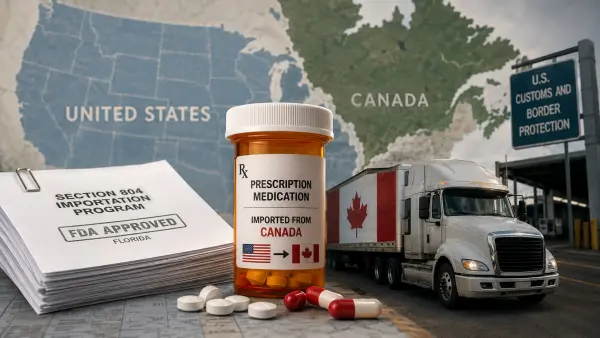
In brief: KFF’s Health Tracking Poll has found majority support in both parties for letting Americans buy prescription drugs imported from Canada in every wave it has run since 2019, most recently in 2025. The federal legal pathway to do this at scale has existed since 2020. Only one state, Florida, has FDA approval to use it, and after two years of extensions, it still has not shipped a single drug.
The Question
The policy is narrower than “lower drug prices.” It is a specific legal mechanism, a Section 804 Importation Program, that lets a state import specific FDA-approved, Health Canada-approved drugs in bulk from a licensed Canadian wholesaler, under a plan the FDA must certify will not endanger safety. It does not touch drug prices generally, does not apply to controlled substances, and does not let individuals order drugs directly from a Canadian pharmacy online, a related but separate and more loosely enforced practice.
Where Majorities Agree
KFF’s Health Tracking Poll has asked about Canadian drug importation repeatedly since 2019 and found bipartisan majority support every time. A poll conducted in April 2025 found 72 percent overall support for importation from Canada, with majorities of Democrats, Republicans, and independents in favor. A separate KFF wave later in 2025 put support at 80 percent, again with majorities across all three groups, though neither release broke out the exact percentage for each party in the portion PoliTalking could access.
Both of the qualifying figures above come from the same organization, KFF. PoliTalking could not locate a second, differently sourced poll published in the past 24 months with its own published party breakdown, which is the main gap in the evidence here. The finding is not new or fringe: a 2019 KFF wave found 75 percent of Democrats, 82 percent of independents, and 75 percent of Republicans in favor, and a peer-reviewed 2019 article cites this as one of the few issues Republicans and Democrats consistently agree on. But a single organization’s tracking poll, however consistent over time, is not the same as independent confirmation, and this piece is naming that limitation rather than glossing over it.
Figures current as of September 4, 2026.
Where Agreement Breaks Down
Public support for the concept has not translated into use of the legal pathway that exists. Florida is the only state with an approved plan, granted in January 2024 after a multi-year application process. The FDA has extended its authorization three times, most recently through May 6, 2026, and as of this writing no shipment has actually arrived. Florida has spent tens of millions of dollars on warehouse and logistics infrastructure, including one facility toured empty by Gov. Ron DeSantis years before any drug moved through it, and state lawmakers are weighing spending several million dollars more in 2026 just to keep that infrastructure in place while shipments remain stalled.
Colorado, Maine, New Hampshire, and New Mexico have submitted their own import plans and are waiting on FDA review. None has been approved. The gap between “the public wants this” and “this is happening” is not primarily a polling gap or a partisan one; it is an implementation gap, driven by manufacturer resistance to the supply chain the law requires and by Canada’s own restrictions on what it will let leave the country.
The exact mechanism also matters to respondents, not just the general idea. The same 2025 KFF poll found lower support, 64 percent, for buying through online Canadian pharmacies directly than for the state-run bulk program, 72 percent, suggesting some of the bipartisan agreement rests on the state acting as a safety intermediary rather than on individuals ordering on their own.
Who Opposes It and Why
KFF’s own research page names the two organized opponents directly: the Pharmaceutical Research and Manufacturers of America, the industry’s main trade group, and the government of Canada. PhRMA’s case is about safety and supply chain integrity, arguing that once a drug leaves a manufacturer’s controlled distribution chain, verifying it has not been counterfeited, mishandled, or diverted becomes much harder, and that importation undermines the incentives that fund new drug research.
Canada’s objection is different and, unlike a trade association’s, is not obviously self-interested: its government has said publicly that its market is a fraction of the size of the United States’ and cannot absorb American demand without creating shortages for Canadians, and it issued an order in 2020 restricting exports of any drug already in short supply domestically. This is a case where the opposing argument does not reduce to industry profit motive, and treating it as if it did would understate a real constraint.
Why It Hasn’t Happened
The legal pathway is old. Congress authorized bulk importation from Canada in a 2003 law, contingent on the Health and Human Services secretary certifying it was safe, a certification no secretary made for 17 years. The Trump administration issued the implementing rule in 2020; the Biden administration approved Florida’s plan in January 2024 and extended the FDA’s own guidance in 2025 to speed up review of the other four pending state applications. Neither the underlying 2003 law nor the 2020 rule required a fresh act of Congress, which is why this has moved through agencies and state governments rather than through a floor vote.
The politics have also been oddly bipartisan in a way that has occasionally made credit-claiming, not opposition, the live question. Florida’s plan was proposed under a Republican governor, approved by a Democratic administration in Washington, and later sped along by a second Trump administration’s own directive on drug pricing. Each side has had reason to take ownership of the idea rather than block it, which is unusual and is part of why this piece treats it as a live proposal rather than a dead one, even without a recent vote to point to.
A broader bill, the bipartisan Safe and Affordable Drugs from Canada Act, sponsored by Sen. Amy Klobuchar and Sen. Chuck Grassley, would go further by opening the pathway to individuals and pharmacies directly rather than routing everything through a state’s own import plan. It remains in committee. Until either that bill moves or Florida’s program actually ships a drug, this is a case where the obstacle is not a stalled vote but a stalled supply chain.
Comparative Reference
The European Union has run an equivalent system, called parallel trade, for decades. Because EU member states set their own drug prices independently while allowing free movement of goods across borders, traders legally buy medicine in a lower-priced country and resell it in a higher-priced one; the trade was estimated at 5.5 billion euros in 2012 alone. It works, in the narrow sense that it has operated continuously without collapsing the market. It has not produced the dramatic price convergence advocates originally predicted, and it has been blamed for shortages in some lower-priced exporting countries, the same concern Canada raises about the American proposal.
What does not transfer is the shape of the trade. The EU’s parallel trade runs in many directions among roughly 30 economies of varying size, each able to adjust its own pricing rules in response. The proposed U.S.-Canada arrangement is one very large economy drawing on one much smaller neighbor, which is a structurally different kind of pressure and a large part of why Canada’s shortage concerns are sharper than any single EU member state’s.
Related Links
- KFF Health Tracking Poll, April 2025
- KFF FAQ on prescription drug importation
- Florida’s stalled import program, local coverage
- Safe and Affordable Drugs from Canada Act of 2025
- CEPR analysis of EU pharmaceutical parallel trade
Discussion Questions
- Did you know the legal pathway for this has existed since 2020?
- Does it change your view that both qualifying survey figures come from one organization?
- Is Canada’s shortage concern a legitimate limit on the policy, or a problem the U.S. should work around?
- Should the program open to individuals and pharmacies directly, as the pending Senate bill proposes, rather than routing through states?
- Why do you think a popular, already-legal policy has produced zero actual shipments in two years?
- Is PhRMA’s safety argument about counterfeiting a genuine concern or a defense of pricing power?
- Does the EU’s decades-long experience with parallel trade make you more or less confident this would work here?
- Should Florida keep funding empty warehouse infrastructure while the program remains stalled?
- What would it take for you to trust an imported drug’s safety as much as one bought domestically?
- Imagine you run a state health agency deciding whether to apply for your own import plan. What would you need to see first?
