
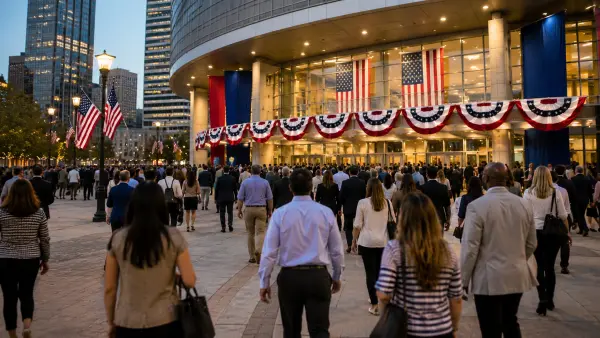
Republicans will hold the first midterm-year national convention in the party’s history on September 9 and 10, a two-day rally at the American Airlines Center in Dallas built around campaign messaging rather than the nominations and platform votes of a traditional convention. Vice President JD Vance is scheduled to give the opening night keynote, and President Trump is set to appear both evenings, closing the event with his own address on night two. The gathering is meant to energize Republican voters ahead of a midterm election that could decide control of both chambers of Congress. It has instead exposed friction inside the party, with dozens of Republican candidates and several state party leaders keeping their distance even as the Trump administration promotes it as a historic showcase.
Background
The Republican National Committee changed its rules at its January 2026 winter meeting to allow a midterm-year convention for the first time in the party’s history. Traditionally, national conventions exist so delegates can formally nominate a presidential candidate and adopt a party platform, a process that shapes months of state-level conventions and credentialing fights beforehand. Under the new rules, the gathering must be called at least 60 days in advance and cannot include the nominating votes or platform business of a traditional convention, so this week’s event runs as two evening sessions built entirely around speeches, candidate showcases and fundraising.
The idea came directly from Trump, who said it would let Republicans “show the great things we have done,” a pitch he first floated last year that the RNC then built into its official rules. Dallas won the host slot after Texas Attorney General and Republican Senate nominee Ken Paxton announced the city’s bid in June, and Trump later confirmed the September dates. The choice was notable because Dallas, unlike its more Republican-friendly neighbor Fort Worth, has voted Democratic in recent elections. Organizers instead pointed to the city’s larger media market and a well-funded local host committee, betting that visibility would matter more than home-turf comfort.
The convention is being paid for largely through private fundraising, with a local host committee co-chair estimating the total cost could reach as much as $40 million. Dallas is separately expecting to spend roughly $1.8 million on police security, a cost the city is still negotiating to have reimbursed rather than absorb outright. That negotiation echoes the last Republican convention Dallas hosted, in 1984, when a similarly “privately financed” event still left the city covering an estimated $1 million to $1.5 million in costs it had been told private money would cover.
For House Republicans, attending comes with its own price tag. Members are expected to contribute at least a $25,000 registration fee that reportedly covers only two tickets and a single hotel room. Vance is scheduled to headline the first night, while Trump appears on both evenings and closes the convention on night two. Both nights also overlap with the first two nights of the NFL season, a scheduling collision several political observers have called an odd choice for a party trying to maximize its television audience rather than compete with it.
Even in the host state, the friction is visible before the event has begun. The Republican Party of Texas cut the price of its premium packages this summer after members raised concerns about cost and access, according to party chair D’rinda Randall. The episode is a small but telling sign that enthusiasm for the gathering cannot be assumed even among Texas Republicans, let alone the wider party.
What Different Sides Are Saying
The RNC and the Trump administration have framed the event as a showcase of what the party calls the Common Sense Revolution, built around lower costs, border security and safer communities, in contrast with what a Republican National Committee statement called Democrats’ “failed agenda of higher costs, open borders, obstruction and radical policies.” RNC Chairman Joe Gruters has separately described the gathering as unlike any convention the country has seen, a framing meant to generate earned media regardless of how the two nights actually go.
Fact-check: the claim that Republicans are “lowering costs” is more complicated than the framing suggests. Annual inflation was 3.4 percent for the twelve months ending in July, according to Bureau of Labor Statistics data, essentially unchanged from June and down from higher readings earlier this year tied to the energy shock that followed the outbreak of the US-Iran war. That means prices are still rising for most goods, just more slowly than in the spring. This is a real but limited improvement, and it cuts against both that framing and the unqualified claim that Americans are being crushed by rising costs, a Democratic talking point addressed below; neither side’s shorthand fully matches what the data shows.
Republican candidates and state party leaders are not uniformly enthusiastic. A Politico survey of more than 70 Republican candidates and party officials found that at least 45 were either skipping the convention or still undecided about attending, citing the registration fee, competing campaign schedules and a wish to keep some distance from a president whose approval ratings remain low heading into November. Reps. Zach Nunn of Iowa, Tom Barrett of Michigan and David Valadao of California, all running in competitive districts, have said they plan to spend the days in their districts instead. House Speaker Mike Johnson has said he is promoting the convention “everywhere” and expects solid attendance, though he has acknowledged that many members will want to stay home because early voting is approaching in some states. State party leaders in several states have also voiced frustration over the timing, cost and short planning window for the event, separate from the specific decision by any one candidate to attend or skip it.
Fact-check: the figure of 45 comes from a media survey, not an RNC-confirmed count of no-shows, and most of those counted told Politico they were undecided rather than confirmed absentees. RNC press secretary Natalie Baldassarre has disputed the framing, saying outreach and enthusiasm to attend has been strong, and a Texas Republican strategist noted that Trump remains a reliable draw for major donors regardless of how many vulnerable candidates stay home. Both things can be true at once: strong donor interest and reluctance among candidates in competitive districts are not mutually exclusive.
Democrats have made the convention itself a target rather than waiting for its substance. House Democratic Leader Hakeem Jeffries described attendees as out of touch, saying Republicans are “partying with their super-rich donors in Dallas” while costs remain a burden for ordinary Americans. He also tied the convention to broader Democratic arguments that Republican policy has cut Medicaid funding to pay for tax breaks and that the administration pursued an unnecessary war with Iran, both separate and contested claims this piece does not evaluate here.
House Democratic leadership is sending a four-member delegation, including Reps. Robert Garcia of California, Jason Crow of Colorado, Madeleine Dean of Pennsylvania and Sydney Kamlager-Dove of California, to Dallas for counterprogramming events organized with the Texas Democratic Party. Crow wrote on social media that Republicans are “celebrating an out of touch President whose tariffs and wars are making things worse.” The delegation’s stated goal is to keep the spotlight on Republicans in competitive districts even while those members are, in many cases, choosing not to be in Dallas at all.
Fact-check: describing convention attendees in extreme terms or accusing them of ignoring the cost of living is opinion and rhetorical framing, not a checkable factual claim. The underlying detail that the event is financed largely through a wealthy private host committee is accurate and consistent with the reporting on the convention’s budget described above.
Note on Scope
This piece reflects reporting as of September 4 and 5, 2026, several days before the convention begins. Final attendance figures, the exact list of speakers and any additional programming could change before or during the event on September 9 and 10. The broader Democratic claims about Medicaid funding, tariffs and the war with Iran raised in connection with the convention involve separate policy disputes with their own evidence and are not fact-checked in full here.
Related Links
- President Trump to Headline 2026 Republican Midterm Convention – GOP.com
- Republican Midterm Convention schedule: Trump, Vance and what happens each night – FOX 4 Dallas-Fort Worth
- Republican state party leaders grumble about the timing, cost and planning of Trump’s midterm convention – NBC News
- Republicans’ midterm convention in Dallas is anything but conventional. Why is it happening? – Houston Public Media
- Some vulnerable Hill Republicans ditch Trump’s midterm convention – MS NOW
- Some Republicans are planning to skip Trump’s GOP convention – The Hill
- 4 House Democrats heading to Dallas for RNC counterprogramming – The Hill
Discussion Questions
- Have you ever watched a political party convention? What stood out to you?
- Do you think Republicans skipping the convention reflects real distancing from Trump, or mostly scheduling conflicts?
- Do you find the RNC’s optimism or the skeptical Republicans’ caution more convincing?
- What matters more to you when judging cost-of-living claims: the inflation data, or how each side frames it?
- Why do you think Republicans chose Dallas over the more GOP-friendly Fort Worth?
- Should political parties spend tens of millions of dollars on events like this?
- How should voters weigh a candidate who skips their own party’s convention?
- What responsibility does a host city have when it was never promised full reimbursement?
- Is it fair for Democrats to campaign against a convention before it has even happened?
- Imagine you are a Republican candidate in a competitive district. Would you attend the convention, and why?
