
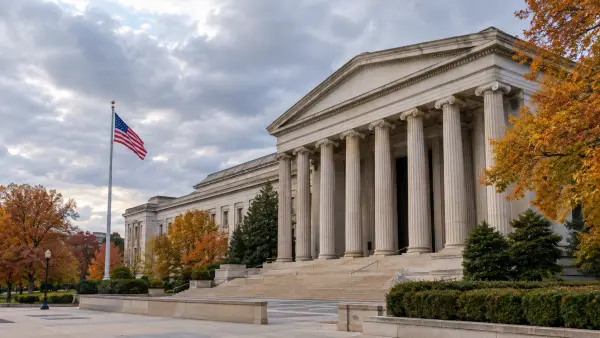
Smithsonian Secretary Lonnie Bunch III announced on September 8, 2026 that he will step down by the end of the year, ending a seven year tenure atop the Smithsonian Institution.
Bunch, the 14th Secretary of the Smithsonian and the first African American and first historian to hold the post, confirmed his resignation in a statement, saying “I have fought for as long as I can. I love this country and I love the Smithsonian and I will always work to defend our more perfect Union.” The Smithsonian’s Board of Regents, chaired by Franklin D. Raines, said it will name an acting secretary while conducting a national search for Bunch’s successor.
In an interview with The New York Times, Bunch said pressure from the Trump administration did not cause his departure, describing the timing instead as simply “now’s the time.” He plans to remain in the role through the end of 2026.
Background
Bunch’s departure follows months of escalating criticism of the Smithsonian from the Trump administration, which has accused the institution’s leadership of presenting what it calls a “radical view” of American history and has threatened to withhold federal funding. In July 2026, the administration issued a report accusing the Smithsonian’s National Museum of American History of “extreme political activism.” Anthea Hartig, director of that museum, testified before a House subcommittee that the museum does not take sides in political debates and follows standard scholarly practice.
The pressure campaign traces back further: in August 2025, Trump publicly called for changes to how the Smithsonian portrays the country’s past, framing it as insufficiently focused on American achievement. Before becoming secretary in 2019, Bunch spent nearly four decades at the Smithsonian, including as founding director of the National Museum of African American History and Culture, which opened on the National Mall in 2016.
What Different Sides Are Saying
The Trump administration has framed its criticism as a correction of what it describes as a politicized and one-sided presentation of history at Smithsonian museums. This is a characterization, not an independently verifiable factual claim, and should be read as the administration’s stated position rather than an established finding.
Smithsonian leadership and museum staff maintain that the institution operates under standard nonpartisan scholarly practice. Hartig’s congressional testimony to that effect is a verifiable fact of record; whether the underlying exhibits are in fact one-sided is a contested judgment call this brief does not resolve.
Historians’ organizations, including the Organization of American Historians, publicly rejected the administration’s July report, characterizing it as an attempt to promote what they called a simplified version of American history. This is the organization’s stated opinion and is presented as such.
Note on scope: Bunch’s own statement that administration pressure “played no role” in his decision cannot be independently verified. Reporting from multiple outlets treats the resignation as occurring in the context of that pressure without claiming it was the sole or direct cause. Readers should treat causation here as unresolved.
Related Links
- ABC News: Smithsonian Secretary Lonnie Bunch resigns amid attacks from Trump administration
- NBC News: Smithsonian Secretary Lonnie Bunch is leaving amid tensions with Trump
- Washington Post: Smithsonian chief Bunch retiring as Trump fights to reshape institution
- NPR: Smithsonian chief Lonnie G. Bunch III resigns
- Deadline: Lonnie Bunch Says He Will Resign As Secretary Of The Smithsonian
Discussion Questions
- Should museums funded partly by federal money be shielded from political pressure over content?
- Do you think Bunch’s stated reason for leaving is the full story?
- How should a national museum decide what counts as a balanced portrayal of history?
- Is it appropriate for an administration to link funding to how history is presented?
- What responsibility do museums have to historians versus to the general public?
- Have you visited a Smithsonian museum? What was your impression of its approach to history?
- Why do disputes over how history is taught or displayed provoke such strong reactions?
- Should the Smithsonian’s leadership be more insulated from changes in presidential administrations?
- What would “radical” history versus “accurate” history mean to you in this context?
- Imagine you are the next Smithsonian Secretary. How would you handle political pressure over exhibit content?
