
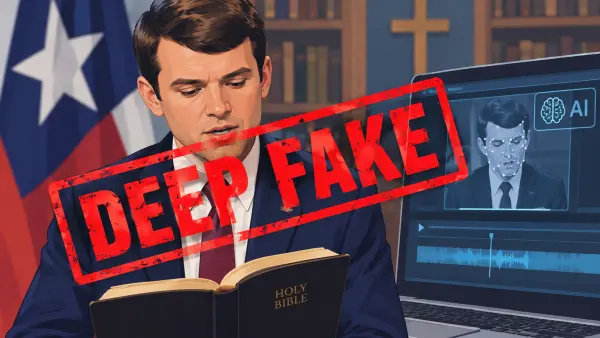
Texas Attorney General Ken Paxton’s Senate campaign released an AI-generated attack ad on September 8, 2026 depicting a synthetic version of Democratic opponent James Talarico reading fabricated Bible passages, drawing sharp criticism from Talarico’s campaign.
The ad, timed to coincide with the Republican midterm convention in Dallas, shows an AI-generated Talarico appearing to read invented scripture passages, an apparent attempt to target his background as a former seminary student. A small disclosure at the end of similar Paxton campaign ads has previously stated that certain video content was AI-generated. Talarico campaign spokesperson JT Ennis said Paxton and his backers “are using AI deepfake videos to literally put words in James’s mouth because they can’t rely on facts to win this race.”
For background on the candidates and district context, see PoliTalking’s Texas Senate 2026 Race Profile: Paxton vs. Talarico.
Background
This is not an isolated incident. The National Republican Senatorial Committee released an ad in March showing an AI-generated Talarico reading his own real social media posts while adding invented reactions such as “So true.” In June, the PAC Citizens for Sanity released a 15-second AI deepfake of a fabricated Talarico singing about gender-related medical care for minors. In August, the American Principles Project PAC released a reworked version of the 1964 “Daisy” ad depicting an AI version of Talarico as a doctor performing a medical procedure on a young girl, part of a reported $10 million ad campaign. Lt. Gov. Dan Patrick also released his own AI-generated attack ad over the Labor Day weekend targeting Texas Democrats.
Texas has one of the country’s strictest state laws on political deepfakes, but the disclosure requirement only applies within the 30 days immediately before an election, meaning most of these ads currently fall outside its reach. Talarico has polled narrowly ahead in a state that has not elected a Democrat to the Senate since 1988.
What Different Sides Are Saying
Paxton’s campaign has not disputed that the ads use AI-generated depictions of Talarico, and has framed the content as commentary on his real public statements and positions. Whether the ads accurately represent Talarico’s actual views is a separate, contested question; his campaign disputes several of the underlying characterizations, including claims about his position on gender-related medical care for minors.
Talarico’s campaign calls the ads deliberate distortions designed to mislead voters, and notes that AI-disclosure text in these ads has been small and easy to miss. This is the campaign’s characterization and has not been independently measured for legibility.
AI and election researchers cited in reporting note that the technical quality of these deepfakes has increased sharply within the current cycle, and flag the gap in Texas’s disclosure law as a policy concern. This reflects expert observation rather than a settled legal finding, since the law’s 30-day window has not yet been directly tested against these specific ads in court.
Note on scope: The claim that Talarico supports “gender-transition surgery for minors,” made in the June ad, is disputed by his campaign and cannot be independently verified from the sourcing reviewed here. This is flagged as a contested claim rather than a resolved fact.
Related Links
- San Antonio Current: Texas Republicans rely on AI slop to attack Democratic rivals
- Newsweek: Talarico’s Chances Against Paxton After Latest AI Attack Ad
- CNN: Republicans release AI deepfake of James Talarico as phony videos proliferate
- PolitiFact: AI ads skewed Talarico’s words and positions
- Christian Post: PAC supporting Paxton reimagines Cold War-era LBJ ad
Discussion Questions
- Have you ever seen a political ad you later learned was AI-generated?
- Do you think a small on-screen disclosure is enough to inform voters an ad is fake?
- Does using real statements to build a fabricated video cross an ethical line for you?
- Should disclosure laws for AI in political ads apply year-round rather than only near an election?
- How should voters verify whether a political video is genuine?
- Why might campaigns increasingly turn to AI-generated attack ads?
- Do you find the Paxton campaign’s or the Talarico campaign’s framing of this dispute more persuasive?
- What role should platforms like X or YouTube play in labeling AI-generated political content?
- Could AI deepfakes affect how much people trust legitimate campaign footage?
- Imagine you are a state legislator. How would you write a law to regulate AI in campaign ads?
