
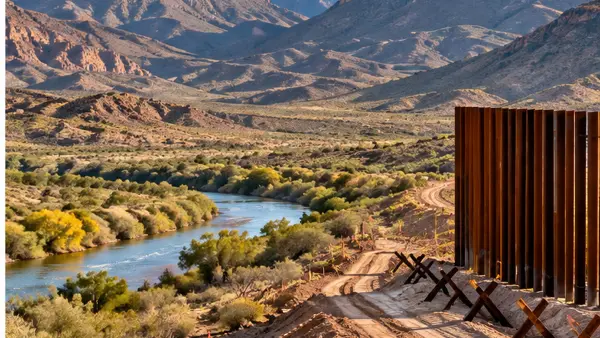
A federal judge has temporarily blocked the Trump administration from building additional border barriers, roads and related infrastructure across the Big Bend region of West Texas, including areas within Big Bend National Park.
U.S. District Judge Kathleen Cardone issued the preliminary injunction on October 2 after conservation groups and local residents challenged the federal government’s decision to waive environmental and other laws to accelerate construction.
The ruling is a setback for the administration’s border infrastructure program, but the case has also drawn opposition from people who otherwise support stronger border enforcement, including prominent Texas Republicans.
Background
Big Bend National Park occupies a remote stretch of the Texas-Mexico border along the Rio Grande. The area is known for its desert mountains, river canyons, wildlife habitats and historical sites.
The region also presents unusual challenges for border enforcement. Its rugged terrain and limited road access make travel difficult, and significant portions of the border are far from populated areas.
The Trump administration has made expanding physical border infrastructure a central immigration-enforcement priority. Congress has authorized substantial funding for border barriers, supporting roads, surveillance equipment and related construction.
In the Big Bend region, plans have included vehicle barriers, access roads and surveillance infrastructure rather than only the tall pedestrian barriers commonly associated with border wall construction.
The Department of Homeland Security used special statutory authority to waive numerous legal requirements that otherwise could delay construction, including environmental and historic-preservation protections.
That waiver authority is at the heart of the legal dispute.
What the Court Decided
The lawsuit was brought by the Center for Biological Diversity, Friends of the Ruidosa Church and local landowner and river guide Danny William Miller.
The plaintiffs argue that the administration exceeded its constitutional authority by using broad statutory waivers to bypass laws intended to protect federal lands, historical resources and private property.
During an October 2 hearing in El Paso, Judge Cardone concluded that the plaintiffs had demonstrated a sufficient likelihood of success on at least part of their legal challenge and faced potentially irreparable harm if work continued.
The court granted a preliminary injunction barring further ground-disturbing construction activities in the affected Big Bend area while the lawsuit proceeds.
The order means the government cannot simply restart the challenged construction under the existing circumstances. It does not permanently prohibit all border infrastructure in the region.
What Different Sides Are Saying
The Administration: Border Security and Congressional Authority
The Department of Homeland Security maintains that it has legal authority to construct border infrastructure and use statutory waivers to speed projects considered necessary for national security.
The administration argues that barriers, roads and surveillance systems help Border Patrol agents detect crossings, reach remote areas and respond to illegal activity.
Customs and Border Protection has defended the project and indicated that it is working with the Justice Department in response to the litigation.
Fact-check: Federal law does provide the government with unusually broad authority to waive certain legal requirements for border barrier construction. The existence of waiver authority, however, does not automatically resolve whether its exercise is constitutional or lawful in every situation. That is among the questions being litigated.
Supporters of border infrastructure also argue that enforcement effectiveness depends on having access to difficult terrain, even where a continuous wall may not be practical.
Fact-check: Physical barriers can impede or redirect unauthorized crossings, but their effectiveness varies with geography, design, surveillance and staffing. This lawsuit does not establish whether the particular Big Bend projects would materially improve border security.
Environmental and Local Opponents: An Irreplaceable Landscape
The Center for Biological Diversity argues that construction threatens sensitive desert and river ecosystems, damages protected public lands and creates lasting changes to one of the country’s most distinctive national parks.
Local opponents also raise concerns about tourism, recreation, private property and historic sites, including the Ruidosa Church area.
The plaintiffs contend that Congress never intended the government’s border waiver authority to override protections so extensively, particularly within a national park.
Fact-check: The injunction is a preliminary ruling. The judge found sufficient grounds to block construction while litigation continues, but the decision is not a final determination that every challenged waiver or project is unlawful.
Opponents also question whether extensive barriers are necessary in this particular location. They argue that the Rio Grande, steep canyons and isolated terrain already create substantial obstacles to unauthorized crossings.
Fact-check: Natural obstacles can make border crossings more difficult, but difficult terrain does not make unauthorized crossings impossible. Whether barriers would provide enough additional enforcement value to justify their financial and environmental costs is a separate question requiring location-specific evidence.
Bipartisan Resistance
The controversy has not followed a simple Republican-versus-Democrat pattern.
Republican Senator John Cornyn of Texas has expressed concerns about constructing barriers in Big Bend, emphasizing the region’s natural defenses and distinctive landscape. Local residents and business owners with differing political views have also opposed the construction plans.
That makes the conflict unusual: some people who favor stronger border security argue that Big Bend requires a different approach from more accessible or heavily trafficked parts of the border.
What Happened Before the Injunction?
The administration had already paused some construction activity in August following public criticism and legal pressure.
That pause did not resolve the underlying dispute. Conservation organizations argued that construction could resume and that work already completed had caused damage.
The plaintiffs sought judicial protection that would remain in effect while their lawsuit proceeded.
The October 2 ruling gives them that protection, subject to further court action.
The Larger Legal Question
At the center of the case is the relationship between congressional authority, executive power and environmental protections.
Congress has authorized border barrier construction and provided special waiver powers. But the Constitution also establishes limits on the exercise and delegation of governmental authority.
The plaintiffs contend that the government’s use of those powers goes beyond permissible limits. The administration maintains that its actions fall within authority granted by federal law.
The dispute could eventually help clarify how courts evaluate executive decisions to waive legal protections for border infrastructure.
What Happens Next?
The preliminary injunction remains in place while the underlying lawsuit proceeds, unless it is modified or overturned.
The administration can pursue further legal challenges to the order. It could also reconsider project designs, locations or legal procedures, although the practical consequences of those alternatives remain uncertain.
The case may have implications beyond Big Bend because the federal government is pursuing additional border infrastructure projects in other environmentally sensitive areas.
Note on Scope
The court has temporarily blocked construction in the affected area. It has not issued a final ruling on the constitutionality of all border barrier waivers, nor has it prohibited the administration from pursuing border enforcement through other methods.
This article does not attempt to determine independently whether the proposed Big Bend infrastructure would prevent enough unauthorized crossings to justify its costs. Publicly available reporting provides extensive detail about the legal and environmental objections but less independently verified evidence about the projected security benefits of these specific projects.
Related Links
- Reuters: Judge Blocks Big Bend Construction
- Associated Press: Big Bend Court Ruling
- Texas Tribune: Big Bend Injunction
- Center for Biological Diversity: Plaintiff Response
- The Guardian: Border Construction Halted
- Background: Expanded Big Bend Lawsuit
Discussion Questions
- Should national parks receive special protection from border infrastructure construction?
- When should national security priorities override environmental laws?
- How much authority should Congress be allowed to delegate to executive agencies?
- What factors should determine whether a particular section of the border needs a physical barrier?
- Should the federal government be required to demonstrate that proposed barriers will be effective before construction begins?
- How should local residents and businesses influence decisions about border infrastructure?
- Does bipartisan opposition to a project necessarily make that opposition more persuasive?
- Could surveillance and increased personnel be effective alternatives to physical barriers in remote areas?
- What role should federal judges play when infrastructure projects may cause irreversible environmental damage?
- How should policymakers balance immigration enforcement, environmental protection, private property rights and public access to national parks?
