
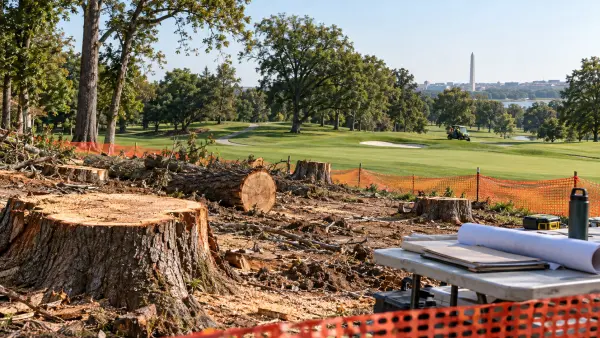
A federal judge has blocked further tree cutting at East Potomac Golf Links in Washington after National Park Service crews felled at least 430 trees over the October 10 weekend. U.S. District Judge Ana Reyes first ordered a 24-hour halt on October 12, then extended it through 2 p.m. Tuesday so she could hear from an Interior Department official. The government says the work followed an earlier tree-management plan; the plaintiffs say it was done without the notice the court had demanded.
This article reflects reporting available as of the morning of October 13, US Eastern time, before Tuesday’s hearing.
Background
East Potomac Golf Links is a century-old public course on federal parkland managed by the National Park Service. The Interior Department ended a lease with the nonprofit that ran it in December, and President Trump wants to redevelop the course. A February lawsuit argues the overhaul would violate the 1897 act that created the park.
The plaintiffs are the D.C. Preservation League and two golfers. They also argue that splitting the work into smaller projects evades the National Environmental Policy Act. At a May hearing, Reyes told the government, “I didn’t want 10 trees chopped down without someone having notice,” ABC News reported. Government lawyers told plaintiffs at 4:55 p.m. on Friday that cutting would take place over the holiday weekend, and the Preservation League sought a restraining order on Sunday.
Tree counts differ. Government lawyers acknowledged 430 trees cut. An official’s declaration had estimated 529 would be removed in total, and the Preservation League says all 529 came down on Saturday, CBS News reported. The number of trees still flagged also varies, from about 99 to about 300 depending on the account. This article could not reconcile these figures.
What the Judge Ordered
Reyes issued a temporary restraining order on October 12 and extended it through 2 p.m. Tuesday to allow testimony from Greg Wischer, the Interior Department’s deputy chief of staff. AP reported that about 300 more trees remain flagged and that she could extend the order up to 14 days. She also plans to require three days’ notice of any future activity at the course, and she ordered Park Service officials, including Deputy Director Frank Lands, to testify. AP reported that Lands said Wischer pushed for the work to be done urgently.
Fact-check: A temporary restraining order preserves the status quo. It is not a ruling that the renovation or the tree removal was unlawful, and the court has not decided the plaintiffs’ legal claims.
What Different Sides Are Saying
The government: Government witnesses testified that the cutting was part of a 2019 plan to remove dead, dying and hazardous trees. Separately, the Interior Department has said the work is meant to restore the course’s historic character and reopen views of nearby landmarks, and the Park Service had said more than 500 trees did not contribute to the historic landscape.
Fact-check: A hazard-removal rationale and a landscape-restoration rationale are different justifications, and the reporting does not show how much of the cutting fell under each. Wischer has not yet testified, and this article could not locate a public statement from him or from Interior addressing the weekend timing.
The plaintiffs: The Preservation League and the golfers say the cutting was irreversible, was done without the notice the court had required, and is part of a plan that should have been reviewed as a whole.
Fact-check: The environmental-review claim is an allegation that has not been decided. News reports establish that many trees were removed; they do not supply a completed environmental or historic-preservation assessment of the effects.
The court: Reyes said the government had lost credibility with her and questioned whether she had been misled. She also said she has not begun contempt proceedings only because her earlier warnings were never put in a formal order, according to ABC News.
Fact-check: A judge’s sharp criticism and a warning about contempt are not a contempt finding. No finding on whether anyone deliberately evaded the court’s directions has been reported.
Why This Is More Than a Golf-Course Dispute
The case tests how much notice a court can require before an agency carries out physical work that cannot easily be undone. Some residents want upgrades to a public facility, while others prioritize affordability, historic character, shade and the existing trees.
Note on Scope
This article does not cover the outcome of Tuesday’s hearing or any ruling after it. The restraining order is temporary, and the course renovation has not been permanently stopped. Tree counts and the number of trees still flagged for removal vary by source and remain unresolved.
Related Links
- AP: Judge Orders Halt for a Day
- CBS News: Judge Chastises Justice Department Lawyers
- ABC News: Judge Explodes at Government Lawyers
- Reuters via Virginia Lawyers Weekly: Judge Blasts DOJ
- WTOP: Judge Extends Pause on Tree Cutting
- WJLA: Judge Temporarily Halts Tree Cutting
- Fortune: Lawsuit Over East Potomac Overhaul
Discussion Questions
- Have you ever visited a public park or course that was changed or renovated? How did you feel about it?
- When should a federal agency be required to give notice before work on public land?
- How should courts respond when work changes a landscape before a case is decided?
- Do you find the hazard-removal explanation or the historic-restoration explanation more convincing, or neither?
- How much should historical significance influence decisions about a recreational facility?
- Is replanting an adequate remedy for removing mature trees?
- Why do disputes over public land so often end up in court?
- What responsibilities do government lawyers have when a court asks for advance notice?
- What information about this project is still missing?
- Imagine you are the judge. What would you require from the government before any more work begins, and why?