
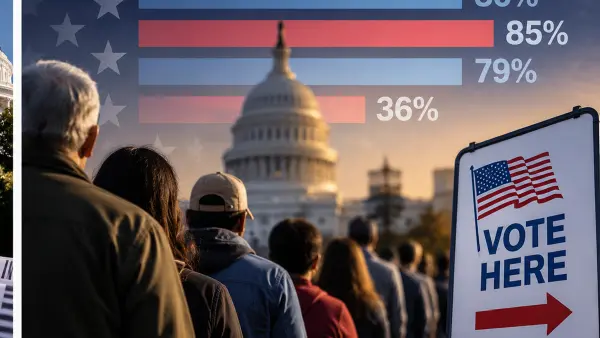
About eight in ten American voters say the country needs substantial change or complete upheaval in how it is governed, according to a new AP-NORC poll released October 15. The economy and cost of living top voters’ priorities, and more voters prefer Democratic control of Congress than Republican control. Neither major party is viewed favorably by most respondents. The midterm elections are on November 3.
The AP-NORC survey of 1,119 adults was conducted October 8 to 12 on NORC’s probability-based AmeriSpeak panel, online and by telephone. It asked about political priorities, views of government and preferences for the congressional elections.
About 80% of voters chose substantial change or complete upheaval. In its summary of the poll, Axios reported that 47% wanted substantial change, 33% wanted complete upheaval and 17% wanted small change.
The economy (85%) and cost of living (84%) led the list of election concerns, followed by health care (69%) and the war with Iran (64%). Immigration and crime were each cited by 45%, artificial intelligence by 35% and transgender issues by 12%. Respondents could name more than one priority, so these figures do not add up to 100%.
Only 36% of voters approved of President Donald Trump’s job performance, and 64% disapproved. Disapproval reached 74% on the economy and 79% on the cost of living.
For Democratic control of the House, 47% of voters said they preferred it, compared with 38% for Republican control. For the Senate, the figures were 46% and 38%. About 15% were unsure.
Background
Midterm elections, held halfway through a president’s four-year term, decide all 435 House seats and about one-third of the Senate. They also let voters signal approval or disapproval of the president, even though the presidency is not on the ballot. The 2026 campaign is unfolding amid concern about household expenses, the economy and the war with Iran.
The poll suggests the dissatisfaction goes beyond individual policies. About two-thirds of voters were pessimistic about the state of American politics, and only about one in ten was optimistic. About half were pessimistic about the future of democracy and of each major party. Favorable views of the Republican Party stood at about 36%, and the Democratic Party was rated favorably by about four in ten.
What Different Sides Are Saying
Democrats see an opening. They argue that frustration with the economy and the administration gives them a chance to win control of Congress, and their emphasis on affordability and health care matches two of the poll’s top three issues. Fact-check: The 47% to 38% House edge measures stated preference, not votes. The party itself is rated favorably by only about four in ten, and Axios reported that 47% of respondents were pessimistic about its future, against 21% who were optimistic. A lead on congressional control is not the same as enthusiasm for the party.
Republicans point to different strengths. Republican voters share the economic concerns but were more likely than Democrats to cite crime and immigration. Trump’s 45% approval on crime is well above his economic ratings, which suggests Republican candidates may do better emphasizing public safety and border security than defending the economy. That is an analytical judgment, not a poll finding. Fact-check: Axios reported that the White House said it had been underestimated and that the pollsters were wrong. A snapshot of opinion from October 8 to 12 cannot confirm or refute a claim about election results. The poll also shows 45% of Republicans wanting substantial change and 13% wanting complete upheaval, a combined 58% that matches Axios’s figure. Wanting change in government does not necessarily mean wanting a different party in charge.
Independents are the swing group to watch. About four in ten independents wanted complete upheaval, above the 33% for voters overall. Their views may matter in close races. Fact-check: The poll does not make upheaval an independent-only view, because about half of Democrats also wanted it. This article could not locate poll data on why independents hold this view, or on whether they are more likely than partisans to be undecided on congressional control.
Note on Scope
The overall margin of sampling error is plus or minus 3.9 percentage points. AP-NORC’s results page gives no separate margin for registered voters, and subgroups such as Republicans, Democrats and independents carry larger margins. This article could not verify a registered-voter margin of 4.2 points or a claim that about three-quarters of Democrats and six in ten Republicans consider voting extremely important, so neither is included. AP-NORC’s summary page describes pessimism about democracy as nearly half in its description and half in its text; this article uses about half.
The poll records attitudes at one moment. It does not predict results, which will depend on turnout, shifts in sentiment, candidate quality and district boundaries, and a national preference for Democratic control does not guarantee a majority in either chamber. This article could not open the Associated Press and Guardian coverage listed below, and it could not locate a sourced international perspective on the poll, so it has no View from Outside the US section. The central open question is whether voters who want change will back the opposition, stay with their party, choose other candidates or stay home.
Related Links
- AP-NORC: Complete October 15 poll findings
- Axios: America’s wits’ end election approaches
- Associated Press: Voter frustration and midterms
- Guardian: Economic concerns among American voters
Discussion Questions
- Do you think the country needs major changes in how it is governed? Why or why not?
- Is “substantial change” different from “complete upheaval” in your view?
- Which issue matters most to you in this election, and why?
- Can a party benefit from voter anger even when voters dislike that party too?
- Why might many Republicans want big changes while their party holds power?
- Does wanting political change always mean wanting different politicians?
- Why might voters who identify with neither party be especially frustrated?
- How much should a poll like this shape how candidates campaign?
- What makes you trust or distrust a political poll?
- Imagine you are a candidate in a close district. What would you tell voters who want change?
