
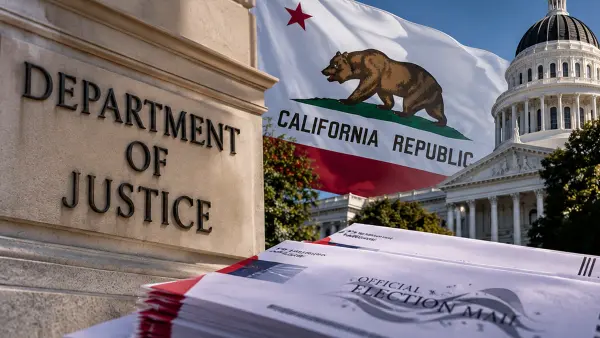
The Justice Department has warned California election officials that they could face federal criminal exposure if they knowingly count ballots from people the government identifies as noncitizens. The October 16 warning came one day after the department sued California to stop it from counting mail ballots from more than 20,000 people it describes as likely noncitizens.
California officials dispute the list and have refused to open the drive it arrived on. With the November 3 midterm elections less than three weeks away, the dispute turns on two questions: how reliable the federal data is, and how far federal authority reaches into elections that states run.
Background
The confrontation unfolded over four days. On October 13, Acting Deputy Attorney General Trent McCotter sent California officials a password-protected drive of names and gave them 48 hours to review it, according to CBS News. The letter asked officials to set aside, not cancel, mail ballots from listed people whose citizenship could not be confirmed. Los Angeles County Registrar Dean Logan said his office would not open the drive because it was not a secure medium.
When the deadline passed, the department filed suit on October 15. Its announcement of the lawsuit says the Department of Homeland Security compared state voter files with federal immigration data, and it describes that analysis as preliminary and ongoing. The department says it is not seeking to purge the rolls or cancel votes. The suit relies on the Constitution’s Supremacy Clause rather than the civil rights statutes behind earlier voter-roll cases, a string in which the department has lost more than two dozen times, ABC News reported.
The October 16 letter, addressed to the Los Angeles County Counsel and copied to Secretary of State Shirley Weber and Logan, said officials who knowingly count such ballots “risk becoming aiders and abettors to a federal crime.” Any resulting cases in the Los Angeles area would fall to Bill Essayli, the region’s top federal prosecutor, who also filed the lawsuit, the Associated Press reported.
Federal law bars noncitizens from voting in federal elections. California mails a ballot to every registered voter, and more than 23 million people are registered there. Matching voter files against immigration records is imperfect: federal records can lag behind naturalization, so a person flagged as a noncitizen may be an eligible citizen. A similar federal claim in Nevada did not hold up on review, though accounts differ on the details. The AP reported that a claimed 1,500 noncitizen voters fell to zero, while ABC News reported that Nevada reviewed 185 flagged people and found all were citizens.
What Different Sides Are Saying
The Justice Department argues that ballots cast by ineligible voters dilute the votes of citizens, and that setting ballots aside until citizenship is confirmed is a modest step compared with counting them first. Supporters of stronger verification say eligibility checks should not rest on applicants’ own declarations, and that federal immigration data can catch errors states miss. Fact-check: The department has prosecuted noncitizen voting this year; the AP counted about 90 people charged with election misconduct, 50 of them for allegedly voting as noncitizens. However, the department’s own release calls its California analysis preliminary, and it has not said publicly how many people on the list actually returned a ballot.
California officials reject the premise. Weber said the federal efforts “serve only to cause chaos and fuel public distrust in our elections,” and noted that state law already limits registration to citizens and requires removal of ineligible registrants. Logan has said removals must rest on verifiable information, not unconfirmed data matching. Fact-check: Weber has said the administration offered no evidence for its claim. The department did deliver names, so the dispute is over whether that list is reliable. Because California has declined to open the drive, neither side has publicly tested the list against state records.
Election-law specialists have been sharply critical. UCLA law professor Rick Hasen said the letter “ups the ante by threatening election officials with potential criminal prosecution.” This is an opinion about strategy and tone, not a ruling on the legal merits, which a court has not yet addressed.
The Central Disagreement
Both sides say they oppose illegal voting. They disagree over how much evidence should be required before a ballot is withheld, who decides, and whether an official who follows state procedures can be held criminally responsible for counting a ballot that federal investigators doubt. A further question is timing. Federal law limits systematic removals from voter rolls in the 90 days before a federal election. The department says setting ballots aside is not a removal; Weber has described the effort as an attempt to purge the rolls. A court may have to decide which description fits.
Note on Scope
This article covers the October 13 demand, the October 15 lawsuit, and the October 16 letter. As of October 17, this article could not locate a court ruling or a scheduled hearing in the case. It also could not verify how the 20,000 names were selected, how many of those people returned ballots, or whether letters sent to other California counties carried the same warning. No one on the list has been publicly shown to be ineligible.
Related Links
- Justice Department Sues State of California over Voter List (Justice Department)
- DOJ Says California Officials Who Process Ballots from Suspected Noncitizens Risk Prosecution (AP via PBS NewsHour)
- DOJ Sues California over Alleged Non-Citizens on Voter Rolls (ABC News)
- Top DOJ Official Orders California to Review List of Possible Noncitizens (CBS News)
- Justice Dept. Sues California Officials over 20K Alleged Noncitizen Voters (Washington Post)
- Justice Department Threatens Legal Action Against California over Alleged Noncitizen Voters (NBC News)
Discussion Questions
- How much evidence should officials need before setting a ballot aside?
- Is setting a ballot aside different from removing a voter from the rolls?
- Should federal immigration records be used to check voter eligibility?
- Why might immigration records and voter files disagree about the same person?
- Was Los Angeles County right to refuse to open the drive?
- Could the threat of prosecution change how election workers do their jobs?
- Why do disputes like this often happen close to an election?
- When, if ever, should the federal government step into elections that states run?
- What would make you trust the final vote count in a disputed state?
- Imagine you are a county election official who has just received this letter. What would you do first?
