
Reading
In most American elections, voters mark one name and the candidate with the most votes wins, even without a majority. This rule, called plurality voting, is simple, but it can produce a winner whom most voters opposed when three or more candidates split the vote. Ranked choice voting (RCV), also called instant runoff voting, is designed to address that problem. Whether it succeeds is disputed.
How the Count Works
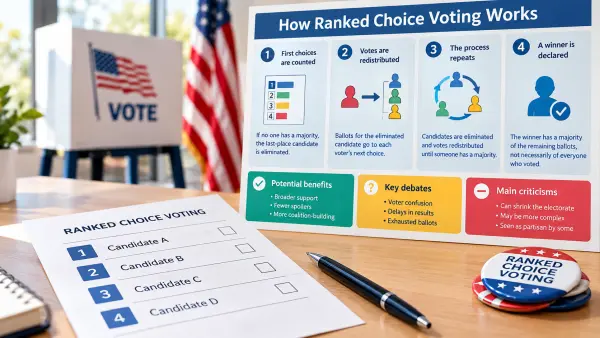
On a ranked choice ballot, voters rank candidates in order of preference: first choice, second choice, and so on. In the first round of tabulation, officials count only first-choice votes. If a candidate has more than half, that candidate wins. If no one does, the last-place candidate is eliminated, and ballots that ranked that candidate first are redistributed to each voter’s next choice. The process repeats until one candidate has a majority of the ballots still in play. It works like a series of runoff elections compressed into one trip to the polls.
A ballot that ranks only eliminated candidates can no longer count toward anyone. This is an exhausted ballot. Because exhausted ballots drop out, the winner’s majority is a majority of the remaining ballots, not necessarily of everyone who voted. In Maine’s 2018 Democratic primary for governor, about 10.7% of ballots were eventually exhausted, mostly because voters left rankings blank. The same analysis found that about 12% of voters ranked only one candidate.
Where It Is Used
Maine, Alaska and Hawaii use RCV in some statewide or federal races, and localities in 13 other states use it for city elections, according to Ballotpedia. Maine uses it for federal races and party primaries, while Alaska pairs it with a top-four primary open to all candidates. Meanwhile, 19 states have banned RCV outright, including Indiana and Ohio in 2026. On November 3, 2026, voters in Irvine, California; Honolulu; and Longmont, Colorado will decide whether to adopt it for city elections.
How It Changes Campaigning
Because second and third choices can decide a close race, candidates have a reason to appeal beyond their own base. Asking a rival’s supporters for a second-place ranking is hard while attacking that rival. Some candidates go further with a cross-endorsement, urging their voters to rank an ally second. In New York City’s 2025 Democratic mayoral primary, Zohran Mamdani and Brad Lander endorsed each other against front-runner Andrew Cuomo.
RCV also changes the spoiler problem. Under plurality rules, a minor candidate can draw votes from a similar candidate and help the other side win, a pattern called vote splitting. With rankings, a voter can put the minor candidate first without wasting the vote, because it moves to the next choice if that candidate is eliminated.
Whether RCV produces more civility is less settled. A research review by the think tank New America rated that claim mostly supported at the local level, but described the benefits as more marginal than many had hoped. Much of the evidence comes from surveys of how voters and candidates perceived campaigns, not direct measures of campaign tone.
How It Has Played Out
Maine, 2018. In Maine’s 2nd Congressional District, Republican Bruce Poliquin led the first round, but neither he nor Democrat Jared Golden had a majority. After two independents were eliminated and their ballots redistributed, Golden pulled ahead by nearly 3,000 votes. Poliquin argued he had won the first-choice count and challenged the system in federal court, but a judge declined to halt the tabulation.
Alaska, 2022. In a special election for Alaska’s only US House seat, Democrat Mary Peltola won 39.7% of first choices, while Republicans Sarah Palin and Nick Begich together won about 59%. When Begich was eliminated, about 29% of his ballots went to Peltola and about 21% ranked neither finalist, so Peltola won. Supporters called her a majority winner; critics noted that most first choices had gone to Republicans. Alaska voters kept the system in 2024 when a repeal failed by 737 votes. A new repeal ballot measure is on the November 2026 ballot, and President Donald Trump has urged Alaskans to end what he called a “disastrous” system.
New York City, 2025. Mamdani led Cuomo by about 7 points in first choices. After seven other candidates were eliminated, the Board of Elections reported that he won the final round 56% to 44%.
The Debate
Supporters argue that RCV produces winners with broader support, reduces spoilers, and rewards candidates who build wide coalitions rather than rely on a loyal minority. These are arguments about values and likely effects, and the evidence behind them is mixed. New America rated claims that RCV raises turnout as “mixed evidence, hard to assess,” and found that most voters say the system is easy to use.
Critics argue that RCV confuses voters, delays results, and lets exhausted ballots shrink the electorate that decides the final round. The Foundation for Government Accountability, a conservative policy group, says simple elections “beat convoluted rankings every time.” That is an opinion. The delays are real, though: New York City’s final primary results came a week after primary day.
The fight has also become partisan. Both 2026 bans, in Indiana and Ohio, were signed by Republican governors, and New America found Democrats more favorable to RCV than Republicans, though support and opposition cross party lines in places such as Alaska.
Glossary
majority (noun): more than half of all the votes counted.
Translations: 过半数 | 過半数 | 과반수 | पूर्ण बहुमत | الأغلبية المطلقة | абсолютное большинство | mayoría absoluta | majorité absolue
- A candidate needs a majority of the ballots still in play to win.
- The bill passed with a clear majority in both chambers.
plurality (noun): the largest number of votes among all candidates, even if it is less than half.
Translations: 相对多数 | 相対多数 | 상대다수 | सापेक्ष बहुमत | الأكثرية النسبية | относительное большинство | mayoría relativa | majorité relative
- She won with a plurality of 38%, while two rivals split the rest.
- Most US states decide elections by plurality.
ballot (noun): the paper or electronic form a voter uses to record choices.
Translations: 选票 | 投票用紙 | 투표용지 | मतपत्र | ورقة الاقتراع | избирательный бюллетень | papeleta | bulletin de vote
- The ballot listed five candidates for mayor.
- He mailed his ballot a week before Election Day.
tabulation (noun): the official process of counting and organizing votes.
Translations: 计票 | 集計 | 집계 | मतगणना | فرز الأصوات | подсчёт голосов | escrutinio | dépouillement
- The final round of tabulation took several days.
- Observers from both parties watched the tabulation.
eliminate (verb): to remove a candidate from the count because he or she has the fewest votes.
Translations: 淘汰 | 除外する | 탈락시키다 | बाहर करना | يستبعد | исключать | eliminar | éliminer
- The last-place candidate is eliminated after each round.
- Officials eliminated two independents before the final round.
redistribute (verb): to move votes from an eliminated candidate to each voter’s next choice.
Translations: 重新分配 | 再配分する | 재분배하다 | पुनर्वितरित करना | يعيد توزيع | перераспределять | redistribuir | redistribuer
- His ballots were redistributed to voters’ second choices.
- Once votes are redistributed, the leader can change.
runoff (noun): a second election between the top candidates when no one wins a majority.
Translations: 决选投票 | 決選投票 | 결선투표 | निर्णायक दूसरा चरण | جولة الإعادة | второй тур | segunda vuelta | second tour
- Georgia holds a separate runoff when no candidate tops 50%.
- Ranked ballots replace the need for a later runoff.
exhausted ballot (noun): a ballot that no longer counts because all of its ranked candidates have been eliminated.
Translations: 失效选票 | 順位が尽きた票 | 소진된 투표용지 | समाप्त मतपत्र | ورقة اقتراع مستنفدة | исчерпанный бюллетень | papeleta agotada | bulletin épuisé
- Ranking only one candidate makes an exhausted ballot more likely.
- Critics worry that each exhausted ballot leaves a voter unheard in the final round.
primary (noun): an election in which voters choose a party’s candidate for a later general election.
Translations: 初选 | 予備選挙 | 예비선거 | प्राथमिक चुनाव | الانتخابات التمهيدية | праймериз | elecciones primarias | primaire
- Seven candidates ran in the Democratic primary.
- Alaska’s primary sends the top four candidates to November.
cross-endorsement (noun): an agreement in which rival candidates ask their supporters to rank each other highly.
Translations: 交叉背书 | 相互推薦 | 상호 지지 | पारस्परिक समर्थन | التأييد المتبادل | взаимная поддержка | respaldo mutuo | soutien croisé
- The two candidates announced a cross-endorsement a week before the vote.
- A cross-endorsement makes sense only when votes can transfer.
spoiler (noun): a candidate with little chance of winning who draws enough votes to change who wins.
Translations: 搅局者 | 票割れを招く候補 | 스포일러 후보 | वोट काटने वाला उम्मीदवार | المرشح المُفسِد | кандидат-спойлер | candidato que divide el voto | candidat trouble-fête
- Some voters avoid third parties because they fear backing a spoiler.
- Both parties have blamed a spoiler for past losses.
vote splitting (noun): the division of votes between similar candidates, which can help a less similar candidate win.
Translations: 分票 | 票割れ | 표 분산 | वोटों का बंटवारा | تشتت الأصوات | раскол голосов | división del voto | division des voix
- Vote splitting between two moderates helped the third candidate win.
- Ranked ballots are meant to reduce vote splitting.
civility (noun): polite, respectful behavior, especially during disagreement.
Translations: 文明礼貌 | 礼節 | 정중함 | शिष्टता | الكياسة | вежливость | cortesía | civilité
- Voters said the debate showed more civility than usual.
- Researchers disagree about how to measure civility in campaigns.
repeal (noun): the official cancellation of a law.
Translations: 废除 | 廃止 | 폐지 | निरसन | الإلغاء | отмена | derogación | abrogation
- The repeal effort failed by a very small margin.
- Supporters of repeal collected signatures across the state.
ballot measure (noun): a proposed law or policy that voters approve or reject directly.
Translations: 公投提案 | 住民投票案 | 주민투표 안건 | मतपत्र प्रस्ताव | مقترح للاستفتاء | вопрос на референдуме | medida electoral | mesure soumise au vote
- The city council placed a ballot measure on the November ballot.
- Each ballot measure needs a simple majority to pass.
coalition (noun): a group of people or organizations that join together for a shared goal.
Translations: 联盟 | 連合 | 연합 | गठबंधन | ائتلاف | коалиция | coalición | coalition
- She built a coalition of labor groups and small businesses.
- Winning a ranked race often requires a broad coalition.
turnout (noun): the number or share of eligible people who actually vote.
Translations: 投票率 | 投票率 | 투표율 | मतदान प्रतिशत | نسبة المشاركة | явка избирателей | participación electoral | taux de participation
- Turnout was higher than in the last city election.
- Researchers disagree about whether ranked ballots affect turnout.
partisan (adjective): strongly connected to or divided along the lines of a political party.
Translations: 党派的 | 党派的な | 당파적인 | पक्षपातपूर्ण | حزبي | партийный | partidista | partisan
- The debate over election rules has become increasingly partisan.
- The commission was designed to be less partisan.
Discussion Questions
- Have you ever ranked candidates or options instead of choosing just one? How did it feel?
- Is it fair for a candidate who led the first round to lose in a later round?
- Would you rank every candidate on a ballot, or only the ones you like? Why?
- Should exhausted ballots count against the idea that the winner has a majority?
- Do you think ranked choice voting makes campaigns more polite?
- Was the Mamdani and Lander cross-endorsement smart strategy or a form of teamwork against one candidate?
- Do you find the supporters’ or the critics’ arguments in the reading more persuasive?
- Why do you think opinions about ranked choice voting have become partisan?
- Should election rules be decided by voters through ballot measures or by state legislatures?
- How important is getting election results quickly compared with other goals?
- Does your country use a runoff, ranked ballots, or plurality voting? What do people think of it?
- Imagine you are a city council member. Would you propose ranked choice voting for your city, and why?
Related Links
- Ranked-Choice Voting (RCV), Ballotpedia
- Ranked Choice Voting, National Conference of State Legislatures
- What We Know About Ranked-Choice Voting, New America
- Ranked-Choice Voting Is Losing, and for Good Reason, Foundation for Government Accountability
- Alaska Senate 2026: Sullivan vs. Peltola Under Ranked Choice
