
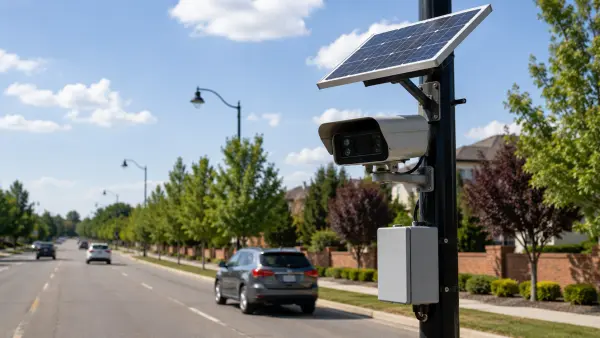
Lawmakers from both parties have spent months criticizing Flock Safety’s automated license plate readers, but as of this week, no bill in Congress would ban the cameras outright. President Trump weighed in publicly for the first time this week too, telling a reporter the technology has “pros and cons” and that his administration is studying the issue with an answer expected within a couple of weeks.
The scrutiny has already pushed the company itself to act. On Aug. 13, Flock announced it would shorten its default data retention period from 30 days to seven, require officers to log a case number for each search, and add tools meant to flag potentially abusive searches.
Background
Flock’s cameras are used by law enforcement in more than 6,000 communities across 49 states, and departments can search and share the resulting data with each other nationwide. Police credit the network with helping solve violent crimes, recover stolen vehicles and locate missing people. Critics on the left and right point to documented cases of officers using the system to track partners, relatives or exes, wrongful stops tied to inaccurate matches, and instances where out-of-state police accessed another state’s camera data, including one case in which a Texas department searched Washington state’s network for a woman who had sought an abortion.
More than 50 agencies or communities have canceled, suspended or rejected a Flock contract since the start of 2026, according to the grassroots tracking group DeFlock. In Congress, the furthest-along proposals come mostly from Republicans: Reps. Keith Self, Eli Crane and Andrew Clyde introduced a bill requiring a warrant before law enforcement can query state and local plate-reader data, and Rep. Thomas Massie has said he will introduce a bill withholding federal funds from agencies that deploy the cameras. Democratic Sens. Ron Wyden and Raja Krishnamoorthi have asked the Federal Trade Commission to investigate Flock’s cybersecurity practices but have not introduced legislation of their own.
What Different Sides Are Saying
Privacy critics, spanning both parties, argue the network amounts to warrantless mass surveillance regardless of who is in charge of it. Robert Frommer, a senior attorney at the Institute for Justice, called Flock’s new safeguards “window dressing that doesn’t address the fundamental problem,” since officers, not judges, still decide when to search the system. Fact-check: the misuse cases critics cite, including officers searching for personal contacts and the cross-state abortion-related search, have been reported by multiple outlets and are the specific failures Flock’s new case-number and audit tools are meant to address. Whether those tools are sufficient is a genuinely open dispute, not a settled fact.
Law enforcement and Flock defend the technology as an effective, widely adopted crime-fighting tool, and the company frames its changes as putting local agencies more firmly in charge of their own data. Fact-check: the specific crime-solving figures attached to Flock in press coverage, such as counts of suspects caught or vehicles recovered, are generally company-supplied or anecdotal rather than independently audited. This article could not verify a comprehensive, independently reviewed success-rate figure for the network, and any vendor-supplied statistic deserves the same scrutiny applied to other interested parties’ self-reported numbers.
State Sen. Jim Runestad, a Michigan Republican who introduced a bill requiring warrants for most plate-reader searches, said passively collecting information around the clock as people go about their daily lives “is a drastic overreach” that goes beyond legitimate public safety needs. Similar bipartisan bills are advancing or pending in Pennsylvania, Washington, California and Oregon.
Note on Scope
Bipartisan concern has translated into faster action at the state level than in Congress, where the most advanced federal proposals so far would restrict funding or require warrants rather than eliminate the technology.
Related Links
- Congress talks tough on Flock cameras, but no bill would ban them outright – Washington Times
- Flock announces changes amid backlash over its license plate reader network – The Press Democrat
- Bipartisan push grows for stricter rules on license plate reader cameras in Michigan – Michigan Public
- ‘Don’t Flock me’: California, U.S. lawmakers debate license plate reader technology – CalMatters
- There’s Not A Single Bill In Congress To Outlaw Flock-Type Spying – The Daily Caller
- Amid public backlash, surveillance tech company Flock announces platform changes – U.S. News (AP)
Discussion Questions
- Have you ever noticed a license plate reader camera in your area? Did you know how the data was used?
- Do you think police should need a warrant to search license plate reader data?
- Do you find privacy advocates’ concerns or law enforcement’s crime-solving claims more convincing?
- What matters more: giving police broad tools to solve crimes quickly, or limiting how much they can track ordinary people?
- Why do you think this issue has drawn concern from both the political left and right?
- Should a private company be allowed to run a searchable, nationwide surveillance network shared across thousands of police departments?
- How should the misuse cases described here change how you think about this technology?
- Is state-by-state regulation enough, or does this need a single federal standard?
- What responsibility does a company like Flock have when police misuse its product?
- Imagine you are a city council member deciding whether to renew a Flock contract. What would you want to know first?
