
Inside the Parties: how each party is processing the 2026 midterms.
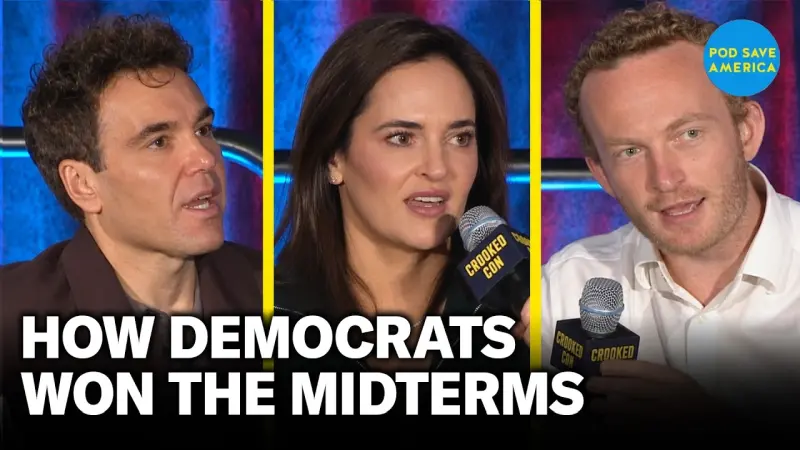
A week after Democrats won both chambers of Congress, three strategists who worked on the cycle sat down at Crooked Con with Pod Save America host Jon Lovett to talk about what they think worked. Lis Smith advised The Bench, a candidate recruitment group. Morris Katz of Fight Agency made ads for campaigns including Abdul El-Sayed’s in Michigan. Danielle Butterfield is president of Priorities USA, a presidential super PAC that treated the midterms partly as preparation for 2028.
The conversation was more celebratory than the title of this series might suggest, but it was not all agreement with party leadership. The panel criticized outside money in Democratic primaries, Senate Democratic leader Chuck Schumer, and the party’s own consultants. The same episode included an interview with Maryland Sen. Chris Van Hollen, who used it to argue against an automatic return for Schumer as leader. Timestamps below refer to the video.
Background: The Results They Were Reacting To
Democrats flipped seven Republican-held Senate seats (North Carolina, South Carolina, Ohio, Texas, Kansas, Iowa and Maine) and won a House majority that included at least three Florida districts redrawn to favor Republicans, according to NPR. Several winners the panelists discussed came from unconventional backgrounds: pastor Adam Hamilton in Kansas, Tejano singer Bobby Pulido in South Texas, and firefighter union president Bob Brooks in Pennsylvania’s 7th District.
The cycle was also the most expensive on record. AdImpact tracked about $5.18 billion in Republican advertising and $4.77 billion in Democratic advertising as of late October. That gap is part of why the panel kept returning to the question of what money can and cannot buy.
What the Panelists Argued
Recruit for roots, not fundraising. Smith said The Bench was formed after 2024 because the party’s usual first question for recruits, how much money they can raise, picks the wrong people (3:42). Its scouts looked instead for people who looked, sounded and lived like the voters in their districts. She described Brooks as someone constituents had to persuade to run for union president, and western North Carolina House candidate Jamie Ager as a farmer whose land became a gathering point after Hurricane Helene (35:12). Katz added a caveat: insiders can win too. He pointed to former North Carolina Gov. Roy Cooper, who won his state’s Senate race, and argued that a career politician should run on a governing record because “you can’t run as something you’re not” (22:31).
Stop sorting candidates by label. Butterfield warned against reading the results as a win for moderates, progressives or outsiders (30:36). The common thread she saw was a willingness to challenge the status quo. Smith gave examples that cut across party lines: Brooks opposed an assault weapons ban, and Hamilton called Biden’s border policy a disaster and described himself as pro-life with a heavy heart (35:51). Her conclusion was that a big tent of voters requires a big tent of candidates, and that there is no one way to be a Democrat (37:02). Lovett noted that El-Sayed, often grouped with the left, called himself a capitalist while backing Medicare for All (32:23). These are characterizations by the panel; this article did not independently review each candidate’s positions.
Attention has to be earned, even when it is paid for. Smith credited Texas Senate winner James Talarico with building a following through viral clips that drew on his Christian faith rather than attacks (10:57). She also told the story of Pulido offering to perform at any quinceañera in the district after his opponent dismissed him as a quinceañera act (12:50), a response Texas Public Radio also documented. Katz said his test for an ad is whether it looks like a political ad; if it does, his team has failed (15:45). Butterfield summed it up: “We can’t buy attention. We have to earn it” (16:05).
Measure what ads actually do. Butterfield said Democratic budgets are now roughly half digital and half television, which she called too slow a shift (8:28). She argued that campaigns lack good metrics for whether ads break through, and that about half of voters do not follow news or politics (9:36). She compared campaigns to a car brand advertising to people without a driver’s license. Her budget split and attention figures are her own estimates; this article could not locate the data behind them.
Rethink outside money. The sharpest criticism was aimed at the Michigan Senate primary (39:04). Katz described AIPAC as a foreign lobby that avoids registering as one. That is his opinion, and it is disputed: AIPAC is not registered under the Foreign Agents Registration Act, and whether it should be has been argued for decades. Smith said pro-Stevens groups spent $80 million in the primary (49:59). This article could not verify that total. AdImpact tracked about $63.9 million in ad spending and reservations supporting Rep. Haley Stevens, most of it from outside groups. Smith also criticized Schumer for backing Stevens and pressuring donors (43:34); the donor claim is hers, though Schumer’s support for Stevens was widely reported. Lovett offered the counterpoint that the spending “almost worked” (52:18), and Butterfield argued donors would get more from funding long-term recruitment and digital infrastructure (53:38).
Prepare for search and AI. Lovett floated a theory, which he said had no data behind it, that voters asking AI chatbots to compare candidates got more even-handed information than ads provided (55:15). Katz claimed Republicans had worked to shape those answers (56:06); this article could not verify that claim. Butterfield described targeting what she called politically adjacent searches, such as how to save on groceries, and said Priorities ran ads about Ken Paxton’s divorce to people searching about infidelity (59:38). Smith said The Bench advised first-time candidates on writing campaign websites that chatbots would summarize accurately (57:46).
Closing lessons. Katz said winners ran on concrete local plans rather than a referendum on Trump. Smith said 2028 candidates should not copy this year’s winners but be themselves. Butterfield argued that the party’s consulting class has its own oligarchy problem and is paid too much (1:02:17).
Van Hollen: Leadership and the Agenda
In the separate interview with Alex Wagner, Van Hollen said “There should be no coronation of the next Democratic leader” (1:08:03). His tests for a leader were using every available tool to end funding for the war with Iran, acting on costs such as electricity prices tied to data centers, and tackling money in politics (1:08:58). He also said the party should stop unconditional military aid to Israel, while acknowledging he could not say Senate Democrats were united on that (1:29:19). He confirmed he is considering a 2028 presidential run (1:11:49).
The leadership question is live. Five incoming senators, including Hamilton and El-Sayed, have said they will not back Schumer, Fox News reported, while no sitting Democratic senator had publicly opposed him. El-Sayed has said he supports Van Hollen. The vote is by secret ballot, and Schumer needs only a majority of the caucus.
What the Results Can and Cannot Tell Us
Election returns show where Democrats gained ground. They do not show which ad, recruit or tactic made the difference. Lovett made the same point on stage: after a win, every winning campaign looks as if it did everything right (52:18). Michigan is the clearest case. El-Sayed won the primary 48.5% to 47.5% and then won the Senate seat. Stevens lost despite a large spending advantage, but a one-point margin cannot settle how much that spending helped or hurt her. Two days before the general election, Stevens endorsed Republican Mike Rogers, Axios reported, which shows how raw the divisions from that primary remained.
The panelists also spoke from inside winning campaigns, and their examples were winners. Those wins were not cheap: spending in Hamilton’s race reached roughly $110 million, a Kansas record. Candidate quality and heavy spending arrived together, which makes it hard to measure either one alone.
Looking Ahead
The next few weeks. Senate Democrats are expected to hold their leadership vote next month. Whether Schumer faces a contested election, and how many freshmen vote against him, will be the first test of whether the anti-establishment energy on this panel translates into power inside the caucus. The lame-duck fight over the defense authorization bill will show whether Van Hollen’s position on Israel and Iran has wider support.
2027: where the money goes. If donors take Butterfield’s advice, the evidence will show up in budgets rather than speeches: year-round recruitment, research teams that keep working between elections, and more spending on search and digital tools. With majorities in both chambers, Democrats will also have to decide how to divide attention between oversight of the Trump administration and their own legislation. Trump’s choice of Stephen Miller as chief of staff, announced the same week, drew criticism from Democratic leaders and from retiring Republican Sen. Thom Tillis.
2028: does the big tent travel? The idea that there is no one way to be a Democrat works when each state picks its own candidate. A presidential primary forces the party to choose one nominee and one position on divisive issues such as Israel, guns and abortion. Watch whether contenders follow the panel’s advice to run as themselves or retreat to familiar labels, and whether Michigan’s early place in the primary calendar gives El-Sayed’s wing extra influence. Butterfield said Priorities’ Ohio work convinced her the state is back on the path to 270 electoral votes (6:58). A presidential electorate is larger and different from a midterm one, so the real signal will be whether Democrats commit staff and advertising to Ohio, Kansas or Texas in 2028.
Related Links
- Lessons From 2026: Live From Crooked Con (episode page)
- CBS News: El-Sayed Defeats Stevens in Michigan Democratic Senate Primary
- Michigan Public: El-Sayed Defeats Mike Rogers in Key Senate Race
- Philadelphia Inquirer: Bob Brooks Unseats Ryan Mackenzie in the Lehigh Valley
- The Hill: Questions Grow About Schumer’s Future as Leader
- White House: Stephen Miller Named Chief of Staff
Discussion Questions
- Have you ever voted for a candidate mainly because of their background rather than their policies?
- Should parties care more about whether a candidate can raise money or whether they can inspire voters?
- Do labels like “moderate” and “progressive” help you understand candidates, or do they get in the way?
- Which panelist’s argument did you find most convincing, and why?
- Should outside groups be allowed to spend unlimited money in party primaries?
- Would you trust an AI chatbot to compare two candidates for you?
- Why do winning campaigns often get credit for strategies that may not have made the difference?
- Should newly elected senators have more say in choosing their party’s leader?
- Which of these lessons do you expect to hold up in a presidential election?
- Imagine you are advising a first-time candidate. What is the first piece of advice you would give?
