
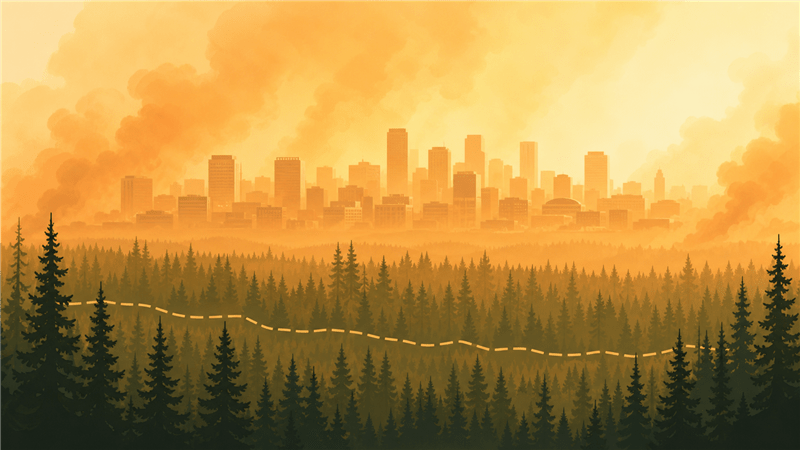
Smoke from Canadian wildfires moved across parts of the U.S. Midwest and Northeast in mid-July, prompting air-quality warnings and disrupting outdoor activity. NASA reported that nearly 850 fires were active across Canada by mid-July, including more than 180 in Ontario. It also reported that 1.9 million hectares had burned nationally by July 14.
President Donald Trump responded by accusing Canada of failing to maintain its forests and brush. In a July 17 social-media post, he said the cost of the pollution should be added to tariffs Canada is already paying. Reporting by Reuters and the Associated Press describes this as a threat, not an announced new tariff rate or a completed trade action.
Fact check: The official Canadian July update says 2026 wildfire activity was still below the five-year average at the time of that update, although fire danger was expected to rise over the summer. That does not contradict the presence of many active fires or serious smoke conditions in particular regions. It does show why a national seasonal comparison and a local smoke emergency can both be true at once.
Background
Wildfire smoke can travel hundreds or thousands of kilometers. Its most concerning pollutant is fine particulate matter, known as PM2.5. The Environmental Protection Agency says smoke exposure can worsen asthma and other lung disease and is also associated with cardiovascular effects. Children, older adults, pregnant people, people with heart or lung conditions, and outdoor workers can face greater risk.
The policy dispute is part of a wider question about what drives large fires and what governments can realistically prevent. Canada has large boreal forests, many in remote areas. NASA says activity picked up after a slow start to the 2026 season amid dry and warm conditions. Canadian officials say the country has invested in forest sustainability and fire prevention and that warming, drier conditions are making fire risk harder to manage.
Research on Canada’s record 2023 season adds important context, but it does not by itself identify the cause of every current fire. A Nature Communications study found that 2023 burned area was about 15 million hectares, more than seven times the historical national average. The Canadian Climate Institute says 93% of the area burned that year came from lightning-ignited fires and that climate change raises the risk that fires spread rapidly. Both sources also describe fire management measures, including prescribed burning and fuel reduction near at-risk communities, as useful tools. The evidence therefore supports a more complicated picture than either an all-management or all-climate explanation.
What Different Sides Are Saying
Trump and some U.S. lawmakers argue that better forest maintenance, thinning, fuel reduction, and fire prevention could reduce smoke crossing the border. Their position emphasizes the health and economic costs borne by U.S. communities and the idea that Canada should do more to limit those harms.
Canadian officials reject the charge that the current smoke amounts to willful negligence. Reuters reported that Emergency Management Minister Eleanor Olszewski cited C$12 billion in forest sustainability and fire-prevention investment since 2020. Ontario Premier Doug Ford pointed to Canada’s past assistance for U.S. firefighting and urged cooperation rather than blame. U.S. Ambassador to Canada Pete Hoekstra had earlier described wildfires as a shared challenge, although he later shared Trump’s post.
Scientists and public-health agencies generally focus on weather, vegetation, ignition sources, and exposure rather than assigning a single national cause. That perspective does not mean forest management has no role. It does mean that claims about a particular fire season need to distinguish between long-term climate conditions, local fuel-management choices, and the immediate weather and ignition patterns behind individual fires.
What Is Still Unclear
Trump’s post did not specify a legal mechanism, rate, or timetable for any additional smoke-related tariff. It is also too early to say how the rest of the 2026 Canadian fire season will compare with past seasons. For people affected by smoke, local air-quality alerts remain more immediately actionable than the political dispute.
Related Links
- NASA Earth Observatory: Ontario wildfire smoke moves east
- Associated Press: Smoke from Canada and Minnesota reaches the U.S.
- Reuters: Trump blames Canada and raises tariffs
- Government of Canada: July wildfire-season update
- EPA: Wildland fires and public-health effects
- Canadian Climate Institute: Climate change and wildfires
- Nature Communications: Canada’s 2023 wildfire season
Discussion Questions
- Have you ever changed plans because of smoky air?
- What should countries owe neighbors affected by cross-border smoke?
- Which details matter most when judging a claim about forest management?
- Why might a leader connect an environmental problem to tariffs?
- How should officials explain the difference between a local emergency and national seasonal data?
- What role can forest management play alongside climate policy?
- Should health costs from cross-border pollution affect trade policy?
- What does a shared response to wildfires look like?
- How should news reports separate evidence from political blame?
- If you advised leaders from both countries, what first step would you recommend?
