
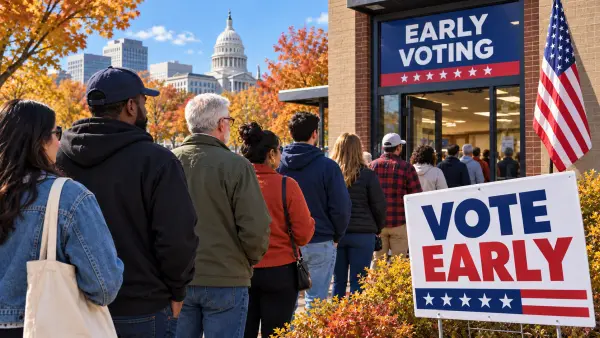
Early voting for the Nov. 3 midterms is running ahead of the 2022 pace in several states that publish comparisons, including Georgia, Ohio, North Carolina and the largest North Texas counties. National counts passed 12.6 million early votes by Oct. 20, according to Axios’s analysis of University of Florida Election Lab data. The figures show how and when people are voting. Analysts caution that they do not show who is winning.
What the Numbers Show
The University of Florida tracker counted 12,618,084 early votes nationwide as of 3:27 p.m. ET on Oct. 20. About 57 million of the roughly 112 million votes cast in 2022 came before Election Day, according to a CNN analysis.
Georgia. The Georgia Secretary of State’s office reported 1,007,015 in-person early votes and 48,916 accepted absentee ballots by noon on Oct. 20. At the same point in 2022, 894,412 Georgians had voted early in person. Fact-check: The office called that a 12% increase, and its own in-person figures work out to about 12.6%. Georgia also hosts a Senate race, covered in our Ossoff vs. Collins briefing.
Ohio. Nearly 195,000 early in-person ballots had been cast by mid-October, against just over 50,000 at the same point in 2022, Cleveland 19 reported. Case Western Reserve law professor Jonathan Entin said competitive governor and Senate races, uncertainty about mail ballots and national issues may be driving the increase. Those are hedged explanations, not established causes. See also our Ohio Senate briefing.
Texas. Early voting began Oct. 19. Dallas County recorded 76,079 in-person votes on day one, up from 32,605 on the first day in 2022 and above its 2024 first-day total of 56,431, NBC DFW reported. Tarrant, Denton and Collin counties each beat their 2022 first days but fell short of 2024, which shows how the choice of baseline changes the story.
North Carolina. Axios reported early voting there was 37% ahead of the same point in 2022 as of Oct. 18, and registered Democrats had cast more than twice as many ballots as registered Republicans. The report did not give the unaffiliated share, so it cannot show the full partisan picture.
Why the Comparisons Are Hard
States set their own schedules and reporting rules, so a low share can reflect timing. Axios listed Oregon at 0.6% of its 2022 turnout and Kentucky at 1.4%, and noted that Tennessee’s figures count only in-person votes. Early voters also tend to be more politically engaged than average, and they skew older.
CNN found that Democrats have recently been more likely to vote early, while Republicans have more often voted early in person or on Election Day. Its Oct. 1 count showed Democrats’ share of mail ballot requests above 2024 levels in Iowa, Pennsylvania, Maine and North Carolina, but below 2022 levels in all of those states except Iowa. CNN cautioned that the shift could reflect Republicans moving to other voting methods rather than a Democratic turnout edge.
What Different Sides Are Saying
Signs of enthusiasm. CNN’s Oct. 1 headline described emerging signs of a Democratic advantage. Georgia Secretary of State Brad Raffensperger, a Republican, said the turnout shows Georgians trust the election process, which is an interpretation, not a measured finding.
Calls for caution. RealClearPolitics analyst Sean Trende argues there is no reliable benchmark, according to an opinion column in PJ Media. In his view, 2022 predates a Republican shift toward early voting in 2024, and 2024 was a presidential year. Fact-check: Both readings assume something about how early voters will vote, and ballots are secret. No state has reported how early ballots were cast, only who requested or returned them.
View from Outside the US
A wire report published by The National, a UAE outlet, on Sept. 18 said early voting rules vary by state and listed fuel prices and the Iran war among voter concerns. This article could not locate non-US reporting that analyzes the October totals.
Note on Scope
These figures run through about Oct. 23 and change daily. A later national report, listed in Related Links, puts the total above 19 million as of Oct. 23, but this article could not open it to check its source, so the body uses the Axios count. Ohio’s source described a Postal Service mail ballot rule as on hold. This article could not confirm the rule’s current status, and our post on the appeals court ruling describes a shifting legal fight. It does not project results.
Related Links
- Where midterms early voting is surging
- Early voting data shows emerging signs of a Democratic advantage in the midterms
- Over 19 million people have already cast their votes for the midterms, data shows
- Georgia Surpasses One Million Early Votes
- Ohio’s early in-person voting turnout nearly quadruples
- Don’t Fall for the Media’s Cheerleading Over Early Voting Results
- How US Elections Actually Work
Discussion Questions
- Have you ever voted early or by mail? How was the experience?
- Does high early turnout tell us anything about who will win?
- Dallas County beat its 2024 first day, but three nearby counties did not. What might explain that?
- Should every state offer early in-person voting?
- Why do Democrats and Republicans now tend to vote in different ways?
- Should states publish early vote counts by party where they can?
- How much should media outlets report early vote totals before Election Day?
- Does record turnout suggest trust in elections, or something else?
- If doubts about mail ballots push people to vote in person, is that a problem?
- Imagine you are a state election director. How would you make early vote counts easier to compare across states?
