
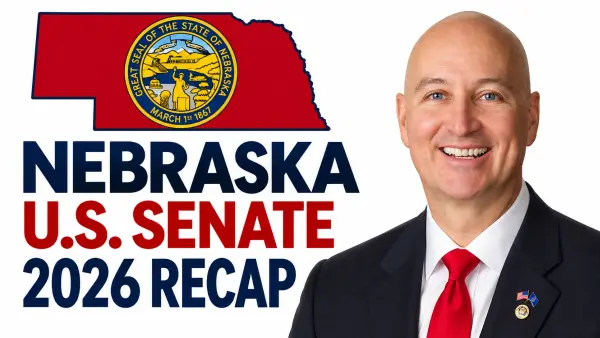
This recap reflects reporting available as of Nov. 21, 2026. Vote figures are the latest reported counts and may differ slightly from certified totals. For the race as it looked at the start of October, see our Nebraska Senate election briefing.
The Result
Republican Sen. Pete Ricketts won his first full term on Nov. 3, defeating independent Dan Osborn by about 47,000 votes, 370,411 to 321,218 in unofficial state results with nearly all precincts reporting. That works out to roughly 50 percent to 44 percent, with three minor-party candidates sharing about 6 percent. The AP called the race at 2:27 a.m. Eastern time, after Ricketts had already declared victory in Omaha.
In a year when Republicans lost Senate seats in Kansas, Texas, Ohio and elsewhere, Nebraska stayed red. Osborn’s margin of defeat was about the same as in his 2024 run against Sen. Deb Fischer.
How the Campaign Unfolded
Our briefing at the start of October described a close race with thin public polling, much of it from Osborn’s side. Republicans treated it as a real threat. Trump held a rally for Ricketts in Grand Island on Oct. 5, and the race drew about $72 million in independent expenditures, including spending still pending in federal filings. More of that money was focused on Osborn’s side of the race than on Ricketts’s.
Ricketts’s central argument never changed: that Osborn, despite his pledge to caucus with neither party, was a Democrat in disguise. He called him “Democrat Dan” throughout the campaign and, by the end, a socialist. Osborn, a former union leader and Navy veteran, ran on working people against wealth and party control, and on limits to presidential power over tariffs and war. Late ads turned harsh on both sides, with Osborn accusing Ricketts over a pardon vote and Ricketts’s campaign using audio it attributed to Osborn to portray him as disrespectful toward women.
Nebraska Democrats had stepped aside for Osborn, and their nominee withdrew in July. But Osborn and the Democratic candidate for governor, Lynne Walz, did not campaign together, and University of Nebraska-Lincoln political scientist Kevin Smith said Osborn spent the race playing defense on whether he was a secret Democrat, according to the Nebraska Examiner.
Why Voters Chose Ricketts
The “Democrat Dan” strategy appears to have worked. In the ABC News Voter Poll, 57 percent of Nebraska voters said Osborn was too aligned with Democrats. About 79 percent said party control of the Senate was crucial or a major factor in their vote, which made it hard for an independent to escape the national contest for the majority.
Ricketts was not popular. His favorability was underwater at 44 percent, about the same as Osborn’s 43 percent, and 54 percent of voters said Ricketts was too supportive of Trump. Osborn’s campaign also reached more voters directly: 46 percent said it had contacted them, compared with 39 percent for Ricketts’s. But Trump’s approval in Nebraska, 47 percent, was far stronger than in most battlegrounds, and Republicans made up nearly half of the electorate. The poll does not break out the Ricketts-Osborn vote by group.
Expectations vs. Outcome
- Polling: The September polls our briefing cited ranged from Osborn ahead by 4 to Ricketts ahead by 4, averaging to a tie. Ricketts won by about 6 to 7 points.
- Forecasters: The Cook Political Report kept the race at Likely Republican through the end of October. The Fox News Power Rankings moved it from Likely to Lean Republican on Nov. 1.
- Prediction markets: Kalshi priced Ricketts’s chances at about 93 percent.
Our briefing said it was untested whether clearing the field for an independent works in a two-way race. This result is one test, and it did not work here, though Osborn ran about even with his 2024 showing. One detail our briefing flagged also mattered at the margin: The Downballot had warned that two new minor parties could draw voters who disliked Ricketts but were not sold on Osborn, and the three minor candidates together took about 6 percent, close to the size of Ricketts’s lead.
Smith had told Newsweek that a presidential visit to a state Trump won easily might signal a tough environment for Republicans. The environment was tough nationally, but Nebraska’s electorate held.
Victory and Concession
Ricketts declared victory in Omaha while votes were still being counted. He thanked his campaign for tracking Osborn, saying it had exposed Osborn as “the fraud that he is,” and told reporters that Democrats had backed Osborn hoping to give Nebraska a socialist senator.
This article could not find a public concession statement from Osborn, or any statement about his plans.
- Ricketts claims victory over Osborn (Nebraska Examiner, article)
- Ricketts’s victory remarks (in our victory speeches roundup)
What’s Next for Both Candidates
Current as of Nov. 21, 2026.
Ricketts, appointed in 2023 and elected to finish Ben Sasse’s term in 2024, now begins his first full six-year term. He serves on the Banking, Environment and Public Works, Foreign Relations and Budget committees. Osborn has run two strong statewide races as an independent and lost both.
