
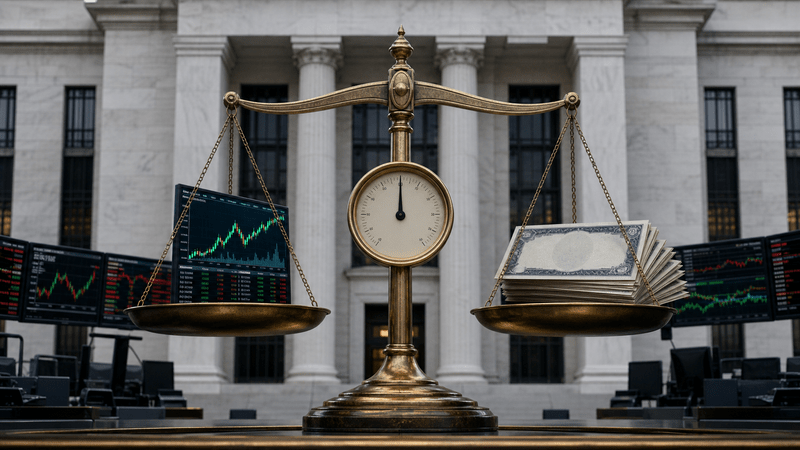
The Federal Reserve kept its benchmark interest-rate target unchanged on July 29, choosing patience even as inflation remained above its goal and three policymakers called for higher rates.
The Federal Open Market Committee voted 9-3 to maintain a target range of 3.50% to 3.75%. Beth Hammack of the Cleveland Fed, Neel Kashkari of the Minneapolis Fed and Lorie Logan of the Dallas Fed dissented. All three preferred a quarter-point increase.
The decision did not produce one simple market verdict. Stocks fell sharply on Wednesday, but oil prices and weakness in artificial-intelligence shares were also major causes. In the bond market, short-term and long-term yields moved in different directions, suggesting that investors expected near-term restraint but remained worried about inflation farther into the future.
Background
The federal funds rate influences overnight lending between banks. Changes in that rate can spread into borrowing costs for credit cards, business loans and other financial products. Mortgage rates and long-term government-bond yields are influenced by the Fed, but they are also set by market expectations about inflation, economic growth and federal borrowing.
The Fed has kept its target range at 3.50% to 3.75% since the beginning of 2026. Its July monetary-policy report said economic activity was expanding at a solid pace, unemployment was 4.2% in June and inflation remained elevated. The report linked higher prices partly to tariffs, energy disruptions related to the Middle East conflict and demand for equipment used in artificial intelligence.
The Fed has two responsibilities set by Congress: maximum employment and stable prices. Raising rates can cool demand and inflation, but it can also weaken hiring and investment. Holding rates steady gives policymakers more time to see whether inflation slows, but it creates a risk that high inflation will last longer.
Why the Fed Held Rates Steady
Fed Chair Kevin Warsh said the central bank remained committed to returning inflation to 2%, but he resisted giving markets a clear forecast for the next decision. He said higher Treasury yields since the Fed’s June meeting were already tightening financial conditions.
Warsh described the divided meeting as a productive internal debate. The Associated Press reported that he called it a “good family fight” and said inflation could not be solved in a few days or weeks.
The three dissenters did not publish separate explanations with the policy statement. Their votes are consistent with earlier warnings that persistent inflation may require tighter policy. Fed Governor Christopher Waller, who ultimately voted to hold, had said in a July 13 economic-policy speech that the Fed must be ready to tighten if inflation failed to improve, while also warning that moving too quickly could raise recession risks.
What Officials Are Saying
Warsh and the committee majority
The majority’s position was that the current rate could remain in place while officials studied incoming data. Warsh emphasized the 2% target but argued that policy should not be judged only by whether the Fed changed its overnight rate at this meeting. Supporters of a hold can point to the risk that another increase would unnecessarily slow employment or investment if energy-related inflation fades.
The three officials who wanted an increase
Hammack, Kashkari and Logan favored raising the target range to 3.75% to 4.00%. Their votes signaled concern that keeping policy unchanged may not be enough when inflation has remained above target for years. However, a dissent records a preferred action; it does not prove that inflation will rise or that a rate increase would have produced a better result.
President Trump
President Donald Trump has repeatedly called for lower rates. After the decision, the Associated Press quoted Trump praising Warsh while blaming what he called a political Fed board for keeping rates high. That interpretation conflicts with the recorded vote: the three members who opposed Warsh’s position wanted a rate increase, not a cut.
How Stock and Bond Markets Reacted
On Wednesday, the S&P 500 fell 1.5%, the Dow Jones Industrial Average lost 1,153 points, or 2.2%, and the Nasdaq composite dropped 1.7%. The AP market report identified several causes: uncertainty about Fed policy, a 7.3% jump in Brent crude after renewed fighting involving Iran, and falling technology and semiconductor shares.
The bond response was especially important. The two-year Treasury yield, which is sensitive to expected Fed policy, slipped to 4.24% from 4.26%. The 10-year yield rose to 4.68% from 4.61%. Because bond prices fall when yields rise, that move meant longer-term Treasuries sold off.
On Thursday morning, the 30-year yield reached about 5.21%, its highest level since 2007. Axios interpreted the yield increase as evidence that investors questioned whether the Fed would act strongly enough against inflation. That is an interpretation of market behavior, not a direct statement from every bond investor.
Stocks rebounded on Thursday, helped by Microsoft’s strongest day since 2008 and other corporate news. The Dow rose 1.2% and the Nasdaq climbed 2.8%. The AP’s next-day market coverage said the 10-year yield held near 4.66% while the 30-year yield remained around 5.21%. The rebound shows why one session should not be treated as a final judgment on monetary policy.
How Different Media Framed the Decision
The Associated Press emphasized the unusual three-way dissent, the continuing burden of credit-card and mortgage costs, and the tension between inflation and economic risk. Its market reporting also cautioned that oil and AI-stock weakness contributed to the selloff.
Axios focused more sharply on credibility in the bond market. It argued that Warsh’s limited guidance and vague answers left investors uncertain about how the Fed would enforce its 2% target.
Le Monde highlighted a contradiction between Warsh’s strong anti-inflation language and a second consecutive decision under his leadership to leave policy unchanged. It also emphasized that he was appointed by a president who wanted lower rates.
Kiplinger’s live analysis concentrated on what investors could use: the policy split, Warsh’s reduced forward guidance and the possibility that rising market yields were already functioning like a rate increase.
These reports did not disagree about the vote or the market numbers. They differed mainly in emphasis: household costs, Fed credibility, political pressure or investment strategy.
Fact Check
Claim: The Fed lowered interest rates
Verdict: False. The Federal Reserve’s official statement says the committee maintained the target range at 3.50% to 3.75%. No rate cut or increase was approved.
Claim: The dissenters wanted lower rates
Verdict: False. The Federal Reserve’s official statement names all three dissenters and says each preferred a quarter-point increase. The vote therefore shows pressure for tighter policy, not for a cut.
Claim: The Fed decision alone caused Wednesday’s stock losses
Verdict: Unsupported. The Associated Press market report identifies multiple forces, including the Fed outlook, higher oil prices and weakness in AI-related shares. It is reasonable to say the Fed added uncertainty, but the evidence does not support assigning the entire decline to one event.
Claim: Holding the Fed rate steady kept all interest rates steady
Verdict: False. The Associated Press reported that the two-year Treasury yield edged lower while the 10-year yield rose sharply. Long-term borrowing costs can change even when the Fed’s overnight target does not.
What Comes Next
Data released the day after the meeting showed why the next decision remains difficult. The latest growth and inflation report showed that the economy expanded at a 1.5% annual rate in the second quarter. Annual PCE inflation eased from 4.1% in May to 3.7% in June, but remained well above the Fed’s 2% goal.
Before its next meeting, the Fed will receive additional inflation, employment and spending data. Markets will watch whether more officials join the three dissenters, whether Warsh offers clearer criteria for a rate change and whether long-term Treasury yields continue to rise. For households, the practical question is not only what the Fed does next, but whether mortgage, auto-loan and credit-card costs respond.
Related Links
- Federal Reserve FOMC statement
- Federal Reserve July policy report
- AP report on the decision
- AP stock and bond report
- Axios bond-market analysis
- Le Monde coverage
- Kiplinger meeting and market analysis
Discussion Questions
- Why did most Fed officials support a pause?
- What do the three dissents reveal?
- Which inflation risk seems most important?
- How can higher rates affect employment?
- Why did short and long yields diverge?
- Which media emphasis was most useful?
- Should Fed officials give markets more guidance?
- How have interest rates affected your choices?
- Why might political pressure matter to markets?
- Imagine you had an FOMC vote. What would you choose?
