
This briefing reflects information available as of September 5, 2026. FL-14 is a live, competitive race, and candidates, polling, and endorsements may change before the November 3 election.
Why This Race Matters
Florida’s 14th Congressional District has sent a Democrat to Congress for two decades, but a mid-decade redistricting fight moved it out of safe territory and into one of the most closely watched House races in the state. Ten-term incumbent Kathy Castor now faces Republican Mike Beltran in a district that state Republicans redrew specifically to be winnable for their party.
The outcome matters past Tampa Bay. FL-14 is one of several Florida seats redrawn this year as part of a wider national redistricting fight, and both parties’ campaign arms have named it a top target. How Castor performs here will help answer a question Democrats have asked since the new map passed: whether Republicans built a map that helps them, or one that spread their voters too thin to hold every seat.
The Race
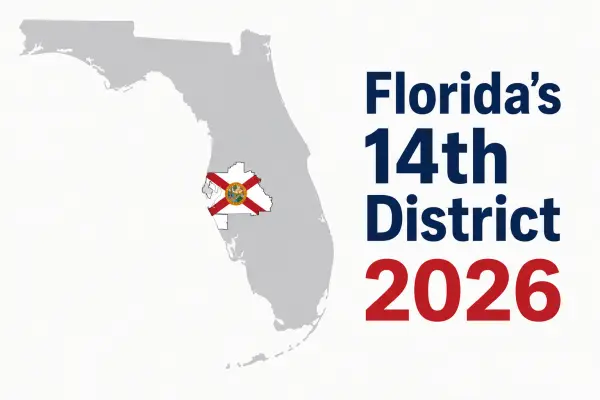
The new FL-14 sits entirely within Hillsborough County, covering Brandon, Riverview, Valrico, Plant City, Sun City Center, Apollo Beach, Wimauma, and part of south Tampa. The map cut the district’s old cross-bay connection to St. Petersburg and added more conservative, rural stretches of eastern Hillsborough. WUSF reported that Castor’s district previously stretched into southern Pinellas County, including St. Petersburg, before this year’s change.
Under the district’s old lines, Kamala Harris carried the 2024 presidential vote by roughly eight points, and Castor won her own race that year by 15 points. Under the new lines, Ballotpedia calculates that Donald Trump would have carried the same 2024 presidential vote by roughly ten and a half points, one of 23 Democratic-held districts nationally that Trump would have won under new boundaries.
State officials defended the redraw as a response to population growth and to concerns that the 2022 map improperly grouped Black voters into specific districts. Castor and other Democrats reject that reasoning and argue the real motive was partisan advantage, a dispute that is now the subject of the ongoing litigation described later in this briefing.
Castor drew no Democratic primary opponent and advanced automatically to November. Republicans ran an eight-candidate primary on August 18. Mike Beltran, a former state representative, won with about 46 percent of the vote, defeating runner-up Kevin Steele’s 30 percent and six other candidates who each finished in single digits.
That primary had a rough patch. WUSF reported that voter guides distributed by the Hillsborough County Republican Executive Committee had Beltran’s name underlined, a move that drew complaints from rival campaigns and a public apology request. The county party said it had not endorsed any candidate in the race and that the volunteers involved had been told to leave the early-voting sites.
Forecasters do not agree on how competitive the seat truly is now. Cook Political Report moved the race from Lean Republican to Toss Up right after the primary. Inside Elections still rated it Lean Republican as of primary day, and Decision Desk HQ called it Lean Democratic, giving Castor roughly a 60 percent edge by that model.
Sabato’s Crystal Ball reached a toss-up conclusion earliest, shifting the race in late July after starting the cycle at Safe Democratic. That spread, from Lean Republican to Lean Democratic among four respected forecasters, says something on its own: this is a race where careful analysts genuinely disagree, not one where the outcome is settled and the ratings just haven’t caught up.
Pre-primary polling adds another data point. A mid-July St. Pete Polls survey, commissioned by Florida Politics, found Castor leading Beltran 46 percent to 38 percent and leading Steele 46 percent to 39 percent in hypothetical general-election matchups, with 15 to 16 percent undecided in each. That poll predates the primary and the two candidates’ general-election campaigns, so treat it as a snapshot of July, not a forecast of November.
The Candidates
Kathy Castor (D) has represented the Tampa area in Congress since 2007 and previously served on the Hillsborough County Commission. She holds a law degree from Florida State University and worked as an environmental attorney before entering politics. In Washington she sits on the House Energy and Commerce Committee, where she is the ranking member of the Energy Subcommittee, and she has pointed to her role helping draft the Affordable Care Act as central to her record.
Castor’s campaign has emphasized federal investments she has helped secure for Tampa Bay, including funding tied to Tampa International Airport, Port Tampa Bay, the University of South Florida, Moffitt Cancer Center, and a bed tower at the James A. Haley Veterans’ Hospital. She has called the new district lines “blatantly illegal” under Florida’s Fair Districts constitutional amendment, a claim that remains in active litigation described below.
Mike Beltran (R) is a trial attorney who served three terms in the Florida House from 2018 to 2024, representing part of the district he now hopes to win in Congress. He holds degrees from the University of Pennsylvania and Harvard Law School and has described himself as “MAGA Mike,” noting he backed Donald Trump for president as early as 2015 and was one of only seven Florida House Republicans who did not endorse Ron DeSantis for president in 2024.
As a state legislator, Beltran’s campaign describes him as a leader on constitutional and judiciary issues who was appointed by two governors to a judicial nominating commission. He has pledged to pursue a constitutional amendment addressing birthright citizenship for children of undocumented immigrants, sometimes referred to informally as anchor babies, alongside pro-life and Second Amendment positions carried over from his legislative record. His voting record on state-funded migrant relocation programs has been mixed: he opposed some funding measures while supporting other enforcement-focused legislation, according to multiple Florida outlets.
Also on the November ballot are Libertarian candidate Brian Lambert and two qualified write-in candidates, Salomon Hernandez Sr. and Keith Varian, whose names will not appear printed on the ballot itself.
Top Issues
Affordability. Both campaigns have centered their message on the cost of living. Castor has pointed to housing costs, electric bills, grocery prices, and hurricane recovery as the pressures facing Tampa Bay families. Beltran has argued that two decades of Castor’s votes contributed to inflation and a weaker economy, and has called for balancing the federal budget.
Healthcare. Castor’s record includes work on the Affordable Care Act and on closing the Medicaid coverage gap in non-expansion states. Beltran’s campaign points to his support, as a state legislator, for measures he says expanded healthcare access and lowered prescription costs in Florida, though those were budget and policy items passed by the full Legislature rather than actions he took unilaterally, a distinction worth keeping in mind when evaluating any single legislator’s claimed credit.
Abortion. Beltran has a consistent anti-abortion record in Tallahassee, including support for Florida’s six-week abortion ban and sponsorship of legislation restricting most abortions to narrow medical-emergency exceptions. Castor supports abortion rights and has been endorsed by EMILYs List, a group that backs Democratic women who support abortion access.
Immigration. Beltran has campaigned on being “tough on violent crime and illegal immigration” and has floated a constitutional amendment on birthright citizenship, discussed further below. Castor has not made immigration a centerpiece of her campaign messaging but has generally opposed the administration’s more aggressive enforcement measures during her time in Congress.
Redistricting itself. The map that created this race is a campaign issue in its own right. Beltran has embraced it, describing Tampa Bay as politically center-right and casting the seat as rightfully Republican under the new lines. Castor has called the map an unconstitutional partisan gerrymander, a claim tied to ongoing litigation covered in the next section.
Evidence Check
One figure circulating for this district does not match current reporting. A widely used online encyclopedia entry lists the district’s Cook Partisan Voting Index as R+4, but that number appears to reflect the district’s pre-2026 boundaries rather than this year’s redrawn map. Multiple Tampa Bay outlets, along with Ballotpedia’s retroactive calculation of the 2024 presidential vote under the new lines, consistently describe a shift of roughly 10 to 11 points toward Republicans. We could not locate an updated, independently confirmed PVI score specific to the new FL-14 at the time of writing, so we are flagging this contradiction rather than picking a number.
Fundraising comparisons need a caveat. Through their second-quarter FEC filings, Castor raised about $2.3 million and spent roughly $819,000, while Beltran raised about $2.1 million and spent roughly $177,000. Those totals look close, but the composition differs sharply: Castor’s total came without any personal loans, while most of Beltran’s came from money he loaned his own campaign. Heading into August, cash on hand was reported as roughly $1.9 million for Beltran and $1.7 million for Castor. A simple comparison of who raised more would miss that one total reflects broad donor support while the other largely reflects one candidate’s personal wealth.
Beltran’s pledge to pursue a constitutional amendment on birthright citizenship deserves context. The birthright citizenship guarantee comes from the 14th Amendment, and changing it through amendment requires two-thirds votes in both chambers of Congress plus ratification by three-quarters of state legislatures, a bar no single House member can clear alone. A House seat gives a lawmaker one vote toward that threshold and a platform to advocate for it, not the power to enact it.
The voter-guide controversy from the primary is well documented but limited in what it proves. Multiple outlets confirmed the Hillsborough County Republican Executive Committee guides had Beltran’s name underlined and that this violated the party’s own rules. We found no evidence in available reporting that Beltran’s campaign directed this, and the county party said it addressed the situation immediately; the episode reflects poorly on the process more than it establishes wrongdoing by the candidate himself.
Supporter Voices
At Beltran’s primary-night celebration, supporter Lynda Read told WFLA, “Just joy welling up inside, like just joy.” Other attendees at the event described similar excitement, and Beltran himself credited a grassroots field operation for the win rather than the establishment support his runner-up had built.
On record support for Castor in available reporting skewed toward national validators rather than district-level voters. EMILYs List, which backs Democratic women who support abortion rights, endorsed her reelection, and the Democratic Congressional Campaign Committee cited internal polling to argue the new map had backfired on Republicans. We were not able to locate an on-record quote from a Hillsborough County voter specifically backing Castor’s reelection, and we are noting that gap rather than filling it with a national group’s statement standing in for a local one.
How This Race Is Being Framed
Republicans frame FL-14 as a seat Democrats no longer deserve to hold, pointing to the new lines and to Beltran’s argument that Tampa Bay is politically center-right territory. National Republican campaign officials have listed the seat as a target pickup opportunity. Democrats, through the DCCC, have used the term “dummymander” to argue that Republicans spread their voters too thin trying to flip several seats at once, leaving this one more competitive than mapmakers intended.
The disagreement among professional forecasters described above is itself part of the story. When 10 Tampa Bay covered the general-election matchup, both candidates leaned on affordability arguments rather than the district’s new partisan lean, with Beltran arguing Castor has “precious little to show” for two decades in office and Castor countering by listing federal investments in the region.
A separate, ongoing legal fight adds uncertainty to how permanent this map really is. A Leon County judge declined in May to block the new statewide congressional map while a lawsuit from voting rights groups continues, and the Florida Supreme Court later let the map stand for this election. The underlying case, which argues the map violates Florida’s Fair Districts constitutional amendment, is still headed toward trial, meaning FL-14’s lines could still be redrawn again after 2026 regardless of who wins in November.
Related Links
- WUSF: Beltran wins the GOP primary
- Ballotpedia: FL-14 candidate and finance overview
- Florida Politics: Cook’s Toss Up shift
- Florida Politics: Sabato’s Crystal Ball shift
- 10 Tampa Bay: candidates trade attacks
- WFLA: supporters react on primary night
- Tampa Bay 28: map stands for 2026
Discussion Questions
- Have you noticed changes to your own congressional district under any recent redistricting?
- Do you think Republicans spread their voters too thin in FL-14, or is the seat genuinely more competitive now?
- Which forecaster’s read on this race do you find most convincing, and why?
- Does it matter to you whether a candidate’s campaign money comes mostly from donors or from personal wealth?
- How should voters weigh a lawmaker’s claimed credit for a broad piece of legislation passed by an entire chamber?
- What do you make of Beltran’s pledge on birthright citizenship, given how difficult a constitutional amendment is to pass?
- Should two decades of incumbency count as a strength or a liability in a newly redrawn district?
- Why might campaign committees and independent forecasters reach such different conclusions about the same race?
- How should a local party organization respond when its own materials appear to favor one primary candidate?
- Imagine you are a longtime FL-14 voter whose representative changed because of redistricting. How might that shift your vote in November?
