
This briefing reflects reporting and polling available as of September 26, 2026. Candidates, endorsements and polling can change before Election Day on November 3, 2026.
Why This Race Matters
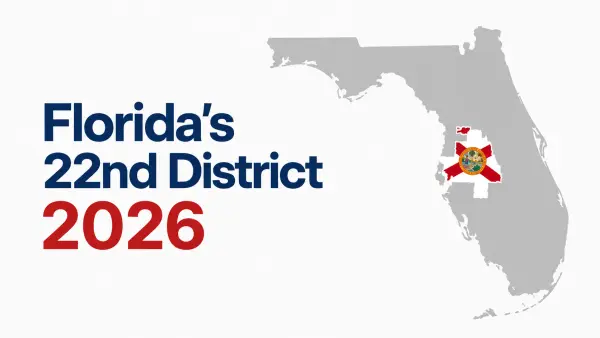
Florida’s 22nd Congressional District is an open-seat contest created by the state’s 2026 congressional map. It links parts of Broward, Palm Beach, Hendry and Collier counties, combining communities that previously voted in different congressional districts. The Cook Political Report moved the race from Lean Republican to Toss Up on September 25, placing it among the closest House contests nationally. The race also provides an early test of whether the new map’s Republican advantage can withstand a more Democratic national environment.
The Race
Democratic Rep. Lois Frankel represents the old 22nd District but chose to run in the reconfigured 23rd after redistricting, leaving the new seat open. Cook currently gives the new district a Republican-leaning partisan baseline. Republican Casey Askar won a seven-candidate August 18 primary with about 31 percent of the vote. Democrat Pia Dandiya won her two-person primary with about 69 percent.
Public polling is limited but close. A Tavern Research survey of 551 likely voters conducted August 10-12 found Dandiya and Askar tied at 50 percent each. A Democratic-sponsored Tulchin Research poll conducted August 24-31 found Dandiya at 46 percent and Askar at 44 percent. Because only a small number of public polls are available, neither result should be treated as a stable measure of the race. Cook’s September 25 Toss Up rating reflects a broader assessment that includes district fundamentals, candidate strength, campaign conditions and polling.
The Candidates
Pia Dandiya, Democrat: Dandiya is a Palm Beach County native, former teacher and high school principal, former White House Fellow and former Apple public-sector executive. Her campaign emphasizes affordability, education, healthcare, reproductive rights and protection of Social Security, Medicare and Medicaid. She says she wants to combine private-sector problem solving with experience in education and government. Her campaign has also emphasized ethics and reducing the influence of corporations and wealthy interests in Washington.
Casey Askar, Republican: Askar is a businessman, U.S. Marine veteran and former 2020 congressional candidate. He leads a family office with interests in franchising, real estate, energy and construction. His platform emphasizes lower taxes and regulation, domestic energy production, stricter immigration enforcement, parental rights in education, election rules requiring citizenship verification and a ban on congressional stock trading. He also calls for replacing the Affordable Care Act with a different healthcare system.
Top Issues
Cost of living: Both candidates make affordability central to their campaigns but diagnose the problem differently. Dandiya argues that housing, insurance, healthcare and everyday expenses require stronger consumer protections and preservation of federal benefit programs. Askar argues that taxes, federal spending and regulation are major drivers of high costs and says reducing them would improve household finances.
Healthcare: The candidates have a clear policy divide. Dandiya supports protecting the Affordable Care Act and federal health programs. Askar’s campaign says Obamacare should be ended and replaced while Medicare and Medicaid should be preserved by reducing waste and fraud. The practical details of a replacement plan are less developed on his public campaign site.
Immigration and border policy: Askar supports continued deportation of people in the country illegally who have criminal records, stronger border enforcement and a merit-based immigration system. Dandiya has placed less emphasis on immigration and more on affordability, education and social programs.
Government ethics: Both candidates say Congress needs stronger accountability. Askar explicitly supports banning members of Congress from trading individual stocks. Dandiya argues that wealthy interests and large corporations exercise too much influence over policymaking.
Evidence Check
Dandiya claim: federal health programs are under pressure. Check: Congress has enacted major changes to healthcare spending and eligibility during the current term, making Medicaid, Medicare and insurance affordability legitimate campaign issues. Whether a particular candidate’s policies would strengthen or weaken access depends on the specific program and implementation, so broad claims that one vote alone determines an individual’s coverage need case-by-case evidence.
Dandiya claim: South Florida families face an affordability crisis. Check: Housing and insurance costs have been persistent concerns in South Florida, but inflation, insurance premiums, rent and home prices are driven by different state, federal and market factors. A congressional candidate has influence over some of those factors but not all of them.
Askar claim: taxes and regulation are adding to the affordability problem. Check: Taxes and regulation can affect business costs and consumer prices, but their effects vary by sector. Current household costs also reflect housing supply, insurance markets, wages, energy prices and national economic conditions. The claim is a policy argument rather than a complete explanation of inflation.
Askar claim: only citizens should vote in federal elections. Check: Federal law already prohibits noncitizens from voting in federal elections. The dispute is over what documentation states should require to verify eligibility and whether additional requirements could deter or delay eligible voters.
Supporter Voices
Publicly available reporting offers more endorsement statements than interviews with ordinary local supporters. On Dandiya’s side, Florida AFL-CIO political director Rich Templin said she understands that working people need “a seat at the table” and cited her positions on jobs, Social Security and Medicare. Her endorsement coalition also includes education, labor and gun-safety organizations.
On Askar’s side, Collier County Sheriff Kevin Rambosk said Askar understands that public safety begins with “strong law enforcement” and secure borders. Republican Rep. Gus Bilirakis has described Askar as an American success story with experience creating jobs. These are endorsements from political or institutional figures, not a scientific sample of district voters.
How This Race Is Being Framed
Republicans are presenting Askar as a business-oriented conservative who can support President Donald Trump’s economic, immigration and energy agenda. Democrats are presenting Dandiya as a pragmatic former educator and public-sector executive focused on costs and government competence. The map itself remains part of the story: Republicans designed the new district to be more favorable to their party, while Democrats argue that the 2026 political environment and Dandiya’s profile have made it competitive. Cook’s shift to Toss Up reflects competitiveness, not a prediction that either candidate will win.
Related Links
- Cook Political Report House ratings
- Pia Dandiya campaign
- Casey Askar campaign
- CBS Miami district guide
- FL-22 public polling
- Florida Politics on Askar
Discussion Questions
- What makes an open-seat race different from a race with an incumbent?
- How much weight should voters give a candidate’s professional background?
- Which affordability issue matters most in South Florida?
- Should Congress try to preserve or replace the Affordable Care Act?
- How should immigration enforcement balance security and due process?
- Should members of Congress be prohibited from trading individual stocks?
- How much should a district’s partisan history matter when evaluating a current race?
- What are the advantages and disadvantages of mid-decade redistricting?
- Why can two polls of the same race produce different results?
- Imagine you live in FL-22. What would you ask both candidates before voting?
