
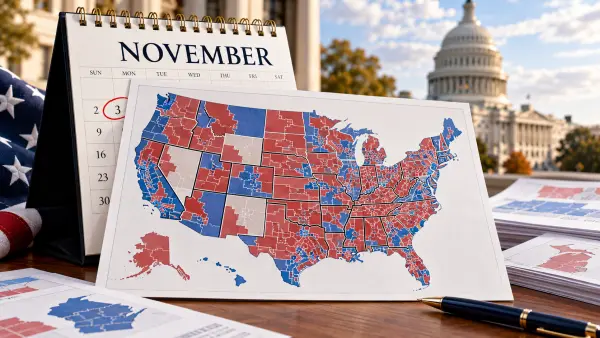
The Senate battlefield has drawn most of the midterm attention, but control of the House, and a wave of open governor’s races, are being shaped by the same underlying dynamics: crowded primaries that left lasting bruises, redistricting fights actively redrawing the map, and, in Florida, an unusually public rivalry within the president’s own party. This roundup goes beyond the ratings to look at what’s actually driving the House and governor contests worth watching.
The House: A Redistricting Tug-of-War
Cook Political Report currently rates 18 House seats as toss-ups, 10 held by Democrats and 8 held by Republicans, out of 42 districts Ballotpedia tracks as genuine battlegrounds. Cook’s own analysts, Erin Covey and Matthew Klein, wrote that Republicans could gain up to three seats from redistricting in Ohio alone, a reminder that this year’s maps are still moving underneath the ratings. A separate Cook redistricting tracker projects Republicans netting roughly four seats nationally from redistricting alone, though Cook still rates Democrats favored to win the chamber given the GOP’s three-seat majority. NRCC spokesperson Mike Marinella argued the numbers favor Republicans regardless, saying “the math is in our favor.”
Fact-check: a September 8-11 Cook/New River Strategies/GS Strategy Group poll of voters in the 37 most competitive House districts found Democrats leading, with Republican pollster Greg Strimple cautioning that redistricting “potentially knocked down the size of the wave” Democrats might otherwise see, meaning both parties’ own analysts see the map, not just persuasion, as a live variable this year.
Among competitive races PoliTalking has profiled in depth, Arizona’s 1st District, where Amish Shah has now twice beaten the national party’s preferred primary pick, Nebraska’s 2nd District, an open seat following Rep. Don Bacon’s retirement, and Iowa’s 1st District, a rematch decided by fewer than 800 votes last cycle, all remain genuine toss-ups worth watching closely.
California Governor: A Crowded Field Narrows to Two Familiar Fights
With Gov. Gavin Newsom term-limited, California’s June top-two primary drew 61 candidates, and the eventual runoff, Democrat Xavier Becerra against Republican Steve Hilton, only became clear after billionaire climate activist Tom Steyer spent $213 million of his own money trying to overtake them. Becerra, a former state attorney general and Biden-era health secretary, led most spring polling with roughly a quarter of the vote; Hilton, a former Fox News host who received Trump’s endorsement in April, consolidated conservative support and edged out Steyer for second.
Becerra’s campaign has centered on cost of living, with spokesperson Jonathan Underland saying after a May poll that Becerra has “built real momentum” among working Californians. Hilton has campaigned on rolling back the state’s clean-energy mandates and, at his primary night event, told supporters “change is coming to California, and it’s long overdue.” Fact-check: Republicans have not won a California governor’s race since 2006, a structural headwind that exists independent of either candidate’s individual campaign strength this cycle.
Florida Governor: An Open Seat, and a DeSantis Subplot
Term-limited Gov. Ron DeSantis’s seat drew a bigger intra-party story than the general election itself for much of the year. Trump endorsed Rep. Byron Donalds in February 2025, before Donalds had even formally entered the race, posting on Truth Social that Donalds is a “TOTAL WINNER” who would work closely with him in office. That early endorsement came as DeSantis’s wife, Casey DeSantis, was privately weighing her own run, and NBC News reported the governor himself began calling Tallahassee lobbyists about her prospects before ultimately not running. DeSantis endorsed Donalds directly on Sept. 3, despite the two men’s well-documented past tensions.
Donalds has built one of the largest campaign war chests in state history, with an affiliated PAC raising more than $107 million and spending nearly $70 million of it through mid-September, backed by major donors including Palm Beach investor Thomas Peterffy and shipping magnate Richard Uihlein. His Democratic opponent, former Republican congressman David Jolly, who left the GOP in 2018, has raised roughly $1 million by comparison. Fact-check: despite that enormous gap, Florida’s own public campaign-finance matching program has actually paid out more matching funds to Jolly than to Donalds so far, since the program specifically rewards small-dollar, in-state contributions rather than the large checks fueling Donalds’s PAC. That is a narrow, technical data point, not evidence the overall financial gap has closed.
Nevada Governor: Still One of the Closest in the Country
Nevada’s governor’s race, between Republican incumbent Joe Lombardo and Democratic Attorney General Aaron Ford, which PoliTalking has profiled in depth, remains a dead heat in the polling averages available, with data center policy and housing costs emerging as defining local issues distinct from the national conversation.
Note on Scope
This roundup reflects reporting, polling and campaign finance filings available as of publication, all of which change frequently this close to an election. Fundraising totals cited here are current through each candidate’s most recent public disclosure at the time of the source reporting. Links to PoliTalking’s own Election Briefings assume those posts are published at the URLs shown; confirm before publishing if any slug has changed.
Related Links
- Cook Political Report unveils 18 toss-up House races for 2026 – The Hill
- New Battleground District Poll Shows Democrats Up – Cook Political Report
- Who are the 2026 California governor candidates? – CalMatters
- Steve Hilton vs. Becerra: Latest California Polls With 7 Weeks to Midterm – Newsweek
- Florida Governor Candidates 2026 General – Sparker’s Soapbox
- Byron Donalds dwarfs David Jolly in early 2026 Florida governor race fundraising – Yahoo News
Discussion Questions
- Does knowing how much a state’s map has changed through redistricting affect how you read a House race’s competitiveness?
- What do you make of a billionaire spending over $200 million of his own money to try to reach a runoff?
- How should voters weigh a candidate’s fundraising total against a state’s own public matching-funds program?
- Why do you think Trump endorsed Donalds so early, before he had even formally entered the race?
- What does it tell you when a sitting governor’s own spouse considers running to succeed him?
- Should structural facts, like California not electing a Republican governor since 2006, factor into how you weigh a close-looking primary result?
- How much should national House ratings affect how you think about your own, possibly less competitive, district?
- Do you think a huge financial advantage, like Donalds’s in Florida, makes a race less interesting to follow?
- What responsibility do party leaders have to stay neutral, or not, in contested primaries within their own party?
- Imagine you are a voter in a battleground House district. What would you want candidates to address that national coverage isn’t focused on?
