
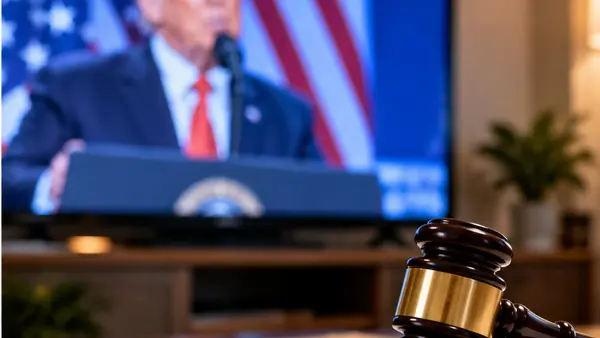
A federal judge in New York ordered the Trump administration on October 11 to stop using Department of Homeland Security (DHS) funds for a series of television ads featuring President Donald Trump. Plaintiffs say the ads kept airing afterward in hundreds of spots, and Justice Department lawyers have apologized, blaming a delay in passing the order to the agency. The administration calls them public-service announcements; challengers call them political promotion, weeks before the November 3 midterms.
This article reflects reporting available as of October 13. The case is moving quickly, and the court has not ruled on whether the government complied.
Background
Agencies routinely buy ads to inform the public about services and programs. Congress appropriates money for specific purposes, and federal law restricts spending on publicity or propaganda, so legality depends on an ad’s content, purpose and funding source.
DHS allocated $20 million for a national media campaign and awarded the ad contract to a Maryland firm, LMD Agency, on September 20, CBS News reported. The tracking firm AdImpact counted more than $21.7 million in cable and broadcast spending on five ads by Monday morning, and it said the figure may be incomplete because the spots were classified as public-service announcements. The ads include a refurbished 2024 Trump campaign video and one on the operation to remove Venezuela’s Nicolás Maduro.
Common Cause, two labor unions and an Alabama Democratic state senate candidate sued the week before the order, according to Democracy Docket. They allege that $20 million was diverted from immigration enforcement funds and argue the spending exceeds what Congress authorized and violates the publicity and propaganda restrictions. The Democratic National Committee has separately sued over the ads.
What the Judge Ordered
U.S. District Judge Jennifer Rochon issued a temporary restraining order on the evening of October 11. It lasts 14 days unless extended, bars DHS from using funds to create or distribute the challenged ads, and requires the government to cancel remaining placements and file a compliance report within 24 hours. Rochon found the plaintiffs likely to succeed on the merits and likely to suffer irreparable harm. She rejected the argument that DHS’s pledge to stop buying ads made the case moot and said a fuller opinion would follow.
Fact-check: A temporary restraining order preserves the situation while a case proceeds. It is not a final ruling that the ads were unlawful.
Ads Aired After the Order
In a Monday filing, plaintiffs said the ads kept running. Citing AdImpact data, they counted nearly 400 spots after the order took effect, including 193 airings on 60 Minutes and 198 on America’s Funniest Home Videos, plus more on Monday afternoon, Democracy Docket reported.
The Justice Department’s filing said the judge emailed the order at 6:46 p.m. Sunday, government counsel forwarded it to agency counsel at 7:58 p.m., and agency counsel did not see it until Monday morning. The department said it “apologizes to the Court and the plaintiffs.” It also said the $20 million purchase order was stayed, payments were frozen and the vendor was told to stop running the ads. Plaintiffs asked for a status conference and are not yet seeking contempt sanctions.
Fact-check: The airing counts come from the plaintiffs’ filing, and this article could not find the government’s own count. The government acknowledged the ads aired after the order, but no court finding on deliberate defiance has been reported.
What Different Sides Are Saying
The administration: A White House official said the ads are “clearly not political” and noted that the president is not on the ballot, CBS reported. The White House likens them to past administrations’ public-service announcements, and Trump has called the spending standard. After Republican criticism, he said he would pay for the ads from his political fundraising, though a White House official said there were no immediate plans to repay money already spent. A DHS official said in a declaration that the funds were available for commemorating efforts and events related to border security.
Fact-check: Agencies may fund public-information campaigns, but the label does not settle whether a given ad complies with spending law. A president off the ballot can still feature in ads that raise election concerns, and a pledge of future private payment does not repay money already spent. Whether a repurposed campaign video fits the stated border-security purpose is a question for the court, and this article does not resolve it.
Challengers and critics: Plaintiffs say the ads promote Trump’s political agenda. Senate Democrats described them in a letter as government propaganda. Republican Senate Majority Leader John Thune said they should not be paid for with taxpayer dollars, and Republican Sen. John Kennedy said officials should not spend public money on ads for themselves.
Fact-check: Bipartisan criticism is not a legal finding, and the judge’s conclusions are preliminary.
Why This Matters
The case tests how far officials can use agency advertising budgets to explain policy without turning taxpayer-funded publicity into campaigning. The compliance dispute is separate from whether the ads were lawful.
Note on Scope
The order is temporary and the litigation continues. Spending figures differ by date and by what they measure, and the amounts committed, spent and paid should not be treated as the same number. Democracy Docket discloses that its founder chairs the board of the plaintiffs’ counsel, Democracy Forward, so key facts here rest on CBS and the filings described.
Related Links
- CBS News: Judge Orders Ads Canceled
- Democracy Docket: Ads Halted by Federal Judge
- Democracy Docket: Ads Kept Running After Order
- CNBC: Judge Orders Immediate Stop to Ads
- CNN: Ads Aired After Judge’s Order
- ABC7 New York: Judge Orders Ads Canceled
Discussion Questions
- Have you ever seen a government ad that felt political? What made it feel that way?
- What distinguishes a public-service announcement from a political ad?
- Should ads featuring an incumbent president face stricter funding rules near elections?
- Does it matter that the president in an ad is not personally on the ballot?
- What evidence would show that a government ad serves a legitimate public purpose?
- How should Congress limit the use of agency funds for publicity?
- What responsibility do agencies, contractors and broadcasters have once a court orders ads stopped?
- Would private funding resolve the controversy or raise different questions?
- What remedies are appropriate if public money was spent unlawfully?
- Imagine you are the judge. What would you want the government to show you at a compliance hearing?
