
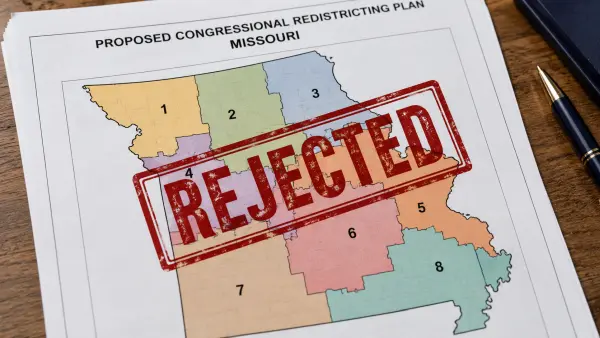
Missouri’s Supreme Court unanimously blocked the state from using a Republican-drawn congressional map in November, ruling that voters must first get a chance to approve or reject it at the ballot box. Because that referendum can’t happen before Election Day, the map Missouri used before 2025 stays in effect for this year’s midterms instead.
The ruling came days before a Sept. 8 deadline to finalize ballot details for November, and Missouri Attorney General Catherine Hanaway said she would appeal to the U.S. Supreme Court.
Background
Missouri’s Republican-controlled Legislature redrew the state’s congressional map in a special session last fall at President Trump’s urging, splitting Kansas City across three districts in a bid to make the area more competitive for Republicans. Missouri currently sends six Republicans and two Democrats to the U.S. House. The advocacy group People Not Politicians gathered more than 330,000 signatures, over double what was required, seeking a statewide referendum on the map. Secretary of State Denny Hoskins, a Republican, rejected the petition on primary day in August, arguing federal law gives state legislatures sole authority over congressional redistricting. A lower court agreed with him.
The Supreme Court reversed that decision unanimously. Judge Ginger K. Gooch wrote in the court’s opinion that “the referendum petition was legal, sufficient, and timely, and the secretary incorrectly concluded otherwise.” Notably, the ruling does not hold that mid-decade redistricting itself is illegal; the same court separately upheld the Legislature’s authority to redraw districts outside the normal once-a-decade cycle in an earlier ruling this year. The map is blocked specifically because voters have not yet had the chance to approve it.
What Different Sides Are Saying
Supporters of the referendum cast the ruling as a straightforward win for direct democracy. Richard von Glahn, executive director of People Not Politicians, said “this is what democracy looks like.” Fact-check: the ruling does center on a specific state constitutional provision allowing referenda on “any act” of the Legislature, which the court found covers congressional redistricting law; it is a narrower legal holding than a broad statement about democracy, though it does have the practical effect the plaintiffs sought.
Hanaway and Missouri Republicans argue the ruling is unprecedented and legally wrong. Hanaway said “never before in American history has a court overturned a congressional map” after a primary and before a general election, and that the decision violates federal law. Fact-check: the timing is genuinely unusual, since Missouri’s August primary was conducted under the now-blocked 2025 map. Whether the U.S. Constitution’s Elections Clause gives state legislatures the exclusive, court-proof authority Hanaway describes is a live and disputed legal question the Missouri Supreme Court considered and rejected, but which the U.S. Supreme Court has not conclusively resolved.
Note on Scope
This article covers the state court ruling as of publication. Whether Hanaway’s federal appeal succeeds, and how the Sept. 8 ballot deadline will be handled procedurally, were not yet known.
Related Links
- Missouri Supreme Court blocks Trump-backed US House map and orders it be put to a vote – CNN
- Missouri court blocks Trump-backed US House map and orders it to be put to a vote – ABC News
- Missouri Supreme Court blocks congressional map, orders vote – KCTV5
- Missouri Supreme Court Blocks GOP Redistricting Map – NOTUS
- Missouri Supreme Court blocks gerrymandered congressional map, orders referendum vote – Missouri Independent
Discussion Questions
- Should voters be able to force a referendum on a legislature’s redistricting decision?
- Do you find the referendum supporters’ or Hanaway’s legal argument more persuasive?
- What should happen when a primary is conducted under a map that a court later blocks?
- How should courts weigh election-deadline pressure against taking the time to get a ruling right?
- Why do you think mid-decade redistricting has become more common across the country?
- Should Congress set uniform national rules for how and when states can redraw districts?
- What responsibility do state officials like the secretary of state have when reviewing referendum petitions?
- How should the public weigh a unanimous state court ruling against the prospect of a federal appeal?
- Does it matter to you which party benefits from a given redistricting map, or just whether the process was fair?
- Imagine you are a Missouri voter asked to approve or reject this map in November. What would you want to know first?
