
What Happened
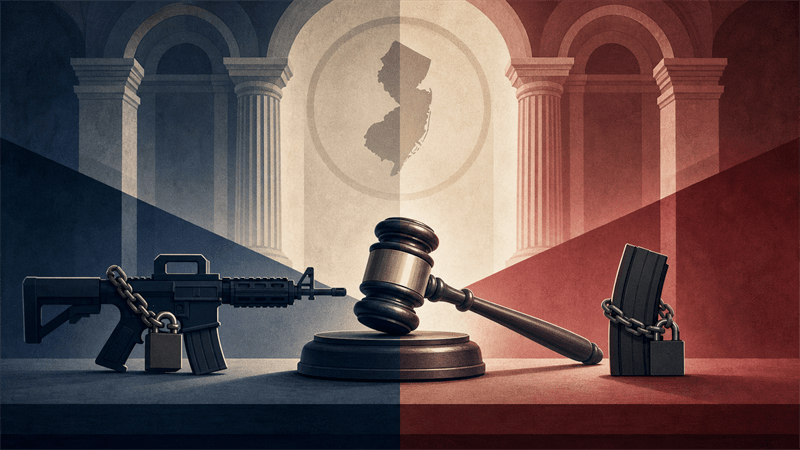
On July 17, 2026, the full U.S. Court of Appeals for the Third Circuit ruled that New Jersey’s restrictions on semiautomatic rifles and magazines holding more than 10 rounds violate the Second Amendment.
The court modified an earlier federal trial-court decision that had focused only on the Colt AR-15. The appeals court said the constitutional problem extended to the full class of semiautomatic rifles covered by the challenged provisions. It also reversed the trial court’s decision upholding the magazine limit.
The ruling is important beyond New Jersey because it is the first federal appellate decision to invalidate a state assault-weapons ban. It also deepens a disagreement among federal appeals courts. Only one week earlier, the Seventh Circuit upheld Illinois restrictions on semiautomatic weapons and large-capacity magazines.
The Supreme Court has already agreed to hear separate challenges involving semiautomatic-rifle restrictions in Cook County, Illinois, and Connecticut during its next term. Those cases could produce a nationwide rule.
Background
New Jersey enacted its assault-firearm restrictions in 1990. The law identifies specific models and also covers firearms that meet listed feature-based definitions. The state later reduced the permitted magazine capacity from 15 rounds to 10.
Gun-rights organizations and individual gun owners challenged the rifle and magazine provisions after the Supreme Court’s 2022 decision in New York State Rifle & Pistol Association v. Bruen. Under Bruen, when conduct is covered by the Second Amendment’s text, the government generally must show that its regulation is consistent with the nation’s historical tradition of firearm regulation.
A federal district judge ruled in 2024 that New Jersey could not ban the Colt AR-15 but allowed the magazine restriction to remain. Both sides appealed, and the Third Circuit considered the consolidated cases as a full court, a procedure known as en banc review.
What the Court Decided
The majority concluded that semiautomatic rifles covered by the case are commonly possessed for lawful purposes. It reasoned that broad bans on an entire class of commonly used arms lack sufficient support in the historical tradition required by recent Supreme Court decisions.
The court also treated detachable magazines as protected arms because many modern firearms require them to operate. It found that New Jersey had not identified a sufficiently similar historical tradition supporting a complete ban on magazines holding more than 10 rounds.
The decision did not resolve every part of New Jersey’s assault-firearm law. The court sent the cases back to the district court for further work on challenges involving other covered firearms, including some semiautomatic pistols and shotguns.
The ruling is binding within the Third Circuit, which includes New Jersey, Pennsylvania, Delaware, and the U.S. Virgin Islands. Its practical implementation may also depend on the appellate mandate and any further court orders. New Jersey officials can seek rehearing or Supreme Court review.
What Different Sides Are Saying
Gun-rights supporters
Gun-rights groups call the ruling a major constitutional victory. They argue that AR-15-style rifles and magazines holding more than 10 rounds are owned by millions of Americans for lawful purposes, including sport, training, and self-defense. In their view, a state cannot ban an arm simply because officials consider it especially dangerous.
Fact check: Semiautomatic rifles are widely owned, and the record accepted by the court described millions in circulation. That does not mean every use is lawful or that every regulation is unconstitutional. The ruling addresses possession bans on the covered class, not all firearm regulations.
Supporters also say the court correctly applied Bruen by requiring the state to identify a relevant historical tradition rather than relying only on modern public-safety arguments.
Fact check: The majority used the Supreme Court’s history-based framework. The disagreement is not whether public safety matters. It is how that concern fits within the constitutional test the Supreme Court has required.
New Jersey officials and gun-control supporters
New Jersey officials argue that the restricted weapons and magazines can make mass shootings more lethal and that elected lawmakers should have room to respond to modern risks. The state attorney general called the decision legally incorrect and said the office was considering its options.
Fact check: Semiautomatic rifles are used in some highly deadly mass shootings, but handguns account for a larger share of firearm homicides overall. The policy debate often concerns the potential number of casualties in particular attacks, not the most common weapon used in gun crime.
Dissenting judges argued that states may restrict weapons they consider dangerous and unusual and that the majority applied history and the common-use test too narrowly. Supporters of the law also point to appellate decisions from other parts of the country that have upheld similar restrictions.
Fact check: Other federal appeals courts have upheld assault-weapons restrictions, including the Seventh Circuit’s July 2026 Illinois decision. That disagreement is one reason the Supreme Court’s upcoming cases matter.
What the Ruling Does Not Do
The ruling does not legalize fully automatic machine guns. A semiautomatic firearm fires one round with each trigger pull, while a fully automatic firearm can continue firing while the trigger remains pressed. Federal law heavily restricts civilian possession of machine guns.
It also does not erase every New Jersey gun law. Background-check rules, licensing requirements, prohibited-person laws, and restrictions not decided in these cases remain separate legal questions.
Finally, the Third Circuit did not establish a nationwide rule. Its reasoning may influence other courts, but the Supreme Court will have the final word if it decides the broader constitutional question in its upcoming cases.
Fact Check
- Claim: The court struck down New Jersey’s entire gun-control system. False. The decision concerns specific assault-firearm and magazine provisions.
- Claim: The ruling covers fully automatic weapons. False. The central holding concerns semiautomatic rifles and magazines.
- Claim: Every federal appeals court agrees with this decision. False. Other circuits have upheld similar laws.
- Claim: The magazine decision automatically invalidates every capacity limit in the country. False. The decision is binding only within the Third Circuit unless the Supreme Court adopts the same rule nationally.
- Claim: The case is completely finished. Misleading. Further district-court proceedings remain, and New Jersey may seek additional review.
Related Links
- Third Circuit opinion in the consolidated New Jersey cases
- Associated Press report on the New Jersey ruling
- Reuters report on the decision and reactions
- National Shooting Sports Foundation statement supporting the ruling
- Associated Press report on the conflicting Illinois decision
- Axios overview of the Supreme Court’s upcoming semiautomatic-rifle cases
Discussion Questions
- What part of the ruling was most surprising to you?
- How should courts decide whether a weapon is in common use?
- How much weight should public safety receive in Second Amendment cases?
- Why do federal appeals courts reach different conclusions under the same precedent?
- Does the distinction between semiautomatic and automatic firearms affect your view?
- Should magazine capacity matter under the Constitution?
- What historical evidence should be most persuasive to a modern court?
- How might this ruling affect lawmakers in other states?
- Which sentence in the court’s reasoning deserves the closest attention?
- If you were a Supreme Court justice, what rule would you adopt?
