
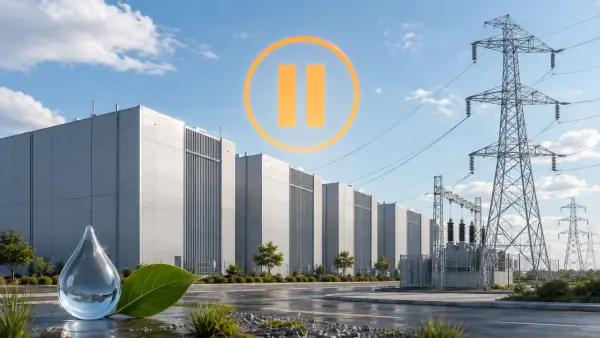
New York became the first state to impose a statewide moratorium on new hyperscale data centers, pausing state environmental permits for up to one year. Governor Kathy Hochul signed the executive order on July 14, 2026, freezing new projects that draw 50 megawatts of power or more while regulators write a permanent rulebook. The stated goal is to keep the cost of new power lines and infrastructure from landing on ordinary utility customers.
The mechanism is a permitting pause, not a demolition order. During the freeze, the Department of Environmental Conservation will not issue discretionary permits that are not already deemed complete, while the state develops a Generic Environmental Impact Statement assessing energy demand, water use, and air quality. Hochul also said she would pursue legislation to repeal sales-tax exemptions for large data centers.
Hyperscale facilities house thousands of servers and need large, steady supplies of electricity and water for cooling. New York pays some of the highest energy prices in the country, and one think tank found residents paid 56 percent above the national average per kilowatt-hour in April 2026, which is the cost pressure the order is built around.
Background
The order did not appear from nowhere. New York already has more than 130 data centers, and the legislature passed its own measure, the Responsible Data Center Development Act, in June, which would pause centers of 20 megawatts or more and add labor and community-funding requirements. Hochul has not signed that bill, with her office calling it complex and saying an executive order was the fastest way to act now.
That choice is part of the story. The executive order sets the threshold at 50 megawatts rather than the legislature’s 20, and drops provisions the Senate bill contained, including mandatory third-party audits and required local infrastructure funding. The result is a narrower pause imposed by the governor instead of a broader one written by the legislature, which is one reason the response has not split neatly along party lines.
New York is not alone in the impulse. Legislators in at least a dozen states, including Georgia, Virginia, Michigan, and Maryland, have filed data-center moratorium bills this cycle, and Arizona’s governor signed a three-year pause on new sales-tax breaks for the industry. New York is simply the first to enact a statewide construction moratorium rather than debate one.
What Different Sides Are Saying
Hochul frames the pause as consumer protection, not technophobia. She said progress should not arrive with a higher utility bill or a depleted water supply, and argued the state can embrace AI while making companies cover their own power costs. State Senator Kristen Gonzalez, who sponsored the legislative version, appeared at the signing and argued that good technology policy should make life easier rather than harder.
The industry and national Republicans call it a costly mistake. The Data Center Coalition warned the moratorium would push investment, jobs, and tax revenue to other states and signal that New York is closed for business. President Trump posted that New York had made a terrible decision and should reverse it immediately, and Hochul’s Republican gubernatorial opponent, Bruce Blakeman, argued that local governments should be free to strike their own deals with tech companies.
The more revealing split is inside the Democratic coalition. Some progressives say the order does not go far enough, noting it raised the size threshold and dropped the audit and community-benefit mandates the legislature had approved. Meanwhile Democratic governors elsewhere, including Maine’s Janet Mills and Virginia’s Abigail Spanberger, have cautioned against moratoriums entirely, wary of turning away investment. The disagreement is less left versus right than growth versus caution, and it runs through both parties.
What to Watch
Two questions will decide whether this is a genuine turning point or a one-year detour. The first is authority. Hochul acted by executive order rather than signing the legislature’s bill, and whether that route holds up, and whether she eventually signs or reshapes the Responsible Data Center Development Act, will determine how durable the pause is. Critics who see this as gubernatorial overreach and allies who wanted the fuller legislative version are watching the same decision from opposite sides.
The second is the framework itself. The moratorium buys up to a year to produce the environmental impact statement and the tax and community-benefit rules that follow. What those rules require of companies, on power sourcing, water, and payments to localities, will matter far more in the long run than the pause. New York’s ratepayers, the tech firms weighing sites in neighboring states, and the dozen other legislatures with pending bills will all be reading the result.
Related Links
- Official announcement of the moratorium and executive order (Office of the Governor)
- New York becomes first state to impose a data center ban (CNBC)
- How the executive order works and what it pauses (Axios)
- Industry and opponent reaction to the moratorium (ABC7 New York)
- Trump criticizes the New York decision (CNBC)
- How the order differs from the legislature’s bill (Futurism)
Discussion Questions
- Have you noticed your electricity bill changing recently? Would data center growth make you more or less worried about it?
- Should a state pause an industry to study it first, or regulate as it grows?
- The same order is called “consumer protection” by supporters and “closed for business” by critics. Why the different framing?
- Is a governor’s executive order a fair way to act quickly, or should this go through the legislature?
- Who should pay for the new power lines a data center needs: the company, all ratepayers, or the local community?
- Data centers create few permanent jobs but large tax revenue. How would you weigh that trade-off?
- Critics say slowing AI infrastructure helps foreign competitors. Does that argument change your view?
- Why might Democrats disagree with each other over a policy like this?
- Imagine you lead a town offered a large data center. What would you demand before saying yes?
- What would make you consider this moratorium a success one year from now?
