
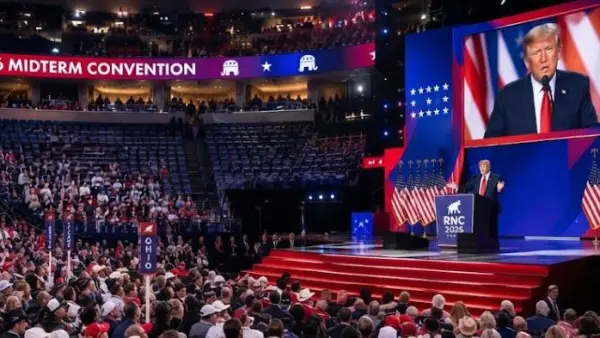
Republicans held their first-ever midterm convention Sept. 9 to 10 in Dallas, and President Trump used it to make two pledges that dominated national coverage. On opening night, he promised a $5,000 “dividend” check to every adult American citizen if Republicans hold the House and Senate in November. On closing night, he led the crowd through a call-and-response voting pledge that included the line, “I’m going to try to cheat like hell like they do.”
Vice President Vance gave the convention’s other headline address, closing his own speech with a plea to persuadable voters: “don’t give the country over to a bunch of crazy people” over a single policy disagreement.
Attendance became its own storyline. Trump had told reporters before the event, “we’re going to be sold out tonight,” but photos and video from inside the American Airlines Center showed large sections of the upper deck sparsely filled well into the evening.
Background
The convention came as Republicans face a difficult midterm environment, with polling showing widespread voter frustration over inflation and the cost of living. Trump said the dividend was possible “because we’ve done so well and because our country is making so much money,” though he offered no specifics on funding or congressional approval. It is not the first time he has floated a payment like this: a similar $2,000 “tariff dividend” promise last year never materialized into an actual program.
At roughly $1.2 trillion for all U.S. adults, the new dividend would need congressional authorization to become real. Sen. Bernie Moreno, R-Ohio, said he would introduce legislation to pass it after the election; other Republicans were less enthusiastic. Rep. Chip Roy, R-Texas, wrote that “dependency is evil and soul-sucking in all its forms.”
On the attendance question, the RNC said the arena holds 21,000 people and that it expected 20,000 attendees. The convention’s opening night also overlapped with the NFL’s kickoff broadcast, a competing draw some analysts cited as a factor in turnout.
What Different Sides Are Saying
Trump and his allies have framed the dividend as a reward for economic success and the “cheat like hell” comment as a joke aimed at Democrats, whom Trump has repeatedly accused, without evidence, of election fraud. Fact-check: election law professor Rick Hasen has written that Trump would likely have a First Amendment defense against any legal challenge to the dividend pledge itself, since candidates are generally allowed to make campaign promises. Separately, government ethics expert Richard Painter noted that promising a specific dollar amount, tied explicitly to voters choosing a party, is legally distinct territory that has not been extensively tested in court.
Critics, including Democratic officials, have characterized the dividend pledge as improper given how directly it links a cash payment to a specific electoral outcome. California Gov. Gavin Newsom said Trump had “replaced the Pledge of Allegiance with a pledge of allegiance to himself.” Fact-check: federal law does make it a crime to offer payment in exchange for a vote, but legal experts cited across multiple outlets have not concluded that a broad, non-individualized campaign promise like this one meets that legal standard; this remains a disputed, unresolved legal question rather than a settled one.
On the funding mechanism specifically, this article could not identify any confirmed source of funds or legislative text backing the dividend as of publication. Whether Congress would need to approve it, and whether Republican leadership supports doing so, remains unclear; reactions among GOP lawmakers themselves ranged from enthusiastic to openly skeptical.
On attendance, Trump maintained the event was a success both in the moment and afterward. During his speech, he called the arena “packed,” suggesting empty seats visible in photos were people who had stepped away, and the next morning he posted that opening night was a “sold-out hit” that broke attendance records and drew a streaming audience bigger than the NFL’s, without providing figures. Fact-check: journalists inside the venue documented a different picture. Washington Post columnist Dana Milbank estimated roughly 5,000 empty seats, close to a quarter of the arena’s capacity, from the venue’s upper level around the time Trump took the stage. A Yahoo News analysis similarly found the lower level crowded while the middle and upper sections remained thin as late as an hour before Trump’s arrival, climbing to an estimated 65% to 70% full by the time he spoke. Some middle-level seats were occupied by members of the media rather than ticketed attendees. No independent, verified attendance count for the full arena was available as of publication, but the visual evidence from multiple outlets does not support a literal “sold out” characterization.
Note on Scope
Both pledges were made as convention remarks, not enacted policy or introduced legislation. This article covers what was said and how it was received, not whether either pledge will result in any actual government action.
Related Links
- At RNC midterm convention, Trump pitches $5,000 payments to U.S. citizens – but only if GOP wins House and Senate – CBS News
- Republican convention wraps with speeches from Vance, Trump – NPR
- Trump Makes RNC Swear Oath To Cheat in Midterm Elections – Newsweek
- Trump’s $1 trillion-plus ‘dividend’ plan meets immediate bipartisan pushback – CNBC
- 5 things to know about Trump’s $5K dividend pledge – The Hill
- Trump promised $5,000 checks if Republicans win the midterms. How would that work? – PBS NewsHour
- Donald Trump’s RNC Convention Appears to Have Empty Seats – Yahoo News
- Dana Milbank: In Dallas, Trump’s Land of Make Believe Unravels – The Washington Sun
Discussion Questions
- Do you think a campaign promise tied directly to an election outcome, like this dividend, crosses a line?
- Did you interpret the “cheat like hell” comment as a joke, a real instruction, or something in between?
- Do you find Trump’s economic framing or critics’ vote-buying concerns more persuasive?
- Why do you think some Republicans, like Chip Roy, publicly broke from Trump on the dividend idea?
- How should voters weigh a campaign promise against a candidate’s history of similar promises not materializing?
- What responsibility
