
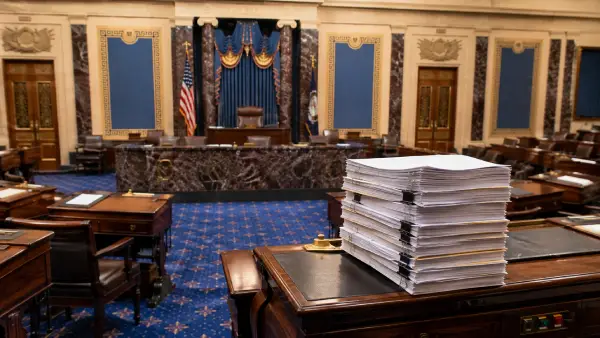
The Senate was scheduled to begin a five-week recess on Thursday, August 6, returning September 14. As of Wednesday evening it had not adjourned, and Majority Leader John Thune described the accumulated workload to Politico as a train wreck.
The chamber worked through several items Wednesday. It agreed by voice vote to proceed to H.R. 6500, the legislative vehicle for a continuing resolution to fund the government, after a 89 to 4 vote Monday evening to advance it. It confirmed Erica Schwartz as director of the Centers for Disease Control and Prevention by 51 to 44. It voted 50 to 44 to invoke cloture on 74 nominations considered together as a group. Still pending were the floor vote on Todd Blanche’s nomination as attorney general and a motion to proceed to the Protect College Sports Act.
Running underneath all of it is the dispute over the SAVE America Act, which President Trump has demanded the Senate pass before leaving town.
Background
Trump demanded on July 27 that Thune cancel the recess until the Senate passes the proof-of-citizenship voting bill, or alternatively eliminate the legislative filibuster. Sen. Mike Lee objected in writing to any adjournment motion and requested a roll call vote, warning Thune not to assume he had consent. Sens. Rick Scott, Ashley Moody, and Jim Banks joined the call to stay in session.
Thune’s response has been consistent and arithmetic. The Senate has voted on the measure five times without success. It needs 60 votes. Republicans hold 53 seats, no Democrat has voted for it, and Murkowski, Tillis, and McConnell have voted against it. On Tuesday he told reporters he was willing to help in any way possible if a path existed, adding: “It seems to me some days that I’m the only one here who can count to 50 in this town. But we don’t have the votes to get rid of the filibuster, and we aren’t flipping 10 Democrats to vote for SAVE.”
McConnell’s continued absence from the Capitol has further complicated the count.
This is not the first year this has happened. Before the 2025 August recess, Trump pressed Thune to keep senators in Washington to clear a backlog of nominations. The Senate left without a deal after negotiations with Democrats collapsed.
What Different Sides Are Saying
Thune says the votes do not exist, and the record supports him. Five failed votes and three named Republican opponents are documented facts, not characterizations. What critics can fairly say is that Thune has also declined to schedule the bill again on its own, which he confirmed, so the claim that there is no path and the choice not to test it again are separate things.
Trump’s allies want the attempt made regardless of the outcome. Lee’s position, restated Sunday, was that the Senate does not need a summer vacation as much as the country needs the bill. This is an argument about visible effort rather than about arithmetic, and it should be read as such. Forcing a roll call on adjournment would put every Republican on record either voting to leave without the bill or voting to stay.
Republicans disagree among themselves about the vehicle. Sen. John Kennedy told Axios that leadership does not want a third reconciliation package, which could carry parts of the SAVE America Act, and called that a huge mistake. Thune has largely deferred to Budget Committee Chair Ron Johnson, who told Axios a budget resolution vote this week was possible. Murkowski has signaled she would likely vote against proceeding to it. This is a dispute inside the majority, not between the parties.
Democrats have offered a trade. According to senators familiar with the discussions, Democrats are willing to speed floor votes on a Russia sanctions bill, the stopgap funding measure, and Blanche’s confirmation in exchange for Republicans deferring any budget resolution covering the Iran war and election measures until after the recess. Whether that constitutes cooperation or leverage depends on which side is describing it.
On whether the objections can actually stop the recess. Reporting continues to conflict on this, as it did last week. Several outlets state that objections can be overridden if 60 senators vote to adjourn; others state that a single senator can force a recorded vote but that only a simple majority is required. Fox News reported a third mechanism entirely: that a motion to adjourn is not debatable, that failing unanimous consent the Senate would simply convene again the next day, and that none of this produces a vote on the bill itself. We could not resolve which characterization is correct.
One point on which the coverage agrees. Whatever the procedural route, none of these maneuvers passes the SAVE America Act. The objection can impose political cost on colleagues and can consume floor time. It cannot supply the 60 votes.
Note on Scope
This is unresolved. As of Wednesday evening the Senate had not adjourned, no adjournment motion had been voted on, and the Blanche confirmation vote had not occurred. Any of these could change within hours.
Reports of Thune’s exact phrasing come from Politico via secondary aggregation, and we have not seen the full quotation in its original context.
For readers following the underlying dispute, our earlier coverage of the recess ultimatum sets out the SAVE America Act’s provisions and the disenfranchisement estimates attached to it.
Related Links
- Senate Republicans scramble for August recess plan amid Trump pressure (The Hill, with the Democratic offer)
- Republicans join Mike Lee’s bid to cancel August recess unless SAVE Act is passed (Deseret News)
- Senate’s SAVE snub (Axios, on the reconciliation dispute inside the majority)
- Reporter’s notebook: inside the Senate showdown over Trump’s push to scrap August recess (Fox News, on the adjournment mechanics)
- Schedule for Wednesday August 5, 2026 (Senate Democratic Caucus, the day’s official agenda)
- Wednesday, August 5, 2026 (U.S. Senate Daily Press, the official floor log)
- Trump demands Senate cancel August break until it passes the SAVE America Act (Associated Press via PBS)
Discussion Questions
- Should a legislature be able to leave with unfinished work on the calendar?
- Is there value in holding a vote you know will fail?
- What does it mean that 74 nominations were confirmed as a single group?
- Should the majority leader schedule a bill the president wants but that lacks votes?
- Is a five-week recess too long, about right, or too short?
- Why might senators of the same party disagree about strategy this sharply?
- Should the rules for adjourning the Senate be clearer than they appear to be?
- Is trading faster votes on some items for delay on others a reasonable way to legislate?
- What would you cut first if you had to clear this agenda in two days?
- Imagine you are a senator facing a recorded vote on going home. How do you explain your vote?
