
Featured Image Alt Text: Open leather agreement folder and fountain pen on a polished table in a sunlit government meeting room
Reading
An Agreement That Nobody Has to Approve
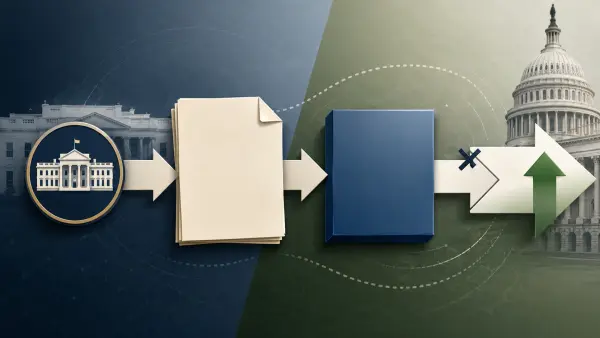
On July 22, 2026, the United States and Saudi Arabia signed a civil nuclear cooperation agreement and sent it to Congress for review. What happens next surprises most people. Congress will not vote to approve it. Under Section 132 of the Atomic Energy Act the agreement takes effect on its own once the review period ends, unless both chambers pass a resolution blocking it and then survive a presidential veto. Doing nothing means yes.
That inversion is the single most useful thing to understand about American foreign policy. The civics-class version, where Congress debates and votes and the president signs, describes almost none of how the United States actually commits itself abroad. Our coverage of the Saudi agreement looks at the substance of that particular deal. This piece looks at the machinery underneath it.
A Constitution That Splits the Job
The Constitution divides foreign affairs deliberately and incompletely. Article II makes the president commander in chief and gives him the power to make treaties, but only with the advice and consent of the Senate. Article I gives Congress the power to declare war, regulate commerce with foreign nations, and raise and fund the armed forces.
Neither branch can run foreign policy alone on paper. In practice the president acts first, because one person can decide faster than 535 can, and Congress responds afterward. Nearly every mechanism described below is a version of that same asymmetry.
Treaties: The Rare Route
A treaty requires two thirds of the senators present to consent before the president can ratify it. That is a supermajority, and outside of amending the Constitution or removing an official from office, it is among the highest bars the document sets.
It is also increasingly unused. Between 1789 and 2004 the United States entered 1,834 treaties and 16,704 executive agreements, meaning roughly one agreement in ten took treaty form. Since the late 1930s the share has fallen well below that. The treaty has not been abolished. It has been quietly bypassed.
Executive Agreements: The Normal Route
An executive agreement is an international commitment made without the Senate treaty process. There are three kinds. Congressional-executive agreements rest on authority Congress granted by statute, needing only ordinary majorities. Some agreements are made under the terms of a treaty already ratified. A third category, sole executive agreements, rests on the president’s own constitutional authority.
The last kind attracts the most alarm and is the least common. One study of the period from 1946 to 1972 found that 88.3 percent of executive agreements rested at least partly on statutory authority, while only 5.5 percent rested on executive authority alone. Most of the time, Congress had already said yes years earlier, in general terms, and then stepped back.
The appeal is speed and privacy. A treaty is slow, public, and can be killed by 34 senators. An executive agreement can be concluded in weeks. The same logic operates at other levels of government, which is why New York’s governor reached for an executive order rather than a bill when she imposed the first statewide data center moratorium this month. Executive tools get used because legislative ones are slow.
Review Periods: Approval in Reverse
Between treaties and pure executive action sits a third design, and it is where the Saudi agreement lives. Congress writes rules in advance by statute, then gives itself a window to object to specific deals made under those rules.
Nuclear cooperation agreements get two review periods totalling 90 days of continuous session, described in a Congressional Research Service primer. Proposed arms sales get 30 days, or 15 for NATO members, Japan, Australia, South Korea, Israel, and New Zealand. In both cases the tool is a resolution of disapproval, and in both cases silence lets the deal enter into force.
The weakness is structural, and it has a specific cause. Congress originally used concurrent resolutions, which pass both chambers but never reach the president’s desk. In 1983 the Supreme Court struck down that device, the legislative veto, as unconstitutional. Congress had to switch to the joint resolution, which the president can veto. Blocking a deal now requires a veto override: two thirds of both chambers, the same supermajority the treaty process demands, except now the burden falls on opponents rather than supporters.
The results are predictable. Congress has never successfully blocked an arms sale through a resolution of disapproval. It came closest in 1981 over a sale to Saudi Arabia, when the House voted 301 to 111 to object and the Senate then rejected the measure 48 to 52.
War Powers: The Sharpest Dispute
Only Congress can declare war, and it last did so in June 1942, against Bulgaria, Hungary, and Romania. Eleven declarations in the whole of American history, none in over eighty years. Korea, Vietnam, the Persian Gulf, Afghanistan, and Iraq all proceeded on other legal footings.
The usual instrument now is an authorization for use of military force, a statute granting the president authority for a defined purpose. The 2001 and 2002 authorizations have been read expansively enough to support operations far from what Congress debated at the time.
After Vietnam, Congress passed the War Powers Resolution over President Nixon’s veto. It requires the president to report within 48 hours of introducing forces into hostilities, after which the deployment must end within 60 days unless Congress authorizes it, with up to 30 further days to withdraw safely. Presidents of both parties have disputed parts of the law since the day it passed, and courts have largely declined to referee, treating the quarrel as one for the political branches to settle.
The Money
Congress’s most dependable lever is not any of the above. It is the appropriation. Nothing gets built, shipped, or staffed without funding, and conditions attached to spending bills are hard to evade.
This is not theoretical in the Saudi case. Through fiscal year 2025, Congress restricted the use of certain funds supporting American nuclear exports to Saudi Arabia unless the kingdom accepted specific safeguards, according to a research service overview. Lawmakers who cannot muster two thirds to block an agreement can often muster a majority to withhold its funding.
The Pattern
Read across all of these routes and one shape emerges. Congress mostly sets terms in advance and reserves a right to object afterward, rather than voting on individual commitments as they arise. Its power is front-loaded and negative, exercised through statutes written years earlier and vetoes it usually cannot sustain. The president’s power is immediate and affirmative.
Whether that division is a sensible adaptation to a world that moves faster than legislatures, or a slow hollowing out of Article I, is argued in every administration by whichever party does not hold the White House. The mechanics stay the same either way, and knowing them is what lets you judge the argument.
Glossary
advice and consent (noun phrase) — the Senate’s constitutional role in approving treaties and certain appointments.
Translations: 建议和同意 | 助言と同意 | 권고와 동의 | परामर्श और सहमति | المشورة والموافقة | совет и согласие | consejo y consentimiento | avis et consentement
- A treaty needs the advice and consent of two thirds of the senators present.
- The advice and consent requirement gives a minority of senators real power.
ratify (verb) — to give final formal approval to an agreement so that it becomes binding.
Translations: 批准 | 批准する | 비준하다 | अनुसमर्थन करना | يصادق على | ратифицировать | ratificar | ratifier
- The president may ratify a treaty only after the Senate consents to it.
- Signing and ratifying an agreement are two separate steps.
executive agreement (noun) — an international agreement made by the president without going through the Senate treaty process.
Translations: 行政协定 | 行政協定 | 행정협정 | कार्यकारी समझौता | اتفاق تنفيذي | исполнительное соглашение | acuerdo ejecutivo | accord exécutif
- More than ninety percent of US international agreements are executive agreements.
- An executive agreement can be concluded far more quickly than a treaty.
supermajority (noun) — a required share of votes larger than a simple majority.
Translations: 绝对多数 | 特別多数 | 초다수 | विशेष बहुमत | أغلبية خاصة | квалифицированное большинство | supermayoría | majorité qualifiée
- The two thirds Senate vote for a treaty is a supermajority.
- Overriding a veto requires a supermajority in both chambers.
joint resolution (noun) — a measure passed by both chambers that goes to the president and can be vetoed.
Translations: 联合决议 | 両院合同決議 | 양원 합동 결의 | संयुक्त संकल्प | قرار مشترك | совместная резолюция | resolución conjunta | résolution conjointe
- A joint resolution of disapproval must be signed or have its veto overridden.
- Congress switched to the joint resolution after a 1983 court ruling.
resolution of disapproval (noun) — a measure Congress can pass to block an action that would otherwise take effect automatically.
Translations: 反对决议 | 不承認決議 | 불승인 결의 | अस्वीकृति संकल्प | قرار بالرفض | резолюция о неодобрении | resolución de desaprobación | résolution de désapprobation
- Congress may file a resolution of disapproval during the review period.
- No arms sale has ever been stopped by a resolution of disapproval.
veto override (noun) — a two thirds vote in both chambers that enacts a measure over the president’s objection.
Translations: 推翻否决 | 拒否権の覆し | 거부권 무효화 | वीटो को पलटना | تجاوز حق النقض | преодоление вето | anulación del veto | passage outre au veto
- Blocking the agreement would require a veto override in both chambers.
- A veto override is rare because it demands support from both parties.
enter into force (verb phrase) — to become legally binding and operational.
Translations: 生效 | 発効する | 발효하다 | लागू होना | يدخل حيز التنفيذ | вступать в силу | entrar en vigor | entrer en vigueur
- The agreement will enter into force when the review period ends.
- Some agreements enter into force without any further vote.
appropriation (noun) — a law setting aside government money for a particular purpose.
Translations: 拨款 | 歳出予算 | 세출 예산 | विनियोजन | مخصصات مالية | ассигнование | asignación presupuestaria | crédit budgétaire
- Congress can shape foreign policy by attaching conditions to an appropriation.
- An appropriation can be limited so that funds cannot be spent a certain way.
authorization for use of military force (noun phrase) — a law giving the president authority to use the military for a defined purpose.
Translations: 军事力量使用授权 | 武力行使権限 | 군사력 사용 승인 | सैन्य बल प्रयोग प्राधिकरण | تفويض باستخدام القوة العسكرية | разрешение на применение военной силы | autorización para el uso de la fuerza militar | autorisation de recours à la force militaire
- Congress passed an authorization for use of military force in 2001.
- An authorization for use of military force can outlast the conflict that prompted it.
separation of powers (noun phrase) — the division of government authority among the legislative, executive, and judicial branches.
Translations: 三权分立 | 権力分立 | 권력 분립 | शक्तियों का पृथक्करण | فصل السلطات | разделение властей | separación de poderes | séparation des pouvoirs
- Foreign policy is a classic test of the separation of powers.
- Courts often avoid separation of powers disputes between the other branches.
legislative veto (noun) — a device once used by Congress to cancel an executive action without the president’s signature.
Translations: 立法否决权 | 立法拒否権 | 입법 거부권 | विधायी वीटो | حق النقض التشريعي | законодательное вето | veto legislativo | veto législatif
- The Supreme Court struck down the legislative veto in 1983.
- Losing the legislative veto made congressional review much weaker.
Discussion Questions
- Before reading this, did you assume Congress votes to approve foreign agreements?
- Does it seem fair that doing nothing counts as approval?
- Why do you think presidents prefer executive agreements to treaties?
- Is a two thirds Senate vote too high a bar for a treaty in the modern world?
- The reading says Congress’s power is “front-loaded and negative.” What does that mean in your own words?
- Should Congress be required to vote yes before a nuclear agreement takes effect?
- Why might courts prefer to stay out of war powers disputes?
- Has your own country’s government ever made a major international commitment without a legislative vote?
- Which lever seems most effective to you: blocking a deal, or cutting its funding?
- Why do parties tend to switch positions on executive power when they lose the presidency?
- Does speed justify concentrating foreign policy power in one person?
- Imagine you are a senator opposed to an agreement you cannot block. What would you do next?
Related Links
- Overview of alternatives to treaties (Constitution Annotated)
- Primer on Section 123 nuclear cooperation agreements (Congressional Research Service)
- Arms sales and the congressional review process (Congressional Research Service)
- Joint resolutions of disapproval explained (Congressional Research Service)
- War Powers Resolution procedures in Congress (Congressional Research Service)
- Full text of the War Powers Resolution (US Code)
- When a president needs congressional approval (National Constitution Center)
