
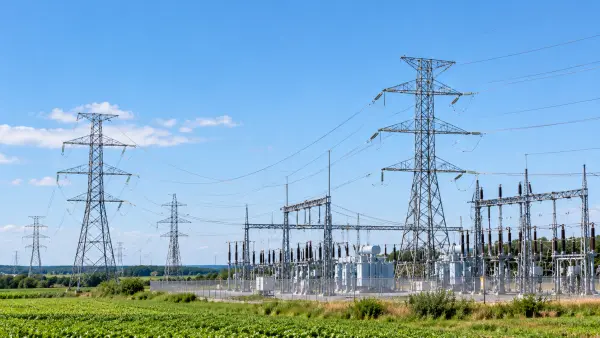
Republican officials in several states are reversing long-held support for data center construction as the political backlash intensifies heading into the midterms. Texas Gov. Greg Abbott paused approval of new data center connections to the state power grid this month, pending an audit of tax breaks, ownership and water use. Michigan Senate nominee Mike Rogers, after previously backing data center construction, called for a one-year statewide moratorium. Pennsylvania gubernatorial candidate Stacy Garrity, the state treasurer, endorsed a temporary moratorium after saying earlier this year that Pennsylvania should welcome more of the facilities.
The shift is most consequential in Ohio, where the National Republican Senatorial Committee warned in an internal memo that data centers are “the anchor hanging around” Sen. Jon Husted’s neck in his race against former Sen. Sherrod Brown.
Background
Data center construction has expanded rapidly to support the AI boom, and much of it has landed in politically purple or Republican-leaning states rather than traditionally Democratic ones. Complaints center on rising utility bills tied to new grid infrastructure, water consumption, and local land-use disputes. A Fox News poll cited by The Hill found 60% of Republicans would oppose a data center being built in their own area, including a majority of self-identified MAGA Republicans.
Husted, who served as Ohio’s lieutenant governor before his Senate appointment, played a leading role in securing tax breaks that drew data centers to the state. Signal Ohio has reported the state lost $1.6 billion in expected tax revenue from those exemptions in 2025, more than 11 times what officials had projected. Gov. Mike DeWine paused new tax exemptions for data centers in May. Brown’s campaign has run multiple ads tying Husted to the resulting utility bill increases; Husted has responded by introducing the Ratepayer Protection Act, a federal bill that would push states to require data centers to cover their own power costs.
What Different Sides Are Saying
State-level Republicans now pushing moratoriums or pauses say the shift reflects genuine constituent anger rather than pure political calculation. Christopher Borick, a political scientist at Lehigh University, told Newsweek that Republican officials have had to substantially rework both their messaging and their policy stances after underestimating how many of their own voters oppose the projects. Fact-check: for several of these officials, including Rogers and Florida Rep. Byron Donalds, this represents a documented reversal from statements they made earlier this year actively supporting data center construction, not simply a continuation of a prior position.
President Trump has continued to back the industry’s expansion. Speaking to reporters this week, he said that if he were a mayor or governor, he would want a data center in his community for the jobs and tax revenue it could bring, while acknowledging the industry “can use a little public relations help.” Fact-check: Trump’s continued support puts him at odds with the direction several state-level Republicans have moved in the past month, an intra-party gap this article observes rather than resolves.
In Ohio specifically, Brown has said Husted was “the point man to bring these data centers to Ohio” and that the resulting tax breaks raised utility bills. Husted’s campaign points to his new federal bill as evidence he is already working to shift costs back to developers. Fact-check: Husted’s bill is real and was introduced last month, though it followed the start of Brown’s ad campaign rather than preceding it, a sequence worth noting without assuming what it says about Husted’s motivation.
Note on Scope
Some tech industry advocates argue this backlash is a temporary, election-year phenomenon that will fade once the midterms pass; others say it reflects durable public opinion. This article does not attempt to resolve which view is correct, since that depends on what happens after November.
Related Links
- Data Center Panic: Republicans Scramble to Join Backlash – TIME
- Republicans Turn on Data Centers After GOP Warns of Election Risk – Newsweek
- Rising data center backlash shakes up midterm races – The Hill
- Leaked memo about data centers shows GOP worried about Ohio’s U.S. Senate race – Ohio Capital Journal
- Fervor over data centers fires up competitive Ohio Senate race – The Hill
- Republicans scramble to remake their stance on data centers – Semafor
Discussion Questions
- Has a data center or similar large development been proposed near where you live?
- Do you think politicians’ recent shift on data centers reflects genuine belief or political calculation?
- Do you find Trump’s continued support or state Republicans’ new caution more persuasive?
- What matters more: the economic benefits data centers bring, or their cost to local utility bills?
- Why do you think this issue has become so potent in Ohio specifically?
- Should companies building data centers be required to cover the full cost of new power infrastructure?
- How should voters weigh a candidate who has changed their position on an issue like this?
- What responsibility do state officials have when tax breaks they approved cost far more than projected?
- Is a one-year moratorium a reasonable response, or does it just delay a decision that has to be made anyway?
- Imagine you are a state legislator deciding data center policy for your district. What would you want to know first?
