
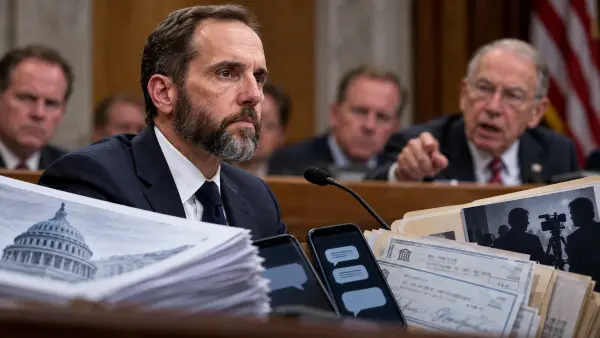
Jack Smith spent about four hours before the Senate Judiciary Committee on September 29, standing by his decision to charge Donald Trump while Republicans accused him of abusing his office. Most coverage dwelt on Sen. Eric Schmitt apparently confusing the Iowa Hawkeyes with the Atlanta Hawks, CBS News reported, and that episode needs no more space here. This post covers the rest: what senators raised, what was new, and which claims hold up.
Background
Smith was appointed special counsel in November 2022 and brought two cases against Trump, both of which ended after Trump won the 2024 election. In July, House Judiciary Chairman Jim Jordan referred him to the Justice Department over allegations that he lied about collecting lawmakers’ phone records. Smith’s lawyers say he gave “truthful, responsive answers,” and former federal prosecutors told NBC News that a perjury case would be hard to bring. Smith had already testified to the House Judiciary Committee, in a closed-door deposition in December and a public hearing in January.
What Was New
Donor checks. Grassley disclosed that investigators obtained at least 4,782 donor checks, some for as little as $1, carrying home addresses, bank account numbers and signatures, the Washington Examiner reported. Asked whether his office obtained donor financial information, Smith said, “Yes, we acquired financial information,” and added that he could not recite every subpoena. Grassley’s office posted a transcript of his own exchanges with Smith, which this post uses alongside news reports.
Journalists’ messages. A whistleblower disclosure released the same day says Smith’s team received communications involving reporters at more than a dozen news organizations. The Examiner reported that the messages came in a National Archives production responding to a June 2023 subpoena for records tied to 87 phones used by officials in Trump’s first White House.
Two kinds of lawmaker records. Smith said he obtained toll records from phone carriers and, separately, National Archives records that included messages between members of Congress and the Trump administration, Roll Call reported. Sen. Marsha Blackburn sued Smith the next day over her toll records.
Smaller admissions. Smith said he used a personal device and email in his first days as special counsel, before he had government accounts, and forwarded the material to government accounts afterward. He also said he told Attorney General Merrick Garland twice that he would prosecute Trump, that Lindsey Graham, whose death we covered, was not a target and likely would have been a witness, and that he regrets saying so little publicly while others mischaracterized the cases.
What Different Sides Are Saying
Republicans say Smith misled Congress about lawmakers’ messages and used January 6 to map Republican organizations. Grassley said Smith’s staff obtained the content of messages from 44 members of Congress, not just toll records as Smith testified earlier, and described the election case as an effort to map Republican groups. Trump has said Smith committed perjury.
Fact-check, the messages: At the December deposition, Smith said he did not seek a search warrant for the content of lawmakers’ texts, only toll records. Justice Department documents later showed his team obtained National Archives text messages that included messages from 44 members, Republicans and Democrats. Smith says every answer was truthful, and Grassley says it was misleading because the messages were obtained. Whether the answer was false depends on the exact question asked, which this article could not review in full. Grassley also says the message content reached case agents before any filter review for privileged material. That claim rests on information provided to his committee, and this article could not verify it.
Fact-check, the donor checks: The 4,782 figure comes from whistleblower records, and Grassley says more may exist. This article could not verify the legal process used, whether investigators examined each check, or Grassley’s claim that donor data does not appear in Smith’s public report. Nothing reviewed shows the donors were targets. Because investigators from the earlier Arctic Frost inquiry preceded Smith, the date range alone does not show what his team requested.
Fact-check, the journalists: The Examiner’s account describes messages that surfaced in a records production for White House phones, which differs from subpoenaing news organizations. This article could not confirm whether any outlet was itself subpoenaed. Our report on the Justice Department withdrawing subpoenas for New York Times reporters covers a separate dispute over journalists’ records.
Democrats say the attacks are a smokescreen and the records were routine. Sen. Dick Durbin accused Republicans of spreading “baseless conspiracy theories,” CBS reported. Sen. Chris Coons said gag orders of this kind are typical and that Trump’s first-term Justice Department obtained similar orders for Democrats’ records.
Fact-check, toll records and gag orders: Smith said his team consulted the Justice Department’s Public Integrity Section before seeking toll records, which show who called whom and for how long but not content. Lawfulness is now contested in court: Blackburn’s suit argues that the Speech or Debate Clause covers toll records and that the gag order violated a federal notice law. Smith said the orders were meant to protect against Trump and his associates, citing obstruction alleged in the classified documents indictment and threats to witnesses in the election case. Those are allegations from cases that never reached a jury.
Fact-check, the Trump-era comparison: A 2024 Justice Department inspector general report found that Trump’s first-term department subpoenaed communication records of two Democratic House members, congressional staffers and reporters. It found no evidence of political motivation by the career prosecutors but said such subpoenas “risks chilling Congress’s ability to conduct oversight.” Coons’s comparison is accurate on the practice, and the report did not judge Smith’s use of it.
Where the parties overlap: Coons and Sen. Mike Lee, a Republican, co-sponsor the NDO Fairness Act to tighten judicial review of gag orders. The House passed its version on August 31, Microsoft noted, and the Senate has not acted.
How Each Side Is Framing the Hearing
In the coverage reviewed, Republicans stressed scale and privacy: thousands of checks, messages from dozens of lawmakers and a hearing whose official title referred to abuse of authority and the targeting of Republicans. The same facts, in Democrats’ telling, support routine investigative practice and a prosecution of a president whose Republican witnesses were central. Smith framed the matter as defending the rule of law and his fired colleagues. He could not discuss the classified documents case in detail because of a federal court order, according to CBS. Blackburn’s lawsuit, filed the day after the hearing, extended the Republican framing into court.
View from Outside the US
This article found one outside report, from Al Jazeera. It summarized the hearing as Republicans focusing on subpoenas for lawmakers’ phone records and donors’ financial information while Smith accused the Trump administration of retaliating against his team. It offered no separate analysis of the claims above.
Note on Scope
This article covers the Smith hearing apart from the Hawks episode and does not assess the merits of the charges against Trump. Grassley’s documents come from whistleblowers and his committee, and this article could not verify them independently. Some exchanges not covered in the news reports reviewed, including Coons’s remarks on gag orders, come from a rough voice-recognition transcript posted online and should be checked against the official video. Smith’s classified documents report remains sealed. Counts of affected lawmakers varied across accounts and are not reconciled here.
Related Links
- Jack Smith defends handling of Trump probes at heated Senate hearing (CBS News)
- Grassley Questions Jack Smith at Senate Judiciary Oversight Hearing (Office of Sen. Chuck Grassley, with partial transcript)
- Jack Smith collected journalists’ private messages for Arctic Frost investigation: Whistleblower (Washington Examiner, which leans right)
- Marsha Blackburn’s new lawsuit against Jack Smith has a fatal flaw (MS NOW, which leans left)
- Blackburn sues Jack Smith over phone records (Roll Call)
- Trump-era Justice Department subpoenaed congressional staffers, watchdog finds (NPR)
- Jack Smith defends investigations into Trump during tense US Senate hearing (Al Jazeera)
Discussion Questions
- Do you watch congressional hearings in full, or mostly see clips?
- Should prosecutors be able to collect phone records of lawmakers who spoke with a suspect?
- How much privacy should donors expect when an investigation reaches a campaign’s finances?
- Is a hearing a good place to test whether a witness told the truth earlier?
- Why can the same documents lead senators to opposite conclusions?
- Should courts be told when a gag order covers a member of Congress’s records?
- Smith said he wishes he had spoken more publicly. Should prosecutors answer critics while a case is open?
- How should readers treat claims released by one party’s committee chair that cannot be checked independently?
- Should the Senate pass the NDO Fairness Act?
- Imagine you sit on the Judiciary Committee. What one question would you ask Smith that was not asked?
