
Reading
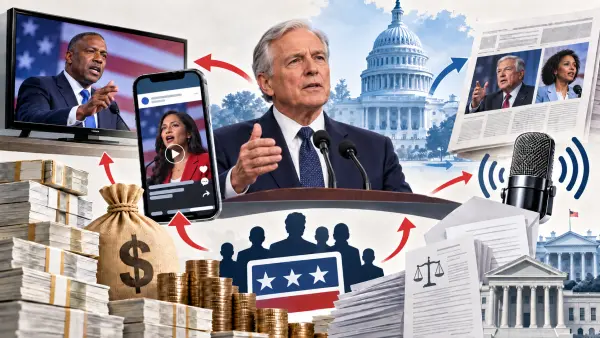
Who pays for a political ad, and where it appears, decides which rules apply. A candidate’s campaign, a political action committee (PAC), a party and a government agency each follow a different legal track, and television, print and online platforms add more differences. Those tracks are now colliding over taxpayer-funded ads featuring President Donald Trump, which critics call illegal and the White House calls routine public service announcement (PSA) spots.
Campaign, PAC and super PAC ads
A candidate’s campaign raises money under strict caps. In the 2025-2026 cycle, an individual may give $3,500 per election to a federal candidate, and primaries and general elections count separately. A super PAC has no cap on what it raises, including from corporations and unions, because its spending counts as an independent expenditure: a communication that urges a candidate’s election or defeat and is made without coordination with the campaign. A traditional PAC may give directly to candidates, but only within limits, as our explainer on how campaigns are funded details.
Parties changed this summer. On June 30, the Supreme Court struck down federal caps on how much a party may spend in coordination with its own candidates, as the Federal Election Commission (FEC) notes on its advertising guidance page. The ruling covered party committees, not super PACs. That page will be revised once the commission regains a quorum, the minimum number of members needed to act officially. The FEC has lacked one since 2025.
How disclosure and the medium change the rules
Every paid political ad needs a disclaimer saying who paid for it. Campaign television ads also need the candidate to say aloud that he or she approved the message. Outside groups must state that no candidate authorized theirs and, on television and radio, that the group is responsible for the content.
Over-the-air television and radio carry the most regulation. The FCC’s guide for the public says stations must give opposing candidates equal opportunities, may not censor ads sponsored by candidates and their campaigns, and must charge them no more than the lowest unit charge in the 60 days before a general election. Outside groups lack those protections, and stations may accept or reject their ads.
Outside groups face a separate trigger on broadcast, cable and satellite. An electioneering communication is an ad that names a federal candidate within 60 days of a general election and reaches that candidate’s voters. Whoever pays for one must report it to the FEC and include a disclaimer. The rule can reach ads that never urge a vote, which is why the line between express advocacy, which tells people how to vote, and an issue ad, which discusses a policy, matters. Print and online ads fall outside this rule.
Print and online rules differ. Newspapers and magazines must charge campaigns rates comparable to other advertisers, the FEC says. Online ads bought for a fee need disclaimers, but not the spoken “stand by your ad” statement. The FCC says it generally does not regulate the internet, so equal-opportunity and rate guarantees appear not to extend to streaming or social platforms, which set their own ad policies.
When the government pays
None of those rules governs government-paid ads, which fall under spending law. In late September, ads featuring Trump began airing with a notice that the U.S. government paid for them. The Washington Post reported that one spot closely resembles a 2024 Trump campaign video, and that on Sept. 19 the White House Office of Management and Budget added $20 million to a Homeland Security line meant for commemorative events, drawing on money Congress gave Customs and Border Protection. The department awarded a $20 million media-campaign contract the next day. A House budget committee report said the line was meant for memorials, anniversaries and commendation ceremonies. This article could not verify how much of the $20 million has gone to airtime.
Annual appropriations laws, which set what agencies may spend, have barred money for publicity or propaganda since the 1950s, and TIME reports that the 2026 funding law Trump signed repeats the ban. The Government Accountability Office (GAO) has read the ban to cover purely partisan, self-aggrandizing or covert material, while noting that administrations may defend their policies. The Hatch Act limits political activity by most executive-branch employees but exempts the president, though some argue it covers White House staff who helped air the ads.
The competing arguments
Critics: Democratic Sens. Patty Murray and Chris Murphy call the ads illegal, and Rep. Jamie Raskin says they could also violate the Hatch Act and the Antideficiency Act, which bars unauthorized spending, according to the Post. TIME reported that Public Citizen, a watchdog group, filed complaints with the GAO and the Office of Special Counsel, which oversees Hatch Act violations. Republicans also objected; Sen. John Kennedy said no official should spend “public money on private ads for themselves.”
The White House: It calls the ads public service announcements, not campaign ads, because they carry no call to action and Trump is not on the ballot, and it cites earlier information campaigns under Presidents Bush, Obama and Biden. Fact-check: Past administrations did run such campaigns, and TIME notes the GAO found one Bush-era campaign broke the propaganda ban. The Post reports that Trump has repeatedly told supporters to vote as if he were on the ballot, and that no precedent exists for government-funded ads like these in an election season.
Enforcement: CNN reported that it is unclear whether outside groups have standing, the legal right to bring a lawsuit, and that Congress has not acted to block the ads. The Post reported that the White House has indicated the ads will continue and expand. Sen. Maggie Hassan has set Oct. 8 as the deadline for the White House to explain how the ads were funded and why they are legal.
Glossary
political action committee (PAC) (noun): An organization that collects donations from members or supporters and spends the money to support or oppose candidates or causes.
Translations: 政治行动委员会 | 政治活動委員会 | 정치활동위원회 | राजनीतिक कार्रवाई समिति | لجنة العمل السياسي | комитет политических действий | comité de acción política | comité d’action politique
- A PAC may give money to candidates, but only within federal limits.
- Every ad paid for by a PAC must say who paid for it.
super PAC (noun): A political committee that may raise unlimited money but spends it on independent expenditures instead of giving it directly to candidates.
Translations: 超级政治行动委员会 | スーパーPAC | 슈퍼팩 | सुपर पैक (सुपर PAC) | لجنة العمل السياسي الفائقة | суперкомитет политических действий (супер-PAC) | super PAC (comité de acción política independiente) | super PAC (comité d’action politique indépendant)
- A super PAC can accept donations from corporations and unions.
- The super PAC ran television ads in the final weeks of the campaign.
independent expenditure (noun): Spending on a message that urges voters to elect or defeat a candidate, made without coordination with that candidate’s campaign.
Translations: 独立支出 | 独立支出 | 독립 지출 | स्वतंत्र व्यय | إنفاق مستقل | независимые расходы | gasto independiente | dépense indépendante
- An independent expenditure has no spending cap.
- The group reported its independent expenditure on billboards to the FEC.
coordination (noun): Planning or sharing information with a candidate’s campaign about how money is spent or what a message says.
Translations: 协调 | 協調 | 조율 | समन्वय | تنسيق | координация | coordinación | coordination
- Spending made in coordination with a campaign is treated differently from independent spending.
- A super PAC must avoid coordination with the candidate it supports.
disclaimer (noun): A required statement in an ad that says who paid for it and whether a candidate approved it.
Translations: 付费声明 | 支払者表示 | 광고 재원 표시 | भुगतानकर्ता की घोषणा | بيان الجهة الممولة | указание заказчика рекламы | aviso de quién pagó el anuncio | mention du financeur
- The ad ended with a disclaimer naming the group that paid for it.
- Online video ads must show a disclaimer for at least four seconds.
electioneering communication (noun): A broadcast, cable or satellite ad that names a federal candidate within 60 days of a general election and reaches that candidate’s voters.
Translations: 选举传播广告 | 選挙直前の候補者言及広告 | 선거 직전 후보 언급 광고 | चुनाव से पहले उम्मीदवार का नाम लेने वाला प्रसारण विज्ञापन | اتصال انتخابي | предвыборное сообщение с упоминанием кандидата | comunicación electoral | communication électorale
- Whoever pays for an electioneering communication must report the spending to the FEC.
- A newspaper ad is not an electioneering communication under the federal definition.
express advocacy (noun): Speech that clearly urges voters to elect or defeat a specific candidate.
Translations: 明确主张 | 明示的な支持・反対の呼びかけ | 명시적 옹호 | स्पष्ट पैरवी | الدعوة الصريحة | прямой призыв голосовать | apoyo o rechazo expreso | plaidoyer explicite
- An ad that tells viewers to vote for a candidate is express advocacy.
- The group argued its ad was not express advocacy because it only discussed policy.
issue ad (noun): An ad that discusses a public policy topic without openly telling voters how to vote.
Translations: 议题广告 | イシュー広告 | 이슈 광고 | मुद्दा-आधारित विज्ञापन | إعلان القضايا | реклама по общественным вопросам | anuncio sobre temas de política | publicité thématique
- The issue ad criticized a proposed tax change.
- An issue ad can still fall under federal rules if it names a candidate close to an election.
lowest unit charge (noun): The lowest price a station gives its best commercial advertiser, which it must offer to candidates in the weeks before an election.
Translations: 最低单位费率 | 最低料金 | 최저 단가 | न्यूनतम इकाई शुल्क | أدنى سعر للوحدة | наименьший тариф за единицу времени | tarifa unitaria más baja | tarif unitaire le plus bas
- Candidates pay the lowest unit charge during the 60 days before a general election.
- The lowest unit charge protects candidates from paying higher prices than regular advertisers.
equal opportunities (noun): The rule that a station that lets one candidate use its airtime must offer opposing candidates a comparable chance.
Translations: 平等机会 | 平等な機会 | 동등한 기회 | समान अवसर | تكافؤ الفرص | равные возможности | igualdad de oportunidades | égalité des chances
- Under the equal opportunities rule, a station that sells time to one candidate must offer the opponent comparable time.
- Appearances on regular newscasts do not trigger equal opportunities.
appropriations (noun): Laws passed by Congress that set how much money federal agencies may spend and for what purposes.
Translations: 拨款 | 歳出予算 | 예산 배정 | विनियोग | المخصصات المالية | ассигнования | asignaciones presupuestarias | crédits budgétaires
- An appropriations law funds federal agencies for a fiscal year.
- Money in an appropriations bill must be spent for the purposes Congress named.
propaganda (noun): Messaging aimed mainly at promoting a person, party or viewpoint rather than informing the public.
Translations: 宣传 | プロパガンダ | 선전 | प्रोपेगैंडा | دعاية | пропаганда | propaganda | propagande
- Critics call the ads propaganda, while the White House calls them public service announcements.
- Federal spending laws bar the use of taxpayer money for propaganda that Congress has not authorized.
Hatch Act (noun): A 1939 federal law that limits political activity by most executive-branch employees and exempts the president.
Translations: 《哈奇法》 | ハッチ法 | 해치법 | हैच अधिनियम | قانون هاتش | закон Хэтча | Ley Hatch | loi Hatch
- Under the Hatch Act, a federal employee may not use official authority to influence an election.
- The Office of Special Counsel oversees violations of the Hatch Act.
Government Accountability Office (GAO) (noun): A nonpartisan agency that investigates how federal money is spent and whether the spending follows the law.
Translations: 美国政府问责局 | 米国会計検査院 | 미국 정부책임처 | सरकारी जवाबदेही कार्यालय | مكتب المساءلة الحكومية | Счётная палата США (GAO) | Oficina de Responsabilidad Gubernamental | Bureau de la responsabilité gouvernementale
- The GAO found that a Bush-era campaign broke the propaganda ban.
- Lawmakers asked the GAO to investigate the ads.
Federal Election Commission (FEC) (noun): The federal agency that enforces campaign finance law and needs four of its six commissioners to take major actions.
Translations: 联邦选举委员会 | 連邦選挙委員会 | 연방선거위원회 | संघीय चुनाव आयोग | لجنة الانتخابات الفيدرالية | Федеральная избирательная комиссия | Comisión Federal Electoral | Commission électorale fédérale
- The FEC publishes guidance on ad disclaimers.
- Without a quorum, the FEC cannot issue fines or formal guidance.
quorum (noun): The minimum number of members that must be in office for a body to take official action.
Translations: 法定人数 | 定足数 | 정족수 | गणपूर्ति | النصاب القانوني | кворум | quórum | quorum
- The FEC needs four commissioners to have a quorum.
- The board could not vote because it lacked a quorum.
standing (noun): The legal right to bring a lawsuit, which usually requires showing direct harm.
Translations: 起诉资格 | 原告適格 | 원고적격 | मुकदमा दायर करने का कानूनी अधिकार | الصفة القانونية للتقاضي | право на обращение в суд | legitimación procesal | qualité pour agir
- A court may dismiss a case if the plaintiff lacks standing.
- It is unclear whether outside groups have standing to sue over the ads.
public service announcement (PSA) (noun): A short message meant to inform the public about a program, a health topic or a safety issue.
Translations: 公益广告 | 公共広告 | 공익광고 | जनहित विज्ञापन | إعلان خدمة عامة | социальная реклама | anuncio de servicio público | message d’intérêt public
- The agency ran a PSA about health insurance open enrollment.
- The White House calls its ads public service announcements.
Discussion Questions
- Do you remember seeing a political ad recently? Did you notice who paid for it?
- Should every political ad, even a short online one, have to say clearly who paid for it?
- Is unlimited super PAC spending a form of free speech or a risk to fair elections?
- Why might lawmakers cap donations to candidates but not spending by outside groups?
- Should TV stations have to run candidate ads even when they contain false claims? What are the trade-offs?
- Should streaming and social media ads follow the same rules as television? Why or why not?
- Should a government ever pay for ads about its own programs? What would make one acceptable?
- Where would you draw the line between a public service announcement and propaganda?
- The White House says the ads have no call to action. Is that a good test?
- Do you find the critics’ argument or the White House’s argument more persuasive, and why?
- Why might some Republicans criticize ads that feature a Republican president?
- Imagine you are a member of Congress. What rule would you propose for government-funded ads, and why?
Related Links
- Public Citizen: White House Spending Taxpayer Dollars for Propaganda Purposes
- The White House: Presidential Public Service Announcements Are Nothing New
- NBC News: FCC Chair Says Government-Funded Trump Ads Are Normal
- FCC: Political Programming Rules
- NOTUS: Trump Put the FEC on Ice; Its Return Remains an Open Question
