
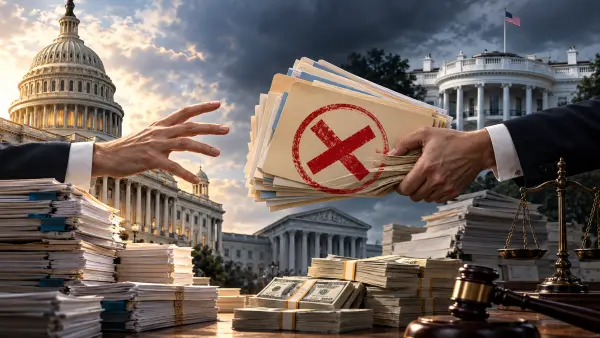
The Trump administration announced on September 25 that it was canceling $810 million in funding that Congress had approved, using a maneuver called a pocket rescission days before the money expired on September 30. Senate Democrats tried to block the cuts on September 30, and Sen. Ron Johnson (R-Wis.) objected, the Washington Post reported. The Government Accountability Office says the move is unlawful, the White House says it is using a process Congress created, and several lawsuits are pending.
Background
Under the Impoundment Control Act of 1974, a president can ask Congress to cancel appropriated funds, which starts a 45-day clock for lawmakers to act. If that clock runs out after the fiscal year ends, the withheld money lapses, which is how a pocket rescission works, Roll Call reported. The administration used the same maneuver last year to cancel about $4 billion in foreign aid.
The package includes $567 million from an account that helps fund the Office of Refugee Resettlement, which the administration said is no longer needed because fewer migrants are crossing the border illegally. It also includes $70 million for exchange fellowships for foreign students and faculty, $56 million for housing counseling, $28 million for health research and $25 million for an Education Department program for migrant students. Those items total $746 million, and this article did not find an itemization of the rest. The White House called the package “historic action to eliminate wasteful and harmful spending.” Our report on migrant-child data sharing covers a related dispute.
The House is out until after the November midterms, and lawmakers face a December 11 deadline to fund the government. Our earlier report on the Senate shutdown deal covers the funding fight that preceded this one.
Lawsuits followed. A coalition of states, including California, Maine, Maryland, Michigan, New Mexico, Nevada and Oregon, sued on Wednesday in federal court in Northern California, arguing that the cancellation violates the Impoundment Control Act and the Constitution, Roll Call reported. Education grant recipients and housing groups have also sued. In the housing case, a judge paused the deadline for canceling the grants and asked the administration to respond by the end of the week of October 5.
What Different Sides Are Saying
The administration says it is using a legal process to cut waste. Budget director Russ Vought called GAO partisan and said it changed its long-standing view on the issue, The Hill reported. The White House pointed The Hill to his statement when asked for comment.
Appropriators in both parties say it is illegal. Sen. Susan Collins (R-Maine), who chairs the Senate Appropriations Committee, said the budget office withheld the funds for months and called the cancellation a “usurpation of Congress’s appropriations powers,” Deseret News reported. Sen. John Curtis (R-Utah) said the job belongs to Congress. Rep. Rosa DeLauro (D-Conn.) said the administration had been unlawfully impounding funds all year. Democratic Sens. Patty Murray and Jeff Merkley asked to pass a bill blocking the cuts, and Johnson’s objection stopped it.
Fact-check, GAO’s position: Vought said GAO changed a view it held in the 1970s. GAO says its position has evolved as it considered Supreme Court case law and amendments to the act, and that its 2018 decision concluded the law does not permit withholding funds through their expiration date. This article could not verify the claim that GAO’s view tracks which party holds the White House. A 1975 GAO letter urged Congress to change the law so funds would not lapse before the 45 days end, and Congress did not, Lawfare noted. Lawfare called the budget office’s statutory case plausible and GAO’s rebuttal extensive.
Fact-check, last year’s Supreme Court order: Roll Call reported that the Supreme Court ultimately ruled the administration could cancel last year’s money. The Hill described the order as finding that the government had shown “at this early stage” that grantees’ suit was likely barred by the act. That is a ruling about who can sue, not a final holding that pocket rescissions are lawful, and this article found no merits ruling. A 2025 D.C. Circuit decision said GAO is the only party that can sue over violations of the act, and GAO did not sue over last year’s rescission, the Washington Sun reported.
Fact-check, whether the money is needed: The administration says the $567 million refugee-program account is unneeded because fewer migrants are crossing the border. Collins called the months-long delay itself an impoundment that was not reported to Congress. Whether the programs are still needed is a policy judgment this article did not evaluate.
View from Outside the US
The package includes $70 million for exchange fellowships for foreign students and faculty, which gives it reach beyond the US, but this article found no reporting on the rescission from non-US outlets.
Note on Scope
This article covers the announcement, the GAO letter, the Senate vote and the lawsuits through October 2. It does not evaluate individual programs or predict how courts will rule. The itemized list above covers $746 million of the $810 million, and the administration’s own breakdown may differ.
Related Links
- White House cancels health, education funds approved by Congress (Roll Call)
- Court challenges mount over Trump’s funding clawback (Roll Call)
- Federal watchdog: Trump canceling $810 million in government funding was unconstitutional (Deseret News)
- Democrats fail to stop Trump from canceling $810M in funds approved by Congress (The Washington Post)
- What is a “Pocket Rescission” and is it legal? (Government Accountability Office)
- Pocket rescissions: legal controversy and political meaning (Lawfare)
Discussion Questions
- Before reading this, had you heard of a pocket rescission?
- Should a president be able to cancel money Congress has already approved?
- If a watchdog agency says an action is illegal but cannot or will not sue, who should enforce the law?
- Why might Republican appropriators object to a Republican president’s cuts?
- Does it matter whether the programs being cut are ones you support?
- Should Congress change the 1974 law so funds cannot lapse while a rescission request is pending?
- How should courts decide who has standing to sue over government spending?
- Is the administration’s claim that fewer border crossings reduce the need for refugee funding persuasive?
- What are the risks of letting the budget office decide which approved programs deserve funding?
- Imagine you are a senator facing a December 11 funding deadline. How would you respond to the rescission?
