
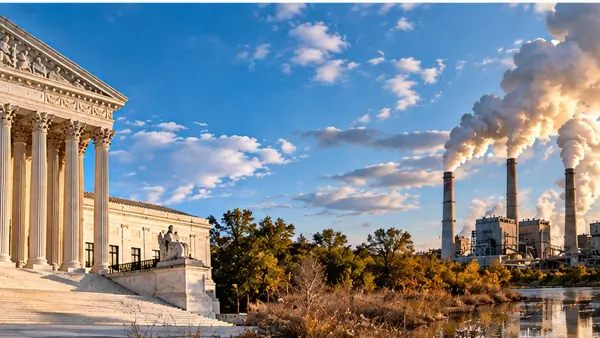
The U.S. Supreme Court heard arguments October 5 in a case that could determine whether state and local governments can sue fossil fuel companies for damages they attribute to climate change.
The dispute involves Boulder, Colorado, and two energy companies, ExxonMobil and Suncor Energy. Boulder alleges that the companies contributed to climate-related damage while misleading the public about the risks associated with their products.
The immediate question is not whether the companies owe Boulder money. The justices are deciding whether federal law prevents Boulder’s state-law claims from proceeding, and whether the Court can review the case before a trial. Their ruling could affect dozens of similar climate lawsuits around the country.
Background
In April 2018, the City of Boulder and Boulder County filed a lawsuit against ExxonMobil and Suncor Energy, seeking compensation for climate-related costs. The claims include nuisance, trespass, unjust enrichment, consumer protection and conspiracy.
The local governments say changing temperatures, precipitation patterns and wildfire conditions are increasing costs for infrastructure, public services and environmental protection.
They also allege that the companies knew for decades about the climate risks associated with fossil fuels but publicly minimized or obscured those risks.
The companies dispute the plaintiffs’ legal theories and argue that Colorado cannot use state law to impose liability for greenhouse gas emissions produced around the world.
The companies tried to move the case to federal court without success. In May 2025, the Colorado Supreme Court held that federal law did not preempt Boulder’s claims, allowing them to proceed. ExxonMobil and Suncor appealed, and the U.S. Supreme Court agreed to hear the case in February 2026.
On October 5, the justices heard oral arguments in Suncor Energy (U.S.A.) Inc. v. County Commissioners of Boulder County, case number 25-170.
The Central Legal Questions
The first question concerns a legal principle called federal preemption. Under the Constitution’s Supremacy Clause, valid federal law can displace conflicting state laws.
The energy companies argue that Boulder’s claims concern worldwide greenhouse gas emissions and therefore cannot be resolved through one state’s legal system.
They contend that the Constitution’s structure, federal foreign affairs powers and the Clean Air Act bar Colorado from imposing liability based on interstate and international emissions.
Boulder argues that its claims target deceptive marketing and the sale of products, not emissions, which it says the Clean Air Act does not regulate. It describes the companies’ position as an attempt to turn an ordinary state-law dispute into a question reserved for the federal government.
The Cornell Legal Information Institute lists a second question: whether the Supreme Court has statutory and constitutional jurisdiction to review the Colorado ruling, which was not a final judgment. Boulder argues the appeal should be dismissed on that ground. If the Court agrees, the case would return to Colorado without a ruling on preemption.
What Happened During Oral Arguments?
The October 5 hearing opened the Supreme Court’s new term. Lawyers for ExxonMobil and Suncor argued that allowing Boulder’s lawsuit to proceed could effectively permit individual states to regulate emissions and energy activity far beyond their borders.
The Trump administration supported the companies. Principal Deputy Solicitor General Sarah Harris argued that disputes over global greenhouse gas emissions require a national legal framework rather than separate state-level liability systems.
Boulder’s attorney, Kevin Russell, responded that states have long provided tort remedies for injuries within their borders, even when the conduct occurred elsewhere. He also argued that Congress could act if it wanted to override state law in this area.
According to CBS News, the argument lasted nearly two hours. Justice Brett Kavanaugh said earlier Court decisions treat interstate pollution as a federal matter. Justice Elena Kagan compared the case to tobacco and opioid lawsuits, in which state claims proceeded. Justice Ketanji Brown Jackson called review premature. Chief Justice John Roberts asked how this case differs from other state suits with broad effects.
These questions are not votes. This article could not verify how any justice will rule.
The Supreme Court’s official recording and transcript provide the arguments presented by both sides and the justices’ questions.
Justice Samuel Alito did not participate. A Clerk’s letter dated September 28 said he would not continue in the case. Fox News reported that no explanation was given. Some critics had pointed to his oil and gas stock holdings, but this article could not confirm his reason. With eight justices, a 4-4 split is possible, which would leave the Colorado ruling in place.
What Different Sides Are Saying
ExxonMobil and Suncor: National Problems Require National Rules
The companies argue that climate change results from greenhouse gas emissions produced by billions of activities around the world, including electricity generation, transportation, manufacturing and agriculture.
They say imposing liability under separate state laws could expose companies to conflicting standards for conduct that federal law permits and regulates. Their lawyer warned that a Boulder win could invite similar suits from as many as 90,000 municipalities, according to CBS.
Fact-check: Climate change is a global phenomenon driven by cumulative greenhouse gas emissions. However, that scientific fact does not by itself resolve whether federal law preempts a particular state-law claim. Preemption is a legal question involving statutory language, constitutional principles and the nature of the claims. The municipality figure is a litigation warning, not a count of lawsuits that would be filed.
Industry supporters also warn that climate liability lawsuits could increase costs for energy producers and consumers and interfere with national energy policy.
Fact-check: Such economic consequences are possible but not established outcomes of this lawsuit. No damages have been awarded against ExxonMobil or Suncor in the Boulder case, and the Supreme Court is not currently deciding a damages amount.
Boulder: Companies Should Answer for Alleged Harm
Boulder officials argue that communities are bearing increasing costs associated with climate change while companies that profited from fossil fuels have avoided paying for the damage.
The plaintiffs also emphasize allegations that the companies misled consumers and policymakers about the risks of fossil fuel use.
They argue that state courts routinely consider complicated questions involving corporate conduct, damages and causation, and that climate-related claims should not automatically be excluded.
Fact-check: Internal corporate documents and historical public statements are relevant evidence in climate litigation, but the allegations in this lawsuit have not been established through a final judgment. Boulder must still satisfy the legal and evidentiary requirements for its claims if the case proceeds.
The city and county estimate they will face substantial costs associated with adapting infrastructure and public services to changing climate conditions.
Fact-check: Projected climate adaptation costs are estimates, not court-established damages attributable to either defendant. A later trial would need to address the required causal relationship between the defendants’ alleged conduct and legally compensable injuries.
The Federal Government: A Uniform Legal Framework
The Trump administration supports the companies’ preemption argument. It maintains that decisions affecting national energy production and international emissions should be governed by federal law and policy.
That position reflects broader concerns about allowing individual states to influence nationwide economic activity through litigation.
Critics counter that federal regulation and state-law remedies can sometimes coexist, especially when the claims involve deception or compensation rather than direct limits on emissions.
Fact-check: The Clean Air Act establishes a federal framework for regulating air pollution, but it does not automatically eliminate every state-law claim connected to pollution. Whether it bars these specific claims is the question before the Supreme Court.
Why the Ruling Could Matter Nationwide
Dozens of climate-related lawsuits have been filed by states, cities, tribes and other jurisdictions against fossil fuel companies. Reports differ on the exact number. An AFP report put it at around 40, and this article could not confirm a precise count.
Some seek compensation for climate adaptation costs. Others focus on alleged deceptive marketing, public nuisance, consumer protection or failures to disclose climate risks.
Although those cases differ in their factual allegations and legal theories, the Supreme Court’s decision could influence how many of them proceed.
A ruling favoring the companies on preemption could substantially restrict state-law claims concerning climate damage from interstate and international emissions.
A ruling favoring Boulder would allow the local governments to continue pursuing their claims, but it would not automatically establish liability or require payment. A dismissal on jurisdictional grounds would also leave the preemption question unresolved for now.
What Happens Next?
A decision is expected by summer 2027, at the end of the current term.
If Boulder prevails on the threshold legal question, its claims could return to the lower courts for further litigation over evidence, causation and damages.
If the energy companies prevail, some or all of Boulder’s claims could be barred, with consequences for related lawsuits elsewhere.
The ruling may also clarify the boundary between federal environmental law and traditional state authority over civil liability.
Note on Scope
The Supreme Court has not ruled that ExxonMobil or Suncor caused legally compensable damage to Boulder. It has not determined whether the companies misled the public or how much compensation, if any, they should pay.
The central issue is whether federal law permits this state-law lawsuit to proceed. The broader scientific evidence concerning climate change and the specific legal responsibility of individual companies are distinct questions.
Related Links
- Supreme Court: October 5 Oral Arguments
- Supreme Court: Official Case Docket
- Cornell: Legal Issues and Case Background
- CBS News: Supreme Court Wrestles With Climate Lawsuit
- Boulder County: Response to Oral Arguments
- AFP: Bid to Shut the Door on Climate Suits
Discussion Questions
- Should fossil fuel companies be financially responsible for some climate-related damage?
- How should courts distinguish responsibility for producing fossil fuels from responsibility for misleading the public?
- Should individual states be able to sue companies over activities affecting the global climate?
- What are the advantages of having uniform federal rules for climate-related liability?
- What are the advantages of allowing state courts to hear these lawsuits?
- How should a court determine whether an individual company’s conduct caused a particular injury?
- Should knowledge of potential environmental risks create additional legal responsibilities for companies?
- Could large climate-related damages awards have unintended consequences for energy prices or investment?
- How important is the distinction between allowing a lawsuit to proceed and finding a company liable?
- What evidence would be most persuasive in determining whether Boulder should receive compensation?
